
A slang-aware translator decodes informal language into plain English and encodes plain English back into slang, all while keeping the original tone intact. The one feature you should never skip is bidirectional, context-aware translation that hands you an example sentence, not just a swapped word. If a tool can't do both directions and explain the vibe behind the phrase, keep looking. Oralingo builds this into real-time chat, which makes it a solid starting point.
TL;DR:
- Effective slang-aware translators must offer true bidirectional translation with example sentences and origin notes to ensure accurate decoding and encoding.
- Real-time chat support, privacy guarantees, and regularly refreshed slang databases are essential features for reliable slang translation tools.
- Polysemous words like "salty" or "slay" require context-aware translation and should never be interpreted from a single-word swap alone.
- Using example sentences and origin notes helps prevent misinterpretation of slang words that have multiple meanings or cultural nuances.
- Privacy and encryption are critical, as slang phrases often involve personal or sensitive communication that should not be stored or exposed without proper protection.
Table of Contents
- How Slang-Aware Translators Actually Work
- Features Checklist: What to Evaluate Before You Trust a Slang Translator
- How to Decode and Produce Slang Without Getting It Wrong
- Where Oralingo Fits Into This Checklist
- Try Oralingo: A Quick Way to Test It Yourself
- A Realistic Take on Slang Translation Tools
- Sources
- FAQ
How Slang-Aware Translators Actually Work
A slang-aware translator does two jobs at once. It decodes: turning "she's the rizz queen of the group chat" into "she's the most naturally charming person in the group." And it encodes: taking a plain sentence and rewriting it in the slang of your choice, whether that's Gen Z shorthand or something more regional.
Most tools handle this with language models trained to recognize slang patterns rather than fixed dictionaries, because slang mutates too fast for a static list to keep up. The model looks at surrounding words to guess intent, similar to how context-aware translation tools map idioms to natural equivalents instead of translating word for word. That distinction matters here more than almost anywhere else in language tech: a literal swap of "bet" for "okay" works fine in one sentence and sounds ridiculous in the next.
The best interfaces wrap that engine in a few practical affordances:
- Preset tone options, so you can flip between casual and workplace-safe without retyping
- Example sentences attached to every result, so you see the term used correctly
- Short glossary notes on where a term came from
- A refresh pipeline that adds new terms as they surface online
Even strong tools hit real limits. Polysemous slang, words with multiple unrelated meanings, trips up plenty of engines. "Salty" can mean bitter or literally salty depending on context, and a model that isn't paying close attention will guess wrong. Rapid turnover is another wall: a term can peak and fade in weeks, faster than most editorial teams can document it. And cultural nuance, especially around dialects like AAVE, needs human judgment no algorithm fully replaces.
Features Checklist: What to Evaluate Before You Trust a Slang Translator
Run any candidate through this list before you rely on it for anything beyond curiosity.
- Real-time chat and voice support. Look for translation that happens before the message displays, not after you've already sent something awkward. Response speed matters, and tools built for live conversation typically return results in a couple of seconds rather than making you wait.
- True bidirectional translation. The tool should decode slang into plain English and encode plain English into slang, each with an example sentence and a note on where the term comes from.
- Tone and generation presets. Gen Z, Millennial, workplace-safe, sarcastic. Some platforms even refresh their slang lists monthly and organize terms by subculture, from gaming to K-pop fandoms.
- Update cadence and editorial review. Ask how often the vocabulary gets refreshed. A translator that hasn't touched its database since last year will miss half of what's trending now.
- Privacy guarantees. End-to-end encryption and control over whether conversation history stays on your device matter more than most people think, since slang often shows up in private, personal messages.
- Practical limits. Check character caps, whether it handles voice input, and if it plugs into the apps you already use, the way browser extensions add in-line translation to messaging platforms.
Pro Tip: Test any slang translator with a phrase you already know the meaning of. If the example sentence it returns sounds off to you, that's a signal the tool is guessing rather than genuinely understanding context.
Trust signals extend beyond the feature list too. Review platforms like the Better Business Bureau show that responsiveness and privacy practices carry real weight when people choose a translation vendor, slang-focused or otherwise.
How to Decode and Produce Slang Without Getting It Wrong
Three quick examples show the difference between a literal swap and a translator that actually gets it.
- "No cap, that fit is fire" decodes to "Honestly, that outfit looks great." Encoded into workplace-safe tone: "I really like your outfit today."
- "He's so mid" decodes to "He's mediocre, nothing special." Encoded sarcastically: "Oh, he's just thrilling."
- "Touch grass" decodes to "Go outside and reconnect with reality." Encoded into a gentler, Millennial-friendly tone: "You might need a break from your screen."
Polysemous slang is where most tools stumble. "Slay" can mean "doing great" or, in older usage, something far more literal. Never trust a single-word substitution. Always check the example sentence a tool provides, since that context tells you which meaning applies.
A reliable sanity-check workflow looks like this: first, get the plain-English meaning. Second, ask for an origin or subculture note. Third, request an example sentence. Fourth, if you're encoding rather than decoding, ask for a safer alternate phrasing before you use it somewhere professional. This four-step pattern, outlined in context-aware translator workflows, catches most embarrassing mistakes before they happen.
Cultural sensitivity deserves its own pause here. A large share of contemporary internet slang traces back to African American Vernacular English and other dialect communities, and stripping that context out when you encode a phrase can flatten or distort its meaning. When a term carries clear cultural origin, especially one tied to a specific community, defer to native speakers or community sources rather than trusting a generic tool to make that call for you. Expert-built translators increasingly pair automated decoding with example sentences and origin attribution for exactly this reason, but the final judgment call on sensitive terms should still be yours, made carefully.
Where Oralingo Fits Into This Checklist
Oralingo was built around the same checklist this article just walked through and can even handle contextual localization and dubbing for video content, demonstrating how slang-aware AI supports multimedia. It translates chat messages before they display, so slang gets decoded in the flow of conversation instead of after an awkward pause. Its hands-free voice mode handles the same job out loud, which helps in the "touch grass" or "he's so mid" scenarios above when you're talking, not typing.
With support for over 100 languages and a stated 99% accuracy rate, Oralingo's tone-aware translation aims to preserve context rather than swap words one for one. Conversations are secured with end-to-end encryption, reflecting the importance of privacy in personal chats where slang often appears.
Try Oralingo: A Quick Way to Test It Yourself
You don't need to take any of this on faith. Oralingo's landing page lets you start with the free tier, and three quick tests will tell you whether it fits how you actually talk.
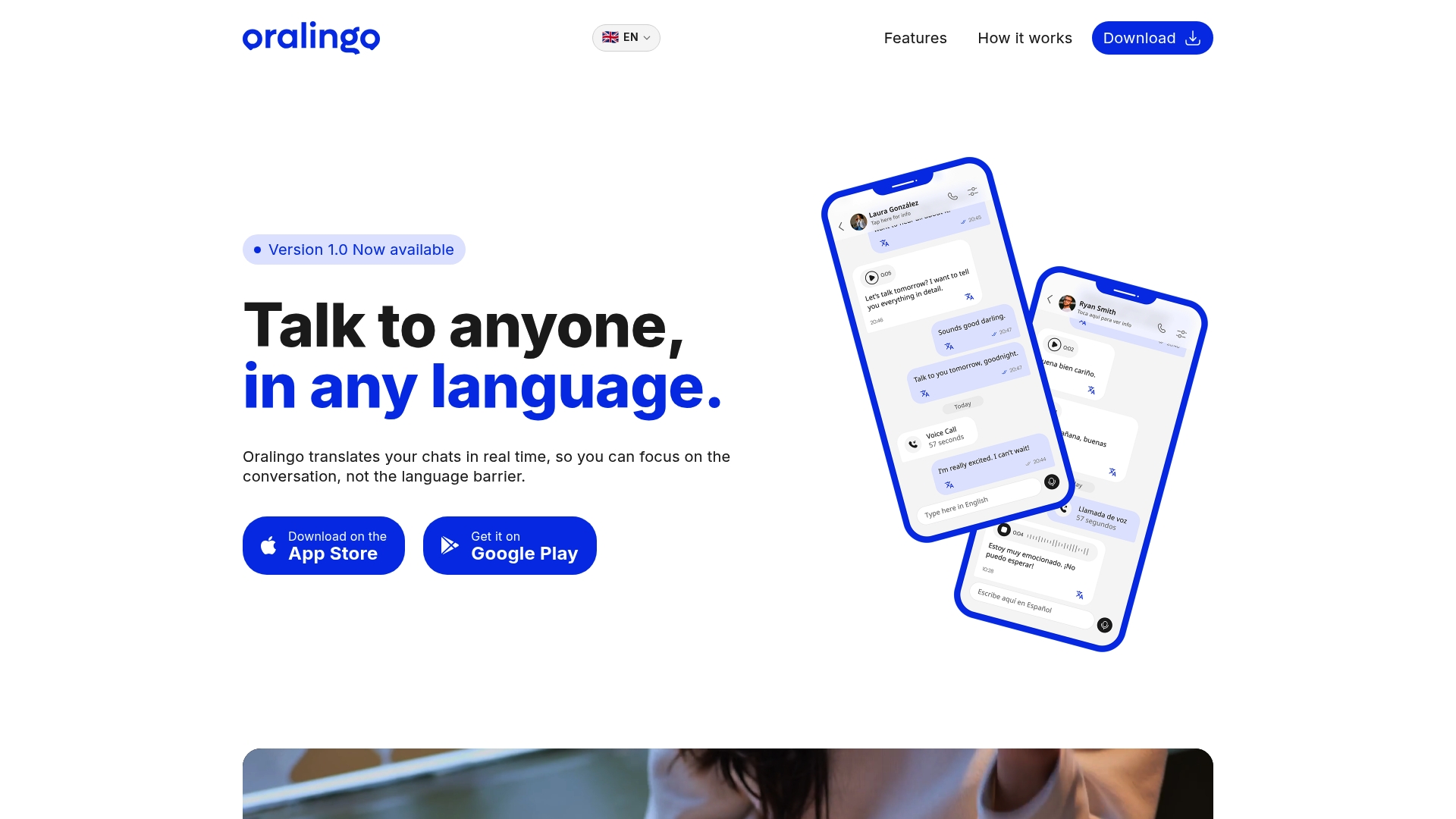
First, toggle between tone presets and watch how the same message shifts from casual to formal. Second, feed it a slang phrase you already know and check whether the example sentence and origin note it returns actually match what you'd expect. Third, switch to hands-free voice mode and have a short back and forth, since that's where a lot of translators quietly fall apart.
While you're in there, confirm the privacy settings match what matters to you: end-to-end encryption should be on by default, and you should be able to control what history stays on your device. If those three tests go well, you've found a tool worth keeping. Download Oralingo and run through them yourself.
A Realistic Take on Slang Translation Tools
Most coverage of slang translators treats them like novelty toys, something you use once to laugh at how "out of touch" you are, then forget. That undersells what these tools are actually for. Slang isn't just decoration on top of language. It's a real signal of belonging, tone, and generational context, and misreading it costs people real social and professional standing, whether that's a parent misjudging a kid's text or a manager sending a message that reads as cringeworthy instead of friendly.
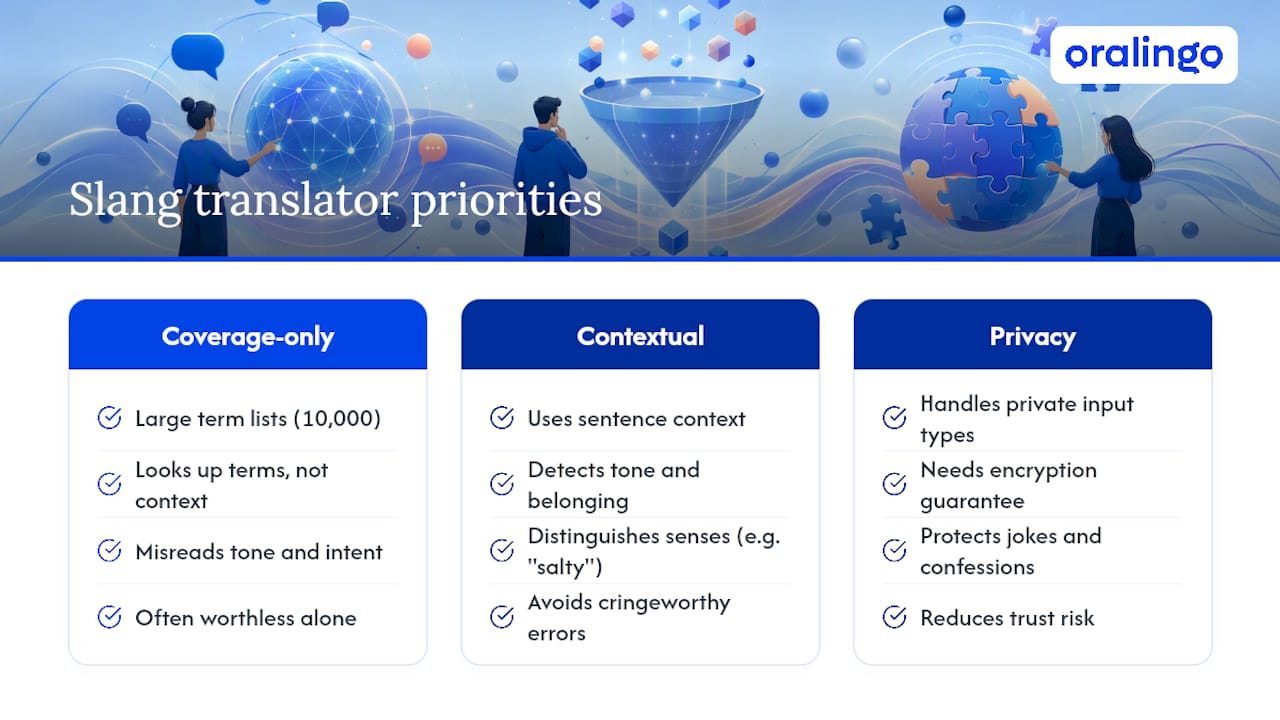
The bigger gap, though, is that most people evaluate these tools on vocabulary coverage alone. Coverage matters less than most assume. A translator with 10,000 slang terms in its database is worthless if it can't tell you that "salty" means something different depending on the sentence around it. The tools worth using are the ones that treat translation as contextual, not just look up a term and swap it.
That's also why the privacy angle gets overlooked so often. People will type things into a slang translator that they'd never say out loud to a stranger, private jokes, awkward confessions, workplace venting. A tool that doesn't guarantee encryption is asking for a level of trust it hasn't earned.
— Poul
Sources
- AI Translator — 9 Languages with Context Awareness (7 Busy Boss)
- Immersive Translate — Firefox Add-ons
- BBB listing for translation services
FAQ
What Are Some Examples of Common Slang Words?
Terms like "no cap" (honestly), "rizz" (charisma), "mid" (mediocre), "bet" (okay, agreed), and "touch grass" (go outside, reconnect with reality) show up constantly in casual conversation and shift meaning depending on tone.
How Do You Translate English Into Slang?
A bidirectional slang translator, like the encoding function in Oralingo's chat translation, takes a plain sentence and rewrites it in the tone or generation preset you choose, returning an example sentence so you can confirm it fits.
What Are Five Slang Words People Search for Most?
"Rizz," "no cap," "mid," "bet," and "touch grass" rank among the most frequently looked-up terms, largely because they cross generational lines and confuse parents and coworkers alike.
Why Does Gen Z Use So Much Slang?
Slang functions as a marker of identity and belonging within a peer group, and rapid turnover keeps outsiders, including older generations, a step behind, which is part of the appeal.
How Do I Know if a Slang Translation Is Accurate?
Check whether the tool provides an example sentence and an origin note alongside the translation. A one-word swap without context is a strong sign the tool is guessing rather than genuinely understanding the phrase.