Sub-second latency is realistic for short phrases in one-to-one chat, but most live speech scenarios land in a 1 to 5 second window, and that window shrinks or grows based on your appetite for translation errors. The trade-off is unavoidable: shave off milliseconds and you usually pay for it in accuracy. This guide covers the metrics that matter (AL, YAAL, UPL), the architectures that hit these numbers, and the engineering fixes that get you there, using benchmarks like Gemini Live Translate and current IWSLT research as anchors, with Oralingo's own chat and voice engineering as a working example.
TL;DR:
- Achieving sub-second latency is feasible mostly for short, one-to-one conversations, but longer audio or complex language pairs increase delay and error rates.
- Fully end-to-end models can reduce latency to around three seconds, but cascaded systems offer better debugging and quality control for high-stakes translation.
- Optimizing audio input, incorporating session-level controllers, and deploying models close to users can significantly cut pipeline delay and improve responsiveness.
- Tail latency metrics like p90 and p99 are crucial, as most user frustration stems from rare but severe delays rather than average lag.
- Proper measurement of latency must include both computational and real-user perception times, along with ongoing monitoring of tail performance.
Table of Contents
- Which Latency Metrics Actually Matter?
- Where Low Latency Matters Most
- Architectures That Deliver Low Latency
- Engineering Techniques to Cut Pipeline Delay
- How to Measure Latency End to End
- Deployment and Infrastructure Choices
- Tuning Policies: Wait-k, LCP, LACP, and SLCP
- A Checklist to Shave Seconds Off Your Pipeline
- What Engineers Get Wrong About Latency
- Try Low Latency Chat and Voice Translation With Oralingo
- Sources
- FAQ
Which Latency Metrics Actually Matter?
Vendor claims about "real-time" translation need a shared measurement standard to be meaningful. Average Lagging (AL) has been the default metric for years. It measures how far behind the source speech your translation output falls, but it was built for short, pre-segmented sentences and breaks down on long, unsegmented audio like meetings or broadcasts.
That's why researchers now push YAAL and its long-form cousin, LongYAAL, as better substitutes. These correct AL's structural bias and give a truer read on how latency actually behaves in messy, real-world audio.
Two more numbers matter for anything user-facing:
- User-Perceived Latency (UPL): the delay a person actually notices, from the moment they stop talking to the moment they hear or read the translation.
- Start offset: how long it takes before the first word of output appears, which shapes how "responsive" a system feels.
- p90/p99: the tail latencies, not the average, because a system that's fast 90% of the time but stalls badly the other 10% will frustrate people.
Pro Tip: Ask any vendor for both computational-aware and computational-unaware latency figures. The unaware number ignores model inference time, which flatters the marketing slide but hides what you'll actually experience in production.
Where Low Latency Matters Most
Not every use case needs the same speed. The right target depends on how the conversation works and what breaks if translation lags.
- 1:1 chat and earbuds: under 1 second, since back-and-forth dialogue collapses if replies feel delayed.
- Meeting interpretation: 1 to 3 seconds is tolerable, because listeners already expect a slight lag from human interpreters.
- Live subtitles and captioning: 2 to 3 seconds, balancing readability against sync with the speaker.
- Dubbing and video translation: 2 to 5 seconds, since audio-video sync and voice cloning add processing steps.
Speaker overlap, interruptions, and harder language pairs (Japanese to English, for instance, due to reordering) all push these numbers upward. Chatty, informal speech is easier to translate fast than dense technical monologue.
Architectures That Deliver Low Latency
Two competing designs shape almost every real-time translation product on the market today.
Cascaded pipelines run automatic speech recognition (ASR), then machine translation (MT), then text-to-speech (TTS) as separate stages. Each stage is easier to tune and debug individually, but the delays stack, and errors from ASR propagate downstream.

End-to-end models, often called SimulST or S2ST, skip the intermediate text representation and translate speech to speech (or speech to text) directly. A recent duplex end-to-end system described in Seed LiveInterpret's research cut cloned-speech latency from roughly 10 seconds down to about 3 seconds while preserving voice quality, which shows how much headroom end-to-end design still has.
A third piece sits on top of either approach: a session-level runtime controller. This layer decides which partial segments are stable enough to commit downstream, rather than translating every fragment as it arrives.
- Cascaded systems fit best when quality and debuggability matter more than raw speed, like legal or medical interpretation.
- End-to-end systems fit best when milliseconds count, like live gaming voice chat or earbuds.
- Session controllers help either architecture avoid re-translating the same phrase three times because the speaker paused mid-sentence.
Engineering Techniques to Cut Pipeline Delay
Most latency isn't lost in the model. It's lost in how audio moves through your pipeline before the model ever sees it.
- Pick your chunk size deliberately. Google's live translation guidance recommends around 100ms chunks for strict low-latency sessions, while browser-based apps often use 300 to 500ms buffers for smoother playback without overloading the main thread.
- Capture audio with AudioWorklet, not ScriptProcessor. ScriptProcessor runs on the main thread and causes audible glitches under load; AudioWorklet runs off-thread and pairs well with circular buffers for stitching chunks cleanly.
- Split partial from committed output. Feed ASR partial hypotheses into MT early for speed, but only send finalized, stable segments to TTS. Synthesizing a phrase that later gets corrected causes audible stutter.
- Use streaming or short-track TTS. Waiting for a full sentence before synthesizing speech adds seconds you don't need to spend.
Pro Tip: If you're seeing stutter in voice output, the bug is almost never in your TTS engine. Check whether you're synthesizing unstable ASR partials instead of committed segments first.
How to Measure Latency End to End
A latency number only means something if you know exactly where the clock started and stopped. Log timestamps at every handoff: microphone capture, ASR partial emission, ASR final commit, MT output, TTS start, and audio playback.
Report both computational-aware latency (the real number, including model inference) and computational-unaware latency (the theoretical floor). Then report median, p90, and p99, not just an average, since the tail is what users remember.
| Test type | What it reveals |
|---|---|
| Single speaker, scripted | Baseline latency floor |
| Long-form, multi-speaker | Real YAAL/LongYAAL behavior under overlap |
| Synthetic burst sessions | How the system handles sudden speech rate spikes |
| Re-translation logging | Cost of correcting unstable segments after commit |
Long-form, multi-speaker sessions matter most because that's where AL's segmentation bias shows up worst, and where YAAL-style metrics earn their keep.
Deployment and Infrastructure Choices
Where your models live physically affects latency as much as the models themselves. Round-trip time (RTT) to a distant region can eat a bigger chunk of your latency budget than model inference does.
- Place inference close to users. Regional or edge deployment cuts RTT meaningfully versus routing every request to one central region.
- Colocate TTS with playback. If synthesized audio has to bounce back across a continent before it reaches the listener, you've added delay you can't get back.
- Plan for GPU cold-starts. A model that scales to zero saves cost but adds a latency spike on the first request after idle time; keep a warm pool for latency-sensitive traffic.
- Use WebRTC properly. Forward error correction (FEC) and adaptive jitter buffers absorb network hiccups without forcing a full re-send, which keeps audio smooth under imperfect network conditions.
- Batch carefully. GPU batching improves throughput but can add queuing delay for individual requests if batch windows are too wide.
Lowering how often you send audio chunks (say, from 20ms to 100ms) meaningfully cuts CPU and network overhead at the cost of a small added buffer delay, usually around 80 milliseconds. That's a trade most production systems happily make.
Tuning Policies: Wait-k, LCP, LACP, and SLCP
Streaming translation systems need a rule for deciding when they've heard "enough" source language to start translating. That rule is called a policy, and the choice matters more than most teams expect.
- Wait-k is the simplest approach: wait for k source words before starting to translate, then translate one word for every new word received. Lower k means faster but shakier output; higher k means slower but steadier.
- LCP (Local Consistency Policy) and its relaxed variants, LACP and SLCP, adapt the wait dynamically instead of using a fixed k. IWSLT 2026 experiments found LACP often gives the best balance of word error rate and latency across test conditions.
- Mask-k retranslation lets a system revise an earlier guess when new context arrives, which helps hit strict YAAL targets but adds the computational cost of re-running translation on segments you already emitted.
Pro Tip: Start with LACP as your default policy. It's less brittle than a fixed wait-k value when speech rate or language pair changes mid-session.
A Checklist to Shave Seconds Off Your Pipeline
Start with the changes that cost you the least engineering time and the most latency.
- Quick wins: shrink your client buffer, switch to AudioWorklet capture, adopt streaming TTS, and move inference to a region closer to your users.
- Mid-term work: build the partial-hypothesis-to-committed-segment flow, add a session-level commit controller, and set a clear re-translation policy.
- Ongoing monitoring: track p90 and p99 latency continuously, not just the average, and run synthetic regression tests before every model or policy change.
For a hands-on walkthrough of testing voice latency in production, see testing multilingual voice chat and the notes on fixing mic and routing issues first before touching your models at all.
What Engineers Get Wrong About Latency
The biggest latency killer I keep seeing isn't the model. It's the microphone chain: bad routing, unnecessary resampling, or a codec hop that adds 200ms before translation even starts. Teams obsess over model architecture while ignoring jitter, then wonder why their p99 looks nothing like their demo. Track the tail, not the average, and read through Oralingo's engineering notes on chat translation before you assume the model is the bottleneck.
— Poul
Try Low Latency Chat and Voice Translation With Oralingo
Oralingo is built for exactly the 1:1 and small-group use cases where a full cascaded research pipeline is overkill. Messages get translated before they ever display, so conversations flow without the visible lag of a translate-then-send app, and the hands-free voice mode extends that same speed to spoken conversation across 100+ languages.
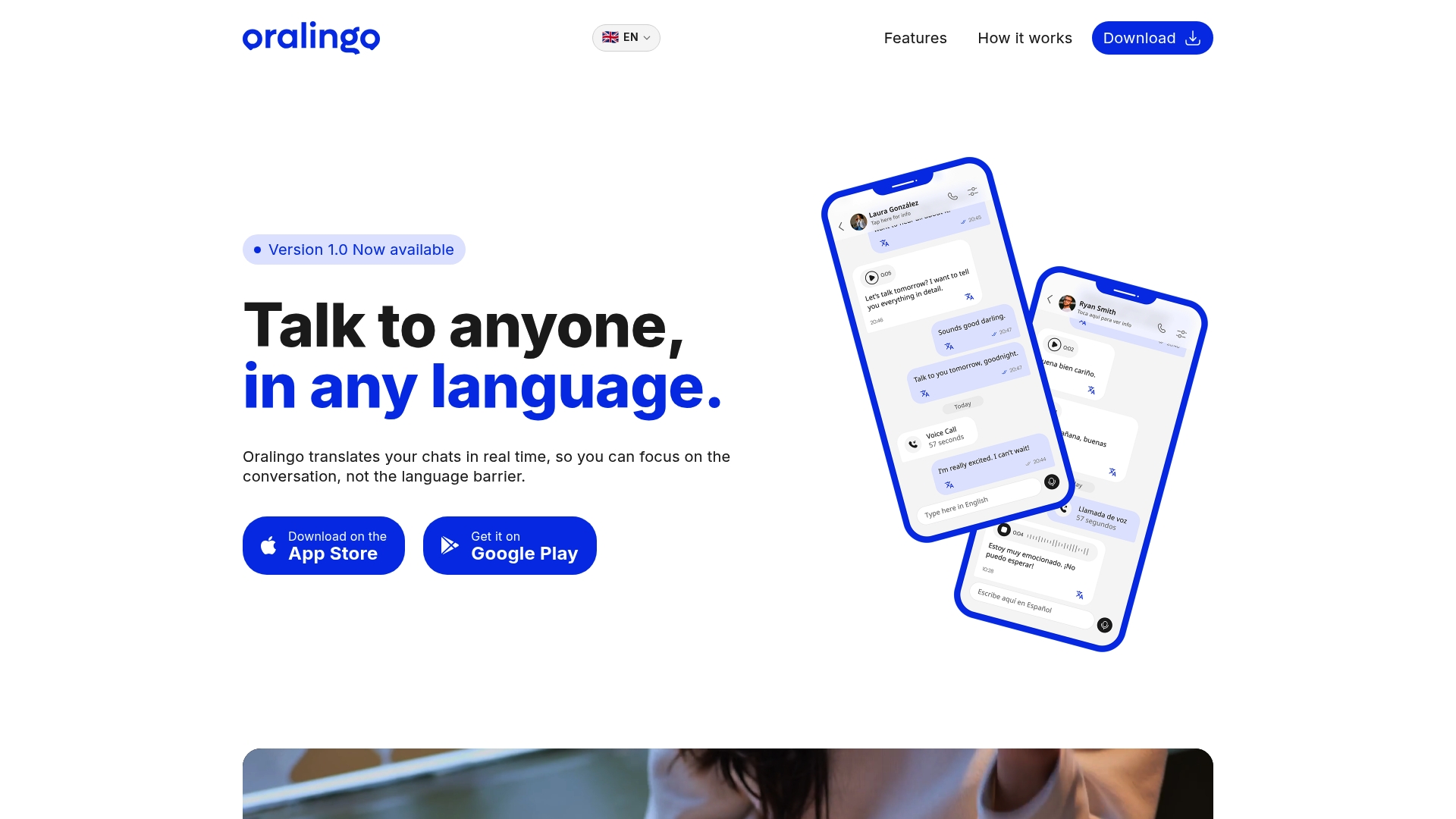
If you're evaluating any low-latency translation tool, run a simple protocol: time from message send to translated display, time from speech end to spoken translation, and check whether tone and context survive the round trip. Oralingo keeps every conversation end-to-end encrypted while you run those tests. Try it yourself at the Oralingo app and see how it holds up against your own latency checklist.
Sources
- Gemini 3.5 Live Translate is here
- On latency metrics for simultaneous translation — YAAL and LongYAAL proposals
FAQ
Is there a real-time translator that actually translates instantly?
No translation happens with zero delay, but several systems get close enough that the lag feels natural. A real-time chat translation app translates messages quickly so conversations flow with minimal visible lag and may support hands-free voice conversation, while streaming models like Gemini Live Translate stay just a few seconds behind the speaker.
What is the highest paid translating job?
Conference interpretation, particularly simultaneous interpreting at international organizations and high-stakes legal or diplomatic settings, tends to command the highest pay in the translation field. Specialized technical and legal translation also pays well due to the accuracy demands involved.
What is the best two-way translation device for travel?
Dedicated hardware translators exist, but most travelers get better results from a smartphone app with a strong voice mode, since it updates faster and supports far more language pairs. Look for one with hands-free voice conversation support and broad language coverage.
What are the three types of language translators?
Translation tools generally split into human translators, machine translation systems (rule-based, statistical, or neural), and hybrid systems that use machine output with human review. Most consumer apps today, including real-time chat translators, rely on neural machine translation for speed and fluency.