The biggest accuracy gains come from a small set of levers: clean input audio, confidence-aware ASR routing with a proper commitment layer, and model-level refinement through ASR-augmented training and LLM-based joint transcription-translation cleanup. Fix those in order and you will close most of the gap between a demo and a production-grade system. Everything past that point trades latency and compute for smaller, harder-won gains.
TL;DR:
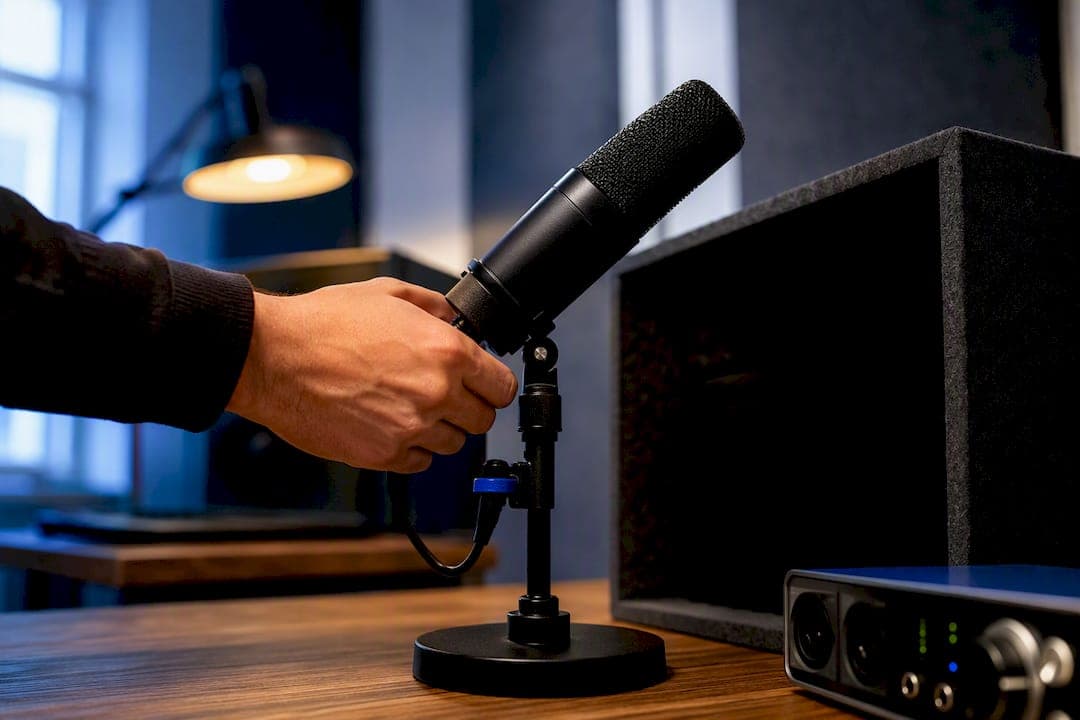
- Improving audio input quality by using close-talking or headset microphones and proper placement reduces errors that models cannot recover from.
- Confidence-aware routing and a commitment layer significantly lower recognition errors by directing low-confidence segments to fallback engines and delaying unconfirmed hypotheses.
- Incorporating ASR augmentation, joint transcription-translation refinement, and domain-specific training strategies leads to measurable BLEU, WER, and COMET score improvements.
- Balancing latency and accuracy requires tuning policies like wait-k and enforcing force-finalization heuristics to prevent stream stalls and unpredictable delays.
- On-device inference suits real-time, privacy-sensitive applications, while cloud deployment benefits larger models and easier updates, with encryption and monitoring essential for data security.
Table of Contents
- How Do You Optimize Voice Translation Accuracy Step by Step?
- Why Does Audio Capture Quality Matter So Much?
- Should You Route Audio Based on ASR Confidence Scores?
- What Model-Level Changes Actually Improve Translation Quality?
- How Do You Balance Streaming Latency Against Accuracy?
- How Do You Test and Benchmark Translation Accuracy?
- Should You Run Voice Translation On-Device or in the Cloud?
- How Does Oralingo Apply These Accuracy Levers?
- Where Does Voice Translation Fit Into Real-Time Applications?
- What Should Teams Realistically Expect From These Techniques?
- Ready to Put These Techniques to Work?
- Sources
- FAQ
How Do You Optimize Voice Translation Accuracy Step by Step?
Start with the cheapest fixes first. Audio and routing changes take hours to days and often produce the biggest jump in perceived quality. Model retraining takes longer and should come after your pipeline basics are solid.
- Fix input audio first. Bad microphones and unmanaged gain create errors no model can fully recover from. Expect a fast, high payoff for low effort.
- Add confidence-aware routing and a commitment layer. Route low-confidence segments to a fallback engine and stop forwarding unstable partials downstream. Moderate effort, high payoff.
- Introduce ASR augmentation in training. Mixing ASR and speech-translation samples improves how the model maps sound to meaning. Higher effort, strong payoff if you control training.
- Layer in LLM-based refinement. Post-process transcription and translation jointly rather than translation alone. Moderate effort, meaningful payoff, some added latency.
- Monitor with real metrics. Track WER, BLEU, COMET, and latency continuously, not just at launch. Low effort, and it is the only way to know if steps 1 through 4 actually worked.
Skip step 5 and you are optimizing blind. Teams that build dashboards before they touch models tend to find their "translation problem" is actually a microphone problem in disguise.
Why Does Audio Capture Quality Matter So Much?
Every downstream error traces back to what the microphone captured. A model can be state-of-the-art and still produce garbage from a clipped, noisy, or under-sampled signal, because the acoustic information it needed was never recorded.
For conversational and meeting scenarios, close-talking or headset microphones consistently outperform laptop or room mics because they capture a cleaner voice signal relative to background noise. Placement matters almost as much as hardware: a mic six inches from the mouth beats a far-field array in a noisy office every time.
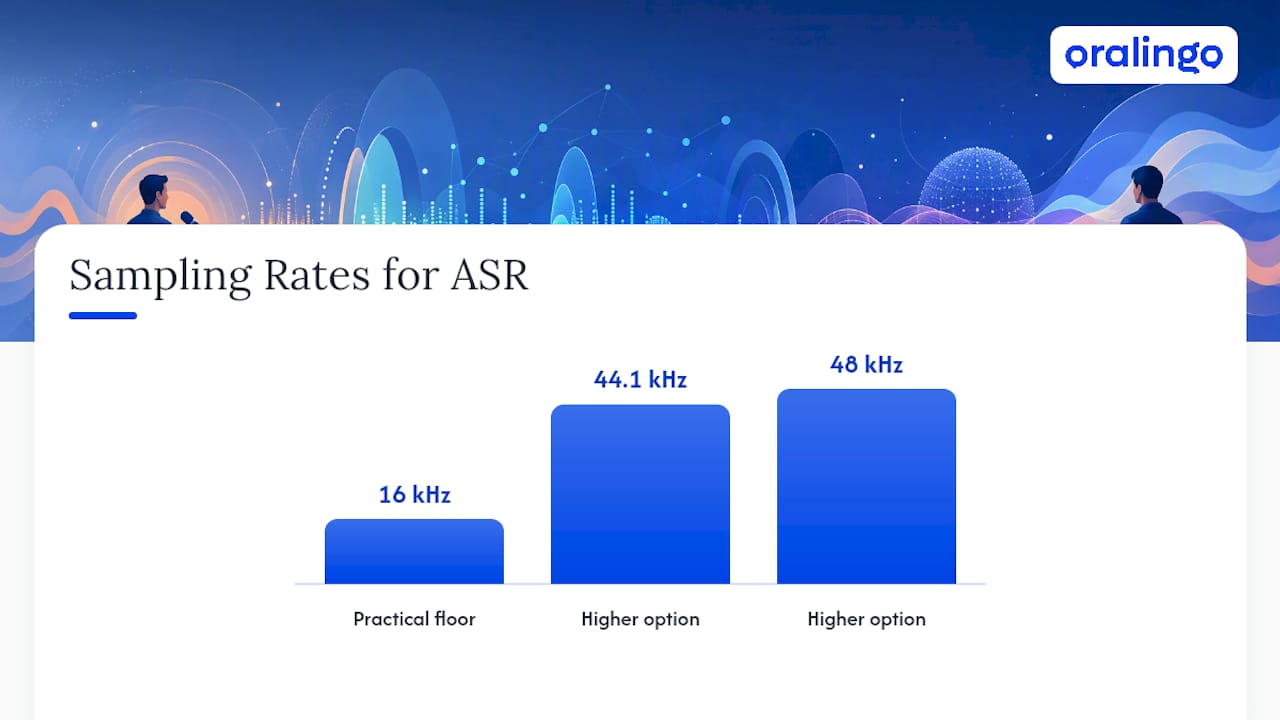
On sampling, 16 kHz is the practical floor for speech recognition and works fine for most conversational voice translation. Going higher (44.1 kHz or 48 kHz) rarely improves ASR accuracy directly, but it helps when your pipeline also handles music, singing, or speaker identification tasks that benefit from richer frequency detail.
Preprocessing does the heavy lifting between capture and recognition:
- Voice activity detection (VAD) trims silence and non-speech noise before it reaches the ASR engine.
- Beamforming on multi-mic arrays isolates the speaker's direction and suppresses off-axis noise.
- Spectral subtraction removes steady background hum without distorting speech formants.
- Target a signal-to-noise ratio (SNR) that keeps you clear of the roughly 40 dB threshold where accuracy degrades sharply as background noise rises and speech rate increases.
Pro Tip: Record a 60-second scripted test phrase across three conditions, quiet room, moderate background chatter, and a moving car, then run each through your ASR pipeline. If word error rate jumps more than a few points between conditions, your noise-suppression chain needs work before you touch the model.
Should You Route Audio Based on ASR Confidence Scores?
Yes, and it is one of the highest-leverage changes you can make without retraining anything. Confidence-aware routing sends low-certainty audio segments to a specialized recognizer or a fallback path instead of letting a shaky transcription flow straight into translation.
A modular offline speech-to-speech system tested a routing threshold around τ ≈ 0.70 and achieved 97.65% routing accuracy, meaningfully cutting recognition errors compared with a single-engine baseline. That threshold will not transfer perfectly to every language pair or noise profile, but it is a reasonable starting point to tune against your own test set.
Routing alone will not save you if unstable partial hypotheses keep leaking downstream. That is where a commitment layer earns its keep:
- Commit a transcription segment only after a punctuation boundary, a silence timeout, or a detected speaker change.
- Keep partial hypotheses display-only in the UI so users see live captions without triggering repeated translation calls.
- Never forward an uncommitted partial to machine translation or text-to-speech; doing so causes flicker and duplicate audio output.
- Log the commit event separately from the display update so you can measure how often early commits get revised.
This pattern, described in the X-Translator system, avoids the repeated-translation problem that makes early streaming demos sound stuttery.
For diagnostics, log commit timestamp, ASR confidence at commit, speaker ID, and downstream latency for every segment. That combination lets you trace a bad translation back to its actual cause, whether that is a low-confidence commit, a speaker mixup, or a slow MT call, instead of guessing.
What Model-Level Changes Actually Improve Translation Quality?
Once your audio and routing are solid, the next gains come from how the model itself is trained and refined. Three techniques stand out for real, measurable improvement.
ASR-augmented training mixes automatic speech recognition samples with speech-translation samples during training instead of training on translation pairs alone. This forces the model to learn a stronger acoustic-to-semantic alignment, and the LLaST research reports notable BLEU gains across test sets when this mixing is combined with adapter-based fine-tuning.
Dual-LoRA fine-tuning applies separate low-rank adapters to the speech encoder and the language model rather than retraining either from scratch. One adapter (commonly labeled S-LoRA) specializes the encoder for acoustic input, while a second (L-LoRA) specializes the LLM for translation output. Because both base models stay frozen, you get translation-specific behavior without the cost or risk of full retraining, a strategy LLaST validates directly.
LLM-based joint refinement takes a rough transcription and rough translation and cleans up both together instead of polishing the translation alone. Research on speech translation refinement using large language models found that refining transcription and translation jointly, an approach the paper calls "Refine Both," produced more consistent BLEU, COMET, and WER improvements than translation-only refinement. Feeding the LLM better source text turns out to matter as much as polishing its output.
Document-level context adds a further boost. Giving the refinement model the preceding few sentences (a K-sentence window) instead of a single isolated utterance measurably improved BLEU and COMET scores in that same research. The trade-off is compute and latency: joint refinement with context adds a processing step your pipeline needs to budget for, so reserve it for use cases where translation quality matters more than shaving off a few hundred milliseconds.
- Mix ASR and ST training data rather than training on translation-only corpora.
- Apply dual-LoRA adapters to specialize encoder and LLM independently and efficiently.
- Refine transcription and translation jointly, not translation in isolation.
- Add a short context window (a handful of prior sentences) when your use case tolerates the extra latency.
How Do You Balance Streaming Latency Against Accuracy?
Every streaming voice translation system runs on a trade-off: wait longer for more context and get better accuracy, or respond faster and risk more errors. The engineering job is picking where on that curve your product needs to sit, then enforcing it consistently.
Read/write policies control this directly. Wait-k policies delay output by a fixed number of source tokens, while monotonic attention and alignment-based policies adapt the delay based on how confident the model is about what comes next. Research on alignment-based streaming translation shows that tuning these policies with confidence thresholds narrows the quality gap between streaming and full-sentence translation while keeping latency predictable, which matters more to users than shaving a few extra milliseconds off best-case response time.
Force-finalization heuristics protect your worst case. Set a hard cap, either a token count or a timeout, after which the system commits its current best hypothesis regardless of confidence. Without this, a single ambiguous phrase can stall your entire output pipeline.
- Tune wait-k or alignment-based policies against your actual latency budget, not a generic default.
- Force-finalize on a timeout so no segment blocks the stream indefinitely.
- Flush segments on punctuation or speaker change to keep multi-speaker conversations properly separated.
- Instrument every stage, ASR commit, MT request, TTS synthesis, and playback queue, so you can see exactly where latency accumulates.
That last point matters more than it sounds. Teams often assume translation is their bottleneck when the real delay sits in TTS queuing or playback buffering. You cannot fix what you have not measured at the component level.
How Do You Test and Benchmark Translation Accuracy?
Word error rate (WER) measures ASR quality on its own. BLEU and COMET measure translation quality, with COMET generally correlating better with human judgment than BLEU alone. For spoken output, ASR-BLEU and Mean Opinion Score (MOS) capture how the full pipeline sounds once speech is translated and re-synthesized.
Build your test set to match reality, not convenience. Include domain-matched audio, a real spread of accents, multiple controlled noise levels, and both scripted and spontaneous speech. A model that scores well on clean scripted audio can fall apart on a spontaneous, accented phone call.
- Compute WER, BLEU, and COMET on every release candidate, not just at initial launch.
- Run canary tests on a small percentage of live traffic before a full rollout.
- Log hypothesis revisions and commit timestamps to catch regressions before users report them.
- Set explicit acceptance thresholds (for example, no more than a two-point BLEU drop) before shipping any pipeline change.
| Metric | Measures | Typical use |
|---|---|---|
| WER | ASR transcription accuracy | Evaluating recognition quality alone |
| BLEU | Translation n-gram overlap | Fast, standard translation benchmark |
| COMET | Translation quality vs. human judgment | Higher-fidelity translation evaluation |
| ASR-BLEU | End-to-end speech-to-speech quality | Full pipeline validation |
| MOS | Perceived naturalness of output speech | User-facing quality checks |
Present results to stakeholders as a delta against your last stable release, not an absolute score. A COMET score means little in isolation; a two-point drop from last week's build means a lot.
Should You Run Voice Translation On-Device or in the Cloud?
Choose on-device inference when latency and privacy matter more than model size, think live conversation apps where a round trip to a server adds noticeable lag. Choose cloud inference when you need larger models, frequent updates, or heavier compute than a phone or edge device can handle.
Whichever you pick, minimize data retention and favor encryption for anything that touches a user's actual conversation. Where you need to keep improving models with real usage data, federated fine-tuning or encrypted telemetry lets you learn from patterns without storing raw audio centrally.
- Cache repeated utterances and reuse speaker voice prompts to cut redundant compute costs.
- Set per-language dashboards so a regression in one language pair does not hide inside an aggregate "all languages" metric.
- Alert automatically on sudden WER or BLEU drops rather than relying on manual spot checks.
- Treat hybrid AI-plus-human review as standard for legal, medical, or brand-sensitive content, where companies routinely route nuanced content to human reviewers even after heavy automation.
How Does Oralingo Apply These Accuracy Levers?
Oralingo runs on the same principles this article lays out, applied to real-time one-to-one conversation instead of a lab benchmark. It supports 100+ languages, offers a hands-free voice mode so you can speak naturally without typing, and encrypts every conversation end-to-end. Oralingo states a 99% accuracy rate for its translations.
What that means in practice: Oralingo optimizes the same three levers covered above: clean audio handling, low-latency routing decisions, and privacy-preserving processing, but wraps them in a product you do not have to build or tune yourself.
If you want to see how these levers perform outside a research paper, test a multilingual voice chat session in about 15 minutes and pay attention to three things: how quickly a spoken sentence turns into translated audio, whether the translation holds up during natural pauses and interruptions, and whether tone and context survive the round trip. Those three checks map directly onto latency, WER, and translation quality, the same metrics this guide recommends tracking in production.
Where Does Voice Translation Fit Into Real-Time Applications?
Voice translation rarely lives on its own. It sits inside a chain: a call center dashboard, a live captioning overlay, a customer support bot, or a chat app's voice mode. How you integrate it changes what "accuracy" even means for your specific use case.
For live captioning, the priority is minimizing flicker. Partial hypotheses should update smoothly on screen while only committed text feeds any downstream logging or archival system. For voice-to-voice calling, the priority shifts to latency consistency. Users tolerate a fixed half-second delay far better than a delay that randomly swings between 200 milliseconds and two seconds.
Customer support integrations add another wrinkle: domain vocabulary. A generic translation model might mistranslate a product name or a support ticket status. Feeding a custom glossary or domain-specific terms into your translation layer, whether through prompt context for an LLM-based system or a fine-tuned vocabulary list, cuts these errors substantially without touching your core model.
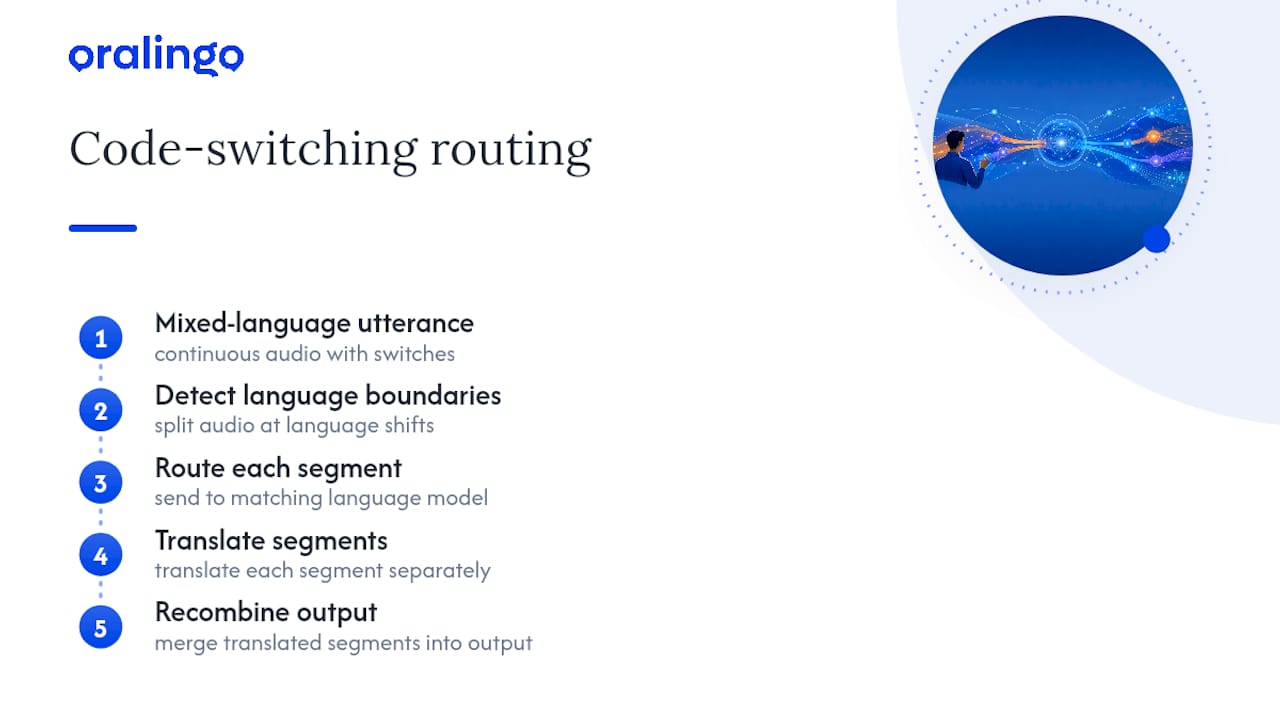
Code-switching, where a speaker mixes two languages mid-sentence, is one of the harder integration challenges. Systems built for single-language-per-utterance input can misfire badly here. The practical fix is detecting language boundaries at the segment level rather than assuming one language per session, then routing each segment through the appropriate language model or translation path.
For multilingual meetings with several speakers, speaker diarization (tracking who said what) needs to run alongside translation, not after it. Binding a translated segment to the wrong speaker breaks trust in the output even when the translation itself is accurate. Systems that tie speaker ID into the commitment layer, rather than bolting it on afterward, tend to handle this more reliably.
What Should Teams Realistically Expect From These Techniques?
Open conversational speech will likely never hit a perfect accuracy ceiling. Accents, cross-talk, and idiom will always create edge cases no model fully solves. Domain-specific speech, think logistics, medicine, or legal proceedings, can get much closer to reliable if you invest in vocabulary customization and confidence routing.
Hybrid human post-editing still earns its place wherever tone or legal exposure matters more than speed. Fold it in as a routing decision, not an afterthought: flag low-confidence or high-stakes segments for review rather than reviewing everything.
If you are prioritizing a roadmap, start with audio and routing. They are cheap and fast. Model-level refinement pays off next, once your pipeline basics stop hiding the model's real performance.
— Poul
Ready to Put These Techniques to Work?
Building and tuning a full speech-to-speech pipeline, mic handling, confidence routing, dual-LoRA adapters, an LLM refinement layer, is months of engineering work most teams do not have time for. Oralingo gives you that stack already built: real-time voice translation with a hands-free mode, support for 100+ languages, and end-to-end encryption on every conversation, with no setup requiring language expertise on your part.
Instead of standing up your own evaluation harness from scratch, run a 15-minute multilingual voice chat test and watch three things: how fast speech turns into translated audio, whether meaning holds up through natural pauses, and whether the tone of what you said comes through on the other end. Those are the same signals this guide told you to measure in your own system. When you are ready to see them in a finished product, try Oralingo and start a conversation in a language you don't speak.
Sources
- Speech Translation Refinement using Large Language Models
- X-Translator: A Real-Time Multilingual Speaker-Aware Speech-to-Speech Translation System
- A modular offline multilingual speech-to-speech translation system with confidence-aware ASR routing and language-aware TTS | Scientific Reports
- Deep Dive into Gemini's Speech-to-Speech Translation — Technology Architecture and Developer Applications | Gemini Lab
FAQ
How Can You Improve Language Translation Accuracy?
Improving translation accuracy starts with clean input audio and a proper signal-to-noise ratio, since noise above roughly 40 dB causes sharp accuracy drops. From there, confidence-aware ASR routing, a commitment layer for stable text, and model-level refinement (ASR augmentation, dual-LoRA fine-tuning, LLM-based joint refinement) each add measurable gains on top.
Which Voice Translator Is Most Accurate?
Accuracy varies by language pair, accent, and background noise, so no single tool wins every scenario. Oralingo states a 99% accuracy rate across its 100+ supported languages, with performance backed by end-to-end encrypted, low-latency processing you can test directly in a short voice chat session.
Can ChatGPT Translate Accurately?
Large language models like the ones behind ChatGPT can produce fluent, contextually aware translations, especially with document-level context, and research on LLM-based joint refinement shows this approach improves BLEU and COMET scores over translation-only refinement. General-purpose LLMs are not purpose-built for real-time streaming voice translation, though, which is why dedicated voice pipelines add commitment layers and confidence routing that a chat-based LLM does not handle natively.
Is There a Translator That Is 100% Accurate?
No translation system, human or AI, achieves 100% accuracy across all languages, accents, and speaking conditions, since factors like background noise, code-switching, and idiomatic phrasing introduce unavoidable edge cases. The practical goal is minimizing error rate through the techniques covered above, audio quality, routing, and model refinement, while using hybrid human review for high-stakes content where precision matters most.