
Voice translation is the process of using AI-driven systems to convert spoken language in real time, enabling communication across languages without a human interpreter present. This technology has moved far beyond novelty. Gemini 3.5 Live Translate supports over 70 languages and handles more than 2,000 language combinations simultaneously, producing continuous audio that preserves the speaker's intonation and pacing. The voice AI agents market is projected to reach $47.5 billion by 2034 at a 34.8% annual growth rate. That scale signals a fundamental shift in how professionals, businesses, and educators handle multilingual communication. Understanding how voice translation replaces interpreters, and where it still falls short, is now a practical necessity.
How does voice translation technology replace human interpreters?
Voice translation technology replaces human interpreters by processing continuous speech in real time rather than waiting for a speaker to pause. Older systems worked turn by turn, which broke the natural flow of conversation. Modern AI systems stream audio and produce translated output with minimal delay, making exchanges feel natural.
Several technical advances drive this shift:
- Continuous speech processing. Systems like Gemini 3.5 Live Translate process audio as it streams, not after each sentence ends. This removes the awkward pauses that made earlier tools feel robotic.
- Massive language coverage. Over 2,000 language combinations are now handled in a single platform. A business call between a Spanish speaker in Madrid and a Japanese speaker in Tokyo no longer requires a bilingual intermediary.
- Preserved speaker tone. AI systems now retain intonation, pacing, and vocal energy. A firm negotiating tone in English carries through to the translated output, not just the words.
- Noise robustness. Streaming translation handles background noise, accents, and overlapping speech better than earlier models. This matters in real-world settings like trade floors, clinics, and classrooms.
- AI as a co-pilot. Professional interpreters use AI-assisted tools to handle terminology lookups and transcription support in real time, freeing their attention for nuance and judgment.
Pro Tip: If you use voice translation in a professional setting, test the system with a native speaker of the target language before a live session. Accent variation and domain-specific vocabulary are the two most common sources of error.
The result is a technology that covers the mechanical core of interpreting: converting spoken words accurately and quickly. What it cannot yet replicate is the human layer on top of that core.

What are the current limits of AI voice translation?
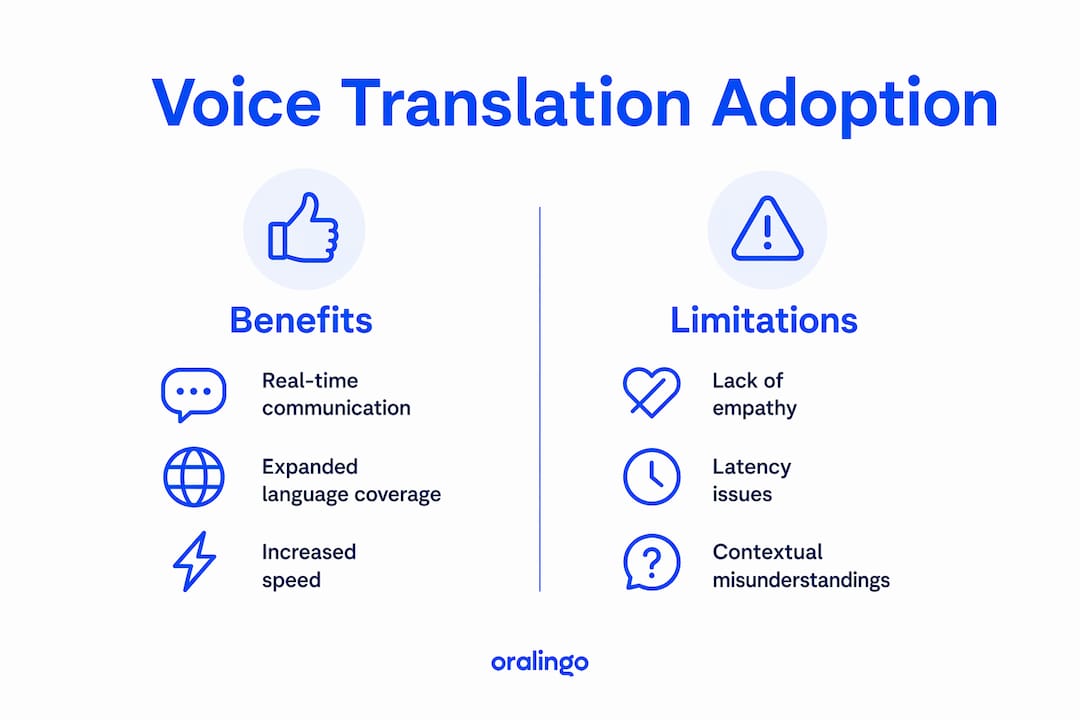
AI voice translation does not fully replace human interpreters in every context. The gap is clearest in high-stakes, emotionally complex situations.
A 2026 validation study published in Nature found that AI-based real-time translation in clinical settings matches human semantic accuracy but lacks prosody, empathy, and nuance. The study recommends AI as an adjunct to certified medical interpreters, not a replacement. That finding matters beyond hospitals. Any setting where emotional tone, cultural sensitivity, or legal precision is critical carries the same risk.
The four most common gaps are:
- Emotional empathy. AI delivers words accurately but cannot read a patient's distress or a negotiator's hesitation and adjust its delivery accordingly.
- Cultural context. A phrase that is polite in one culture can be offensive in another. Human interpreters carry that cultural knowledge. AI systems do not.
- Latency in complex languages. Language structure requires a 1–2 sentence delay in some language pairs because the AI needs context before it can produce an accurate translation. Users must manage conversational timing to avoid talking over the output.
- Critical terminology judgment. In legal or medical settings, a single mistranslated term can have serious consequences. Human interpreters apply professional judgment to flag ambiguity. AI systems do not.
"Learning a language remains important as it conveys cultural understanding that AI cannot authentically replicate." — DeepL CEO, VivaTech 2026
The honest picture is this: AI voice translation handles volume, speed, and coverage better than any human team. Human interpreters handle depth, judgment, and trust better than any AI system. The best outcomes come from combining both.
How is voice translation changing business, schools, and classrooms?
Real-world adoption of voice translation technology is accelerating across three sectors: business meetings, language schools, and educational classrooms. Each sector uses the technology differently, and the results are concrete.
Business meetings
DeepL's CEO stated at VivaTech 2026 that AI removes barriers in business communication, allowing participants to speak their own language fluently during multilingual calls. DeepL Voice achieved a 96.4 quality score in independent evaluations. That performance level means a German executive and a Korean supplier can negotiate in real time without a human interpreter on the call. For companies running dozens of international meetings weekly, the cost and scheduling savings are significant. You can read more about voice translation in meetings and how it reshapes multilingual collaboration.
Language schools
Language schools are adopting AI to handle administrative communication across languages. AI adoption in language education saves up to 80% in reception and inquiry costs by automating multilingual responses. That is not replacing teachers. It is replacing the administrative overhead of managing inquiries from students who speak dozens of different languages. The school staff can focus on instruction while AI handles intake communication.
Classrooms
AI transcription tools are changing how students participate in language learning. Research from 2024 to 2026 shows that AI transcription reduces student anxiety and supports turn-taking in English as a Foreign Language classrooms. Students who hesitate to speak aloud gain confidence when they can see their words transcribed and translated in real time. That is a direct example of how voice translation aids classroom participation without replacing the teacher.
| Setting | Primary benefit | Current limitation |
|---|---|---|
| Business meetings | Real-time multilingual calls without interpreters | Latency in complex language pairs |
| Language schools | Up to 80% reduction in admin communication costs | Does not replace human instruction |
| Clinical settings | Fast semantic accuracy for routine exchanges | Lacks empathy and prosody for sensitive conversations |
| EFL classrooms | Reduces anxiety, supports turn-taking | Risk of over-reliance weakening student autonomy |
Pro Tip: In classroom settings, use AI transcription as a confidence tool for speaking practice, not as a substitute for producing language independently. Students who rely on real-time translation for output lose the productive struggle that builds fluency.
How do professionals combine AI and human interpreting?
The most effective approach to multilingual communication in 2026 is a hybrid model. AI handles speed and volume. Human interpreters handle judgment and nuance. Getting the balance right requires deliberate practice.
Professional interpreters using AI co-pilot tools upload specialized vocabulary before sessions so the AI produces accurate terminology in real time. The interpreter then monitors output, corrects errors, and manages the emotional register of the conversation. This is not the interpreter being replaced. It is the interpreter working faster and more accurately with AI support.
Practical steps for professionals building a hybrid workflow:
- Prepare vocabulary files. Upload domain-specific glossaries to your AI tool before each session. Legal, medical, and technical terms are where AI makes the most errors without preparation.
- Set latency expectations. Tell all participants that a 1–2 sentence delay is normal in some language pairs. This prevents speakers from repeating themselves or talking over the output.
- Keep human oversight on critical exchanges. Use AI for routine back-and-forth. Bring a human interpreter into any exchange involving consent, legal terms, or emotional distress.
- Avoid over-reliance in education. A blended model using AI for comprehension support and human-driven speaking tasks produces better learning outcomes than full AI substitution.
- Review output regularly. AI systems improve with feedback. Flagging errors in your platform of choice builds a more accurate system over time.
The professionals who adapt fastest are not the ones who resist AI or the ones who hand everything over to it. They are the ones who treat AI as a skilled assistant and stay in control of the conversation. For a deeper look at applying this in negotiations, the real-time multilingual negotiation guide covers practical frameworks for high-stakes multilingual exchanges.
Key takeaways
Voice translation technology replaces interpreters effectively for speed, volume, and language coverage, but human interpreters remain necessary for emotional nuance, cultural judgment, and high-stakes precision.
| Point | Details |
|---|---|
| AI handles volume and speed | Systems like Gemini 3.5 Live Translate cover 2,000+ language combinations with minimal latency. |
| Human interpreters cover nuance | Clinical and legal settings require empathy and cultural judgment that AI cannot replicate. |
| Hybrid models outperform either alone | Professionals who use AI for terminology support while managing nuance themselves get the best results. |
| Classrooms benefit with guardrails | AI transcription reduces student anxiety but over-reliance weakens language learning outcomes. |
| Business adoption is accelerating | AI voice tools with quality scores above 96 are making interpreter-free multilingual meetings standard. |
The part nobody talks about honestly
I have spent years watching professionals treat new technology as either a threat or a silver bullet. Voice translation is neither. It is a tool with a specific range of competence, and the people who use it well are the ones who understand that range clearly.
The clinical research finding that AI matches semantic accuracy but fails on prosody and empathy is the most important data point in this entire conversation. It tells you exactly where the boundary is. Words, yes. Feeling, no. That boundary does not disappear as models improve. It narrows, but it does not close.
What I find genuinely underappreciated is the classroom application. AI transcription as an interaction resource for language learners is not about replacing teachers. It is about giving anxious students a safety net that lets them attempt speech they would otherwise avoid. That is a real pedagogical gain. The risk is that schools treat it as a shortcut rather than a scaffold.
My honest prediction: within five years, the question will not be whether to use AI voice translation. It will be how to structure the human oversight layer around it. The professionals who figure that out now will be far ahead of those who wait.
— Poul
Talk to anyone, in any language, with Oralingo
Real-time voice translation is no longer a specialist tool. It belongs in every professional's communication kit.
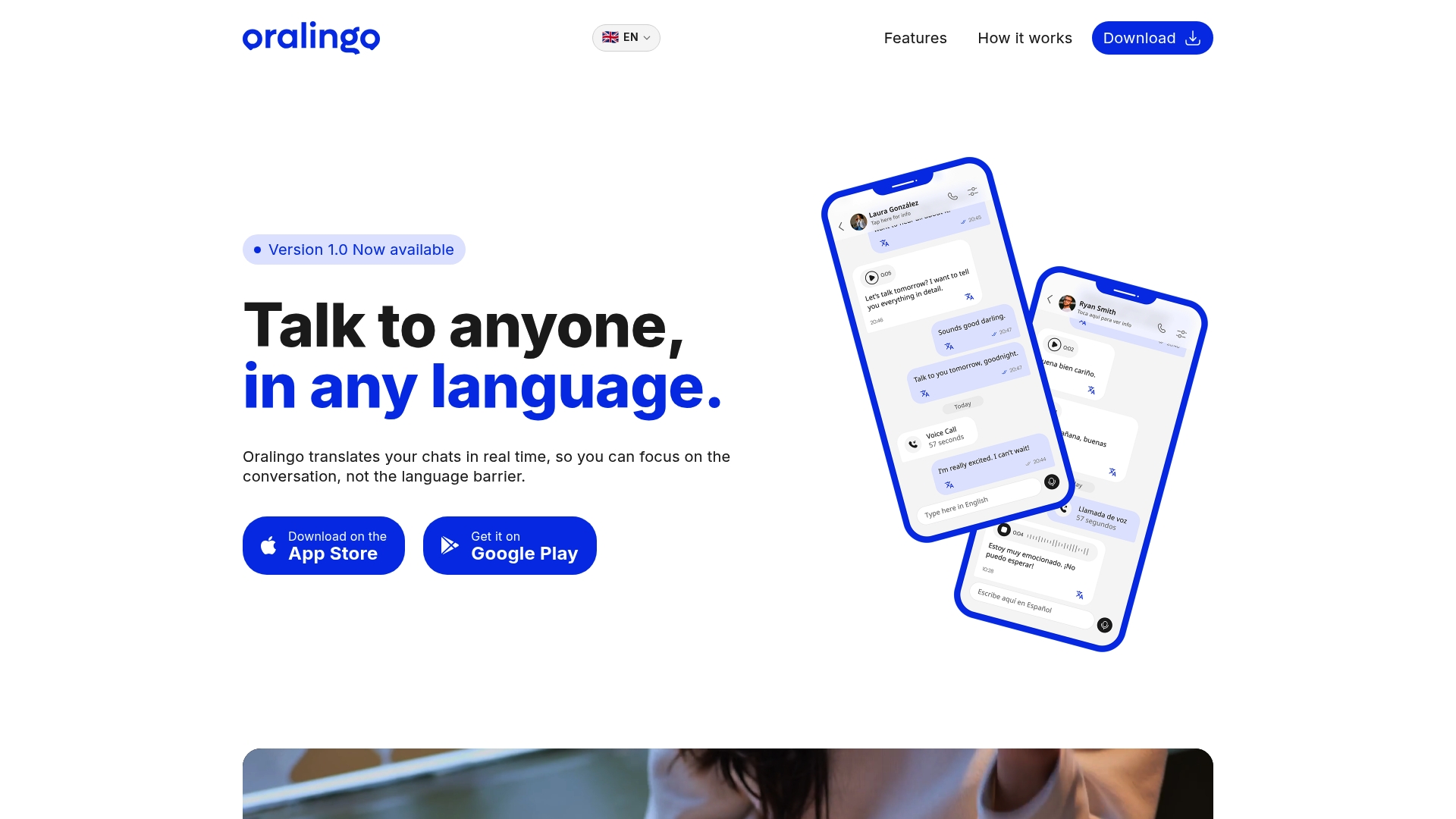
Oralingo delivers real-time voice translation across more than 100 languages with a 99% accuracy rate. Its hands-free voice mode lets you speak and listen naturally without typing a word. Every conversation is end-to-end encrypted, so your discussions stay private whether you are closing a deal, supporting a patient, or connecting with family abroad. You focus on the conversation. Oralingo handles the language. Download the app and start talking to anyone, anywhere, today.
FAQ
How does voice translation replace interpreters in real time?
AI voice translation systems process continuous speech as it streams and produce translated audio output with minimal delay. Modern platforms like Gemini 3.5 Live Translate handle over 2,000 language combinations, covering the core mechanical function of a human interpreter.
Can AI voice translation replace medical interpreters?
A 2026 study published in Nature found that AI matches human semantic accuracy in clinical settings but lacks empathy, prosody, and nuance. Certified medical interpreters remain the recommended standard for sensitive or high-stakes patient conversations.
How does voice translation aid classroom participation?
Research shows AI transcription reduces anxiety and supports turn-taking in language learning classrooms. Students gain confidence to speak when they can see real-time transcription, but educators should use it as a support tool rather than a full substitute for language production.
What is the main technical limitation of real-time voice translation?
Latency is the primary challenge. Some language pairs require a 1–2 sentence processing delay so the AI can gather enough context to produce an accurate translation. Participants need to manage conversational timing to avoid talking over the output.
What is the best way to combine AI and human interpreting?
The most effective approach is a hybrid model where human interpreters use AI tools for real-time terminology support and transcription while retaining control over nuance, emotional register, and critical judgment calls.