
Real-time multilingual negotiation is the coordinated use of simultaneous interpreting, specialized translation, and cultural-legal intelligence to enable immediate, accurate communication across languages during live business negotiations. The Harvard Program on Negotiation identifies translation in negotiation as a tactical tool requiring deliberate planning, not a passive service. Three core components drive this process: simultaneous interpreting for spoken dialogue, legal document translation for written terms, and real-time cultural intelligence to prevent costly misunderstandings. When these elements work together, negotiators can maintain deal momentum across any language barrier.
What is real-time multilingual negotiation and how does it work?
Real-time multilingual negotiation is defined as the live, simultaneous facilitation of spoken and written communication across two or more languages during a business negotiation. The industry term for the spoken component is simultaneous interpretation, which delivers speaker content with only seconds of delay. This is distinct from consecutive interpretation, where the speaker pauses after each statement to allow the interpreter to translate. Both modes serve different negotiation contexts, and choosing the wrong one can slow a deal or introduce errors.
The process also extends beyond spoken words. Multilingual negotiation support includes legal document translation and localization of negotiation materials, requiring understanding of linguistic, legal, and cultural nuances. In Sino-foreign business contexts, for example, a single mistranslated contract clause can void an agreement or trigger a dispute. Real-time oral interpretation and precise downstream document translation work together as a complete system, not as separate services.

What interpreting modes are used in multilingual negotiations?
The two primary modes are simultaneous interpretation and consecutive interpretation. Each has a distinct role depending on the pace and stakes of the negotiation.
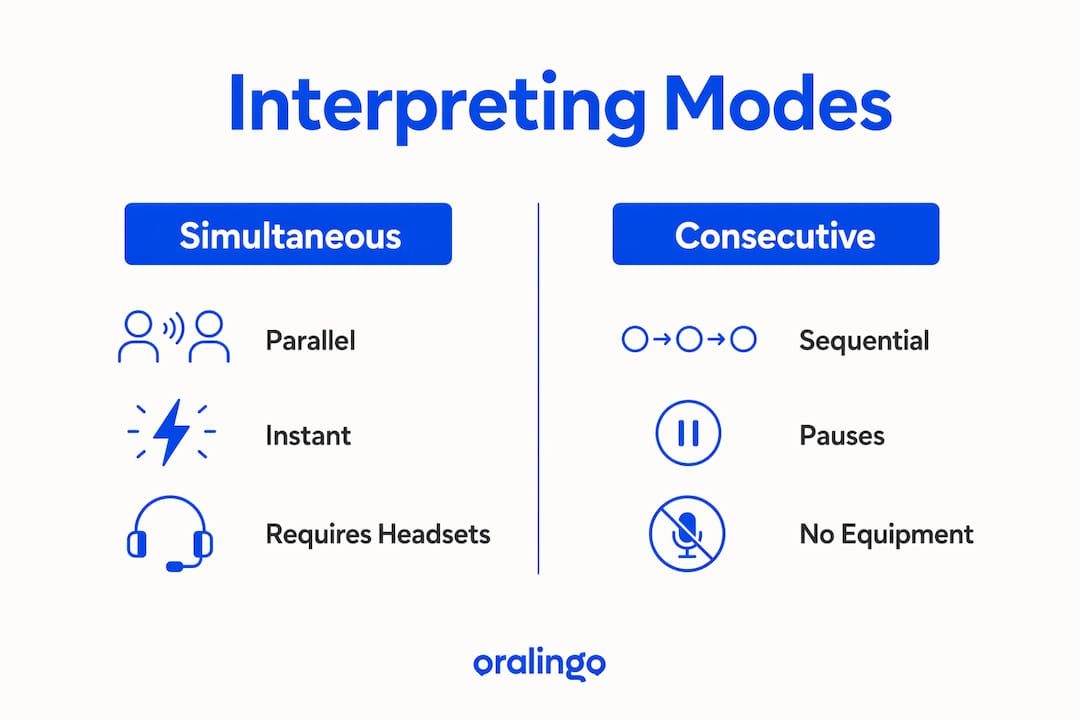
Simultaneous interpretation runs in parallel with the speaker. The interpreter listens and translates at the same time, typically from a soundproof booth using headsets. This mode suits fast-paced negotiations, board meetings, and multi-party deals where stopping for translation would break momentum.
Consecutive interpretation requires the speaker to pause after each statement. The interpreter then delivers the translation before the next statement begins. This mode works well for smaller, bilateral negotiations where precision matters more than speed. However, long uninterrupted statements lead to errors. Chunking speech into short, complete ideas is the single most effective way to protect accuracy.
Interpreter briefing is the most overlooked preparation step. Interpreters rarely know your industry's terminology, deal structure, or negotiation objectives. Preparing interpreters with detailed terminology and business intent reduces meaning loss. A custom glossary covering key contract terms, product names, and negotiation positions should be shared at least 48 hours before the session.
Key preparation steps for interpreter briefing:
- Share a glossary of technical and legal terms specific to the deal
- Explain the desired translation style (literal vs. interpretive)
- Provide background on the counterpart's culture and communication norms
- Clarify which topics are sensitive or confidential
- Walk the interpreter through the negotiation agenda in advance
Pro Tip: Always hire your own interpreter rather than relying on the other party's. An interpreter hired by your counterpart has a conflict of interest, even if unintentional. Your interpreter works for your communication clarity.
How does latency affect real-time multilingual negotiation?
Latency is the time gap between a speaker finishing a phrase and the translated version reaching the listener. In real-time negotiation, this gap directly controls whether the conversation feels natural or disjointed. Sub-800 millisecond first-chunk latency is perceived as live by listeners, enabling fluid interaction. Latency between 800 milliseconds and 1.5 seconds is workable for structured presentations. Anything above 2 seconds breaks conversational flow and forces speakers to slow down or repeat themselves.
ITU and AIIC standards support these benchmarks for remote simultaneous interpretation systems. The practical implication is clear: user satisfaction depends more on first-chunk speed than on overall processing time. A system that delivers the first translated word quickly feels responsive, even if the full sentence takes slightly longer.
AI-powered platforms like DeepL Voice and KUDO AI have entered this space with measurable latency improvements over traditional remote setups. Human interpreter setups still outperform AI in cultural nuance and legal precision, but AI tools close the gap significantly for structured, lower-stakes conversations. Understanding how real-time chat translation handles latency helps teams choose the right tool for each negotiation context.
| Latency range | User experience impact |
|---|---|
| Below 800 ms | Perceived as live; supports natural back-and-forth dialogue |
| 800 ms to 1.5 sec | Acceptable for lectures and structured presentations |
| 1.5 sec to 2 sec | Noticeable delay; speakers begin to adjust pacing |
| Above 2 sec | Conversation flow breaks; errors and repetition increase |
Matching interpreting mode or AI tools to negotiation urgency and stakes is the core decision. A high-stakes M&A negotiation demands human simultaneous interpreters with sub-second audio setups. A routine vendor call can tolerate AI-assisted translation with slightly higher latency.
What best practices ensure successful multilingual negotiation?
The most effective multilingual negotiation strategies combine preparation, communication discipline, and the right staffing model. No single tactic works in isolation.
Simultaneous interpretation causes notable cognitive fatigue after 20–30 minutes. Professional teams manage this through interpreter rotation, typically switching every 20–30 minutes during long sessions. Strict audio discipline, meaning no crosstalk, no side conversations, and clear speaker identification, protects accuracy throughout. Structured redundancy and handover protocols help maintain quality during critical negotiation phases.
Speech habits matter as much as interpreter quality. Speak in complete, short ideas. Avoid idioms, acronyms, and culturally specific references unless you have confirmed they translate accurately. Pause deliberately between points, even in simultaneous mode, to give the interpreter processing space.
Practical multilingual negotiation best practices:
- Use simultaneous interpretation for fast-paced, multi-party sessions
- Use consecutive interpretation when precision outweighs speed
- Rotate interpreter teams every 20–30 minutes in long sessions
- Avoid idioms, slang, and culturally specific humor
- Confirm key terms and numbers verbally and in writing
- Request a post-session debrief with your interpreter to flag any ambiguities
Pro Tip: After each major agreement point, ask your interpreter to confirm the counterpart's understanding in their own words. This catches translation drift before it becomes a contractual problem.
Technology for multilingual negotiation adds a practical layer for distributed teams. AI-powered business communication tools now handle routine multilingual exchanges with high accuracy, freeing human interpreters for the highest-stakes moments.
How does real-time negotiation intelligence go beyond translation?
Real-time negotiation intelligence is defined as the immediate analysis of linguistic, cultural, and legal nuances during a negotiation, going well beyond word-for-word translation. This intelligence reduces precontractual risks by flagging legal meaning gaps, cultural misalignments, and strategic signals that a standard interpreter would miss. Specialized bicultural legal interpreters act as guardians of legal meaning, operating under strict confidentiality protocols.
In Sino-foreign negotiations, for example, concepts like guanxi (relationship networks) and face (social standing) carry negotiating weight that does not translate literally. A bicultural interpreter recognizes when a counterpart's phrasing signals discomfort or a face-saving retreat, and can alert your team in real time. This kind of cultural signal reading prevents misreads that derail deals at the final stage.
In contract-heavy negotiations, real-time oral support is supplemented with precise downstream document translation to ensure linguistic and legal equivalence. The table below summarizes the core components of real-time negotiation intelligence.
| Component | Role in negotiation |
|---|---|
| Linguistic precision | Accurate word-for-word and contextual translation |
| Legal equivalence | Ensures contract terms carry the same legal weight in both languages |
| Cultural signal reading | Identifies face-saving, indirect refusals, and relationship cues |
| Confidentiality protocol | Protects deal-sensitive information shared with interpreters |
| Terminology research | Custom glossaries built before the session to prevent meaning loss |
The practical result is a negotiating team that responds to what the counterpart actually means, not just what they literally said. That distinction closes deals.
Key Takeaways
Real-time multilingual negotiation requires simultaneous interpreting, latency-aware technology, and cultural-legal intelligence working together to protect deal accuracy and flow.
| Point | Details |
|---|---|
| Definition is specific | Real-time multilingual negotiation combines simultaneous interpreting, document translation, and cultural intelligence. |
| Latency controls flow | Sub-800 ms first-chunk latency feels live; above 2 seconds breaks conversation rhythm. |
| Briefing is non-negotiable | Share custom glossaries and deal context with interpreters at least 48 hours before the session. |
| Hire your own interpreter | Relying on the other party's interpreter creates a conflict of interest that risks your position. |
| Intelligence beats translation | Bicultural legal interpreters catch cultural signals and legal gaps that word-for-word translation misses. |
Why preparation beats technology every time
The biggest mistake I see negotiators make is treating interpretation as a commodity. They book an interpreter the day before, hand over no background materials, and expect fluent, accurate output. Then they blame the interpreter when a term gets mistranslated.
Technology has genuinely improved. AI tools like DeepL Voice have pushed latency benchmarks to competitive levels, and platforms like KUDO AI have made remote simultaneous interpretation more accessible than ever. But technology does not know your deal. It does not know that "standard terms" means something different to your counterpart's legal team, or that a particular phrase carries a specific cultural weight in the room.
The negotiators I have seen succeed consistently do two things well. First, they invest in preparation: custom glossaries, interpreter briefings, and a clear communication protocol for the session. Second, they treat their interpreter as a strategic partner, not a language machine. That shift in mindset changes how you brief, how you speak, and how you respond to what you hear.
Cultural sensitivity is not a soft skill in multilingual negotiation. It is a deal variable. A negotiator who understands that silence from a Japanese counterpart signals consideration, not agreement, operates with a real advantage. That kind of intelligence does not come from an app. It comes from preparation, the right interpreter, and the discipline to listen carefully.
— Poul
How Oralingo supports real-time multilingual communication
Real negotiations move fast. Your communication tools need to keep up.
Oralingo translates messages instantly before they are displayed, so your team reads responses in their own language without any pause in the conversation. With support for over 100 languages and a 99% accuracy rate, Oralingo handles the routine multilingual exchanges that fill a negotiation day: pre-meeting chats, follow-up confirmations, and quick clarifications between sessions. Its hands-free voice mode lets you speak naturally without typing, and every conversation is end-to-end encrypted. For business teams negotiating across language barriers, Oralingo keeps communication clear, fast, and confidential.
FAQ
What is real-time multilingual negotiation?
Real-time multilingual negotiation is the live facilitation of business negotiations across two or more languages using simultaneous interpreting, legal translation, and cultural intelligence. It enables negotiators to communicate accurately and maintain deal momentum without language delays.
What is the difference between simultaneous and consecutive interpretation?
Simultaneous interpretation runs in parallel with the speaker, delivering translation within seconds. Consecutive interpretation requires the speaker to pause after each statement so the interpreter can translate before the next point begins.
How much latency is acceptable in real-time negotiation?
Latency below 800 milliseconds is perceived as live and supports natural dialogue. Latency above 2 seconds breaks conversation flow and forces speakers to repeat or slow down significantly.
Why should I hire my own interpreter instead of using the other party's?
An interpreter hired by your counterpart has a potential conflict of interest, even unintentionally. Your own interpreter works solely for your communication clarity and can be briefed confidentially on your negotiation position.
What is real-time negotiation intelligence?
Real-time negotiation intelligence is the immediate analysis of cultural, legal, and linguistic signals during a negotiation, beyond basic translation. Bicultural legal interpreters provide this service, flagging legal meaning gaps and cultural cues that standard interpretation misses.