
Seamless multilingual conversation is the AI-powered ability to communicate naturally across different languages in real time, without interruption or loss of meaning. Unlike traditional translation, which requires copying text into a separate app or waiting for a batch result, this technology translates speech and text instantly as the conversation happens. Meta's SeamlessM4T model, which supports over 100 languages, represents the current benchmark for this capability. Oralingo applies the same principle to everyday chat and voice calls, letting you focus on what you are saying rather than how to say it in another language.
What is seamless multilingual conversation and how does it work?
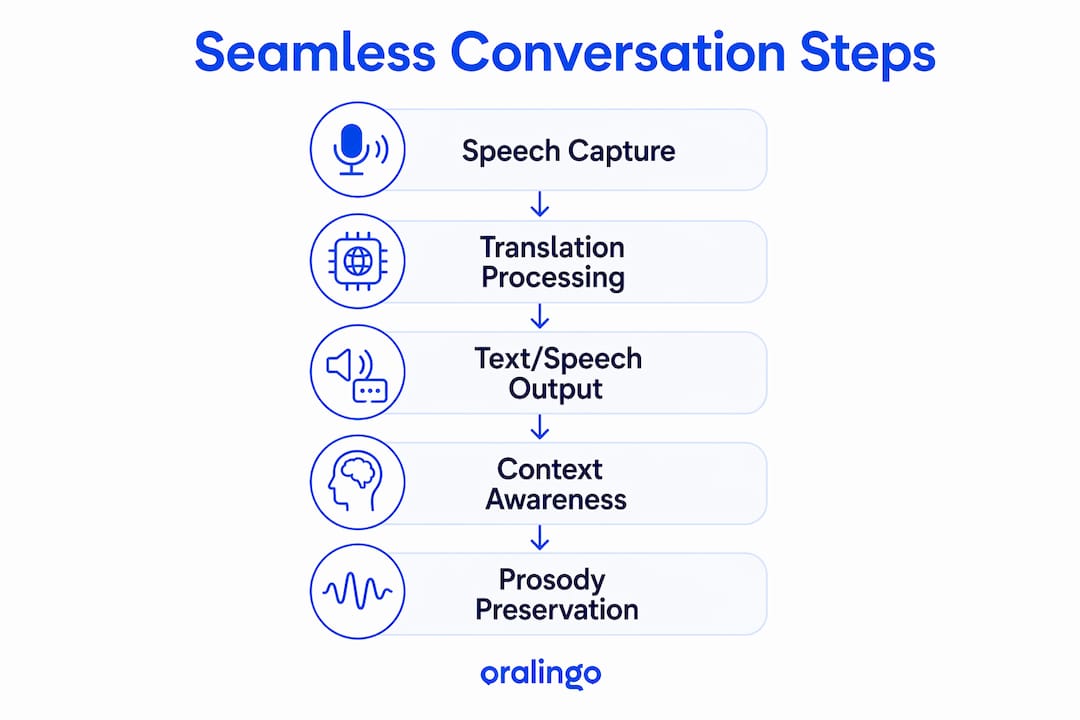
Seamless multilingual conversation combines three core translation processes: speech-to-speech (S2ST), speech-to-text (S2TT), and text-to-speech (TTS). Each process runs in parallel so the system can handle spoken words, typed messages, and voice replies within a single conversation. The result is a fluid exchange that feels closer to talking with a bilingual friend than using a translation tool.
The biggest technical leap in recent years is latency reduction. Real-time S2ST latency has dropped to approximately 2 seconds, compared to the traditional 4–5 seconds of older cascaded systems. That 2–3 second difference is the gap between a conversation that feels natural and one that feels like a phone call with a bad connection.

Training these models requires aligning audio recordings with subtitles across many languages, then feeding that data into large neural networks. The networks learn not just vocabulary but also prosody, the rhythm and pitch of speech that carries emotional meaning. Expressivity preservation captures tone, emotional intent, and prosody rather than producing flat, literal output. That is why a frustrated question in Spanish can arrive in English sounding frustrated, not robotic.
Pro Tip: If you are evaluating a multilingual communication tool, ask specifically whether it preserves prosody. A tool that flattens emotional tone will create misunderstandings in high-stakes conversations, even when the words are technically correct.
| Feature | Traditional cascaded systems | Modern seamless systems |
|---|---|---|
| Latency | 4–5 seconds | ~2 seconds |
| Accuracy (S2ST) | Baseline | 23% higher |
| Accuracy (S2TT) | Baseline | 8% higher |
| Expressivity | Minimal | Tone and prosody preserved |
| Language support | Varies | 100+ languages |
SeamlessM4T's accuracy gains of 23% in speech-to-speech tasks and 8% in speech-to-text represent a meaningful jump for real-world use. Higher accuracy means fewer corrections, fewer misunderstandings, and faster conversations.
Key features that set seamless cross-language chat apart
Cross-language chat built on modern AI differs from traditional translation in several concrete ways. Understanding those differences helps you choose the right tool for your situation.
Real-time streaming. The system translates each sentence as it is spoken or typed, not after the full message is complete. You read or hear the translation almost instantly, which keeps the conversation moving.
Multilingual support at scale. Supporting 100+ languages simultaneously is not just a number. It means a group chat with participants in Brazil, Japan, and Germany can all read messages in their own language without anyone switching apps.
Context-aware translation. Neural machine translation with contextual learning maintains meaning, tone, and formatting across a full conversation thread. A standalone translator treats each sentence in isolation. A context-aware system remembers what was said two messages ago, so technical terms stay consistent throughout.
Code-mixing detection. Many real conversations switch languages mid-sentence. Automatic language detection on each message lets the AI adapt when a user shifts from English to Spanish mid-chat, a pattern common in communities that speak Singlish or Spanglish. This removes the friction of manually selecting a new language.
Emotionally coherent voice output. Text captions alone strip out personality. Direct speech-to-speech translation better conveys human connection because the listener hears tone and energy, not just words.
Key distinguishing features at a glance:
- Instant on-screen translation before the message is displayed to the recipient
- Per-message language detection for mid-conversation language switching
- Conversation history cache to maintain technical and contextual accuracy
- Prosody and emotional tone preserved in voice output
- End-to-end encryption for private multilingual exchanges
- Hands-free voice mode for verbal communication without typing
Practical applications: where seamless multilingual conversation matters most
The technology is most valuable when the cost of miscommunication is high. Here are the settings where it makes the clearest difference.
-
International business meetings. A sales call between a team in Tokyo and a client in São Paulo no longer requires a human interpreter on the line. Real-time speech translation handles the exchange, and both sides hear responses in their own language within seconds.
-
Cross-language team chat. Global teams working across time zones use context-aware multilingual chat to keep project threads coherent. Orbios AI Bot, for example, maintains a message cache so that technical terminology stays consistent across languages throughout a project thread. This is what makes cross-language team chat genuinely useful rather than just functional.
-
Customer support. Live chat translation lets a support agent in one country handle tickets from customers in another without multilingual staffing. Neural translation in enterprise chat reduces the need for dedicated language staff while keeping response quality high.
-
Cross-language couple and family chat. Partners or family members who speak different native languages use real-time chat translation to stay connected daily. The emotional tone preservation feature matters most here. A loving message should arrive feeling warm, not clinical.
-
Cross-language student chat. Students in international programs or language exchange partnerships use multilingual chat to practice and communicate simultaneously. The AI handles the translation while the student focuses on the content of the discussion.
-
Live global conferences. Simultaneous speech translation lets conference speakers address multilingual audiences without pre-recorded dubbing. Attendees hear the speaker in their own language with minimal delay.
Pro Tip: For business use, choose a tool that keeps a conversation history cache. Orbios AI Bot's message cache approach shows why this matters: without it, a term like "sprint" might translate as a running action rather than a software development cycle.
Noisy environments and strong regional accents remain the hardest challenge for all these use cases. A conference hall with crowd noise or a call from a speaker with a thick regional accent can reduce accuracy noticeably. The best tools handle this with noise filtering built into the audio pipeline, but no system is fully immune.
Limitations and future directions in multilingual AI translation
Current seamless multilingual systems are impressive, but they are not finished products. Understanding the gaps helps you set realistic expectations.
The most persistent problem is noise. Seamless multilingual models struggle in noisy environments and with strong accents, and this remains an active area of research. A quiet office call translates well. A street-level conversation in a busy city is harder.
Language coverage is another constraint. Supporting 100+ languages sounds broad, but there are roughly 7,000 languages spoken worldwide. Many regional dialects and low-resource languages receive little or no coverage in current models.
Word order differences between languages also create real-time challenges. Japanese sentences place the verb at the end, while English places it near the beginning. A streaming system must sometimes wait for a full clause before it can produce an accurate translation, which adds micro-delays even in otherwise fast systems.
Human-in-the-Loop (HITL) review addresses some of these gaps by pairing AI speed with human contextual judgment. In sensitive enterprise settings, a human reviewer can catch errors that the AI misses while the system still handles the bulk of the translation load. HITL keeps sub-second latency on routine messages while flagging edge cases for review.
| Capability | Current state | Near-future goal |
|---|---|---|
| Noisy environment accuracy | Limited | Improved noise filtering |
| Language coverage | 100+ languages | Broader dialect support |
| Expressivity | Tone and prosody preserved | Full emotional range |
| Word order handling | Clause-level buffering | Sentence-level prediction |
| Multimodal input | Speech and text | Speech, text, and gesture |
The next frontier is multimodal translation, combining speech and text with visual input like gestures or on-screen context. A system that reads both what you say and what you point at could handle ambiguous references far more accurately than audio alone.
Key takeaways
Seamless multilingual conversation works because AI models now translate speech and text in real time, preserve emotional tone, and maintain conversation context across 100+ languages.
| Point | Details |
|---|---|
| Real-time latency | Modern systems translate in ~2 seconds, down from 4–5 seconds in older tools. |
| Accuracy gains | SeamlessM4T delivers 23% better accuracy in speech-to-speech tasks than previous systems. |
| Context matters | Tools with a message cache keep technical terms consistent across long conversations. |
| Expressivity is key | Preserving tone and prosody makes AI translation feel human rather than mechanical. |
| Limitations remain | Noisy environments and strong accents still reduce accuracy in all current systems. |
Why expressivity is the feature most people overlook
I have spent years watching professionals adopt multilingual communication tools, and the pattern is always the same. They test accuracy first, latency second, and language count third. Almost nobody asks about expressivity until something goes wrong.
The first time a frustrated client's message arrives sounding cheerful because the AI flattened the tone, the damage is done. The recipient misreads the situation, responds incorrectly, and the relationship takes a hit that a better tool would have prevented. Preserving emotional tone is not a nice-to-have feature. It is the difference between a tool that translates words and one that translates communication.
I also think the privacy conversation around automated translation is underappreciated. When you run a sensitive business conversation through a third-party translation service, you are sharing that conversation with that service. End-to-end encryption is not a marketing checkbox. It is a basic requirement for any professional use case involving contracts, personnel matters, or client data.
My honest advice: test any multilingual tool with an emotionally charged message before you commit to it. Send something that sounds urgent or warm in your language and check whether it arrives that way. If it does not, the tool is not ready for real communication.
— Poul
How Oralingo makes cross-language conversations easy
Real-time multilingual chat does not have to be complicated. Oralingo translates messages instantly before they appear on screen, so both sides of the conversation always read in their own language. There is no copy-pasting, no switching apps, and no waiting.
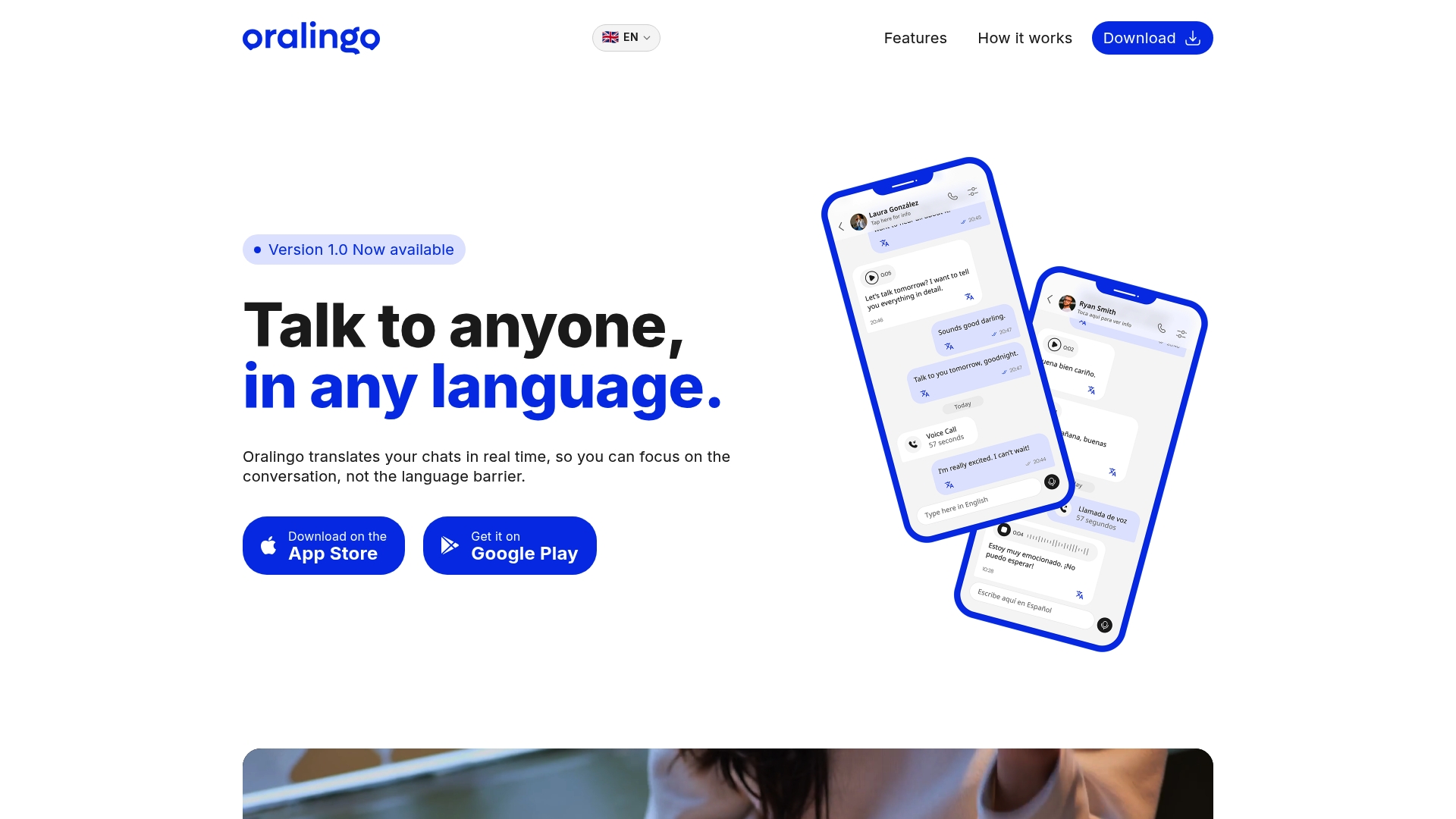
Oralingo supports over 100 languages with a 99% accuracy rate and includes a hands-free voice mode for verbal conversations. Every chat is end-to-end encrypted, so your conversations stay private. Whether you are coordinating with a global team, staying in touch with family abroad, or chatting with a new contact in another country, Oralingo gives you a direct line to anyone, in any language. You can also learn more about how real-time chat translation works under the hood before you get started.
FAQ
What is seamless multilingual conversation?
Seamless multilingual conversation is AI-powered real-time translation of speech and text across multiple languages, preserving tone and context without interrupting the conversation flow.
How accurate are current multilingual AI translation systems?
Meta's SeamlessM4T achieves 23% greater accuracy in speech-to-speech tasks compared to previous systems, making it one of the most accurate multilingual models available as of 2026.
What is seamless cross-language team chat?
Cross-language team chat is a real-time messaging system where each participant reads messages in their own language. Tools like Orbios AI Bot use a message cache to keep technical terminology consistent across the full conversation thread.
Can AI handle code-mixing, like Spanglish or Singlish?
Yes. Modern systems use per-message language detection to identify and translate each message independently, so the AI adapts automatically when a user switches languages mid-conversation.
What are the main limitations of seamless multilingual translation?
Noisy environments and strong regional accents remain the biggest challenges, reducing accuracy in real-world conditions. Human-in-the-Loop review is the most common solution for high-stakes enterprise settings.