
Multilingual families face a distinct set of pressures that go far beyond simply speaking two languages at home. The common challenges multilingual families face include language production gaps, cultural integration hurdles, identity conflicts, and communication breakdowns in essential services like healthcare. Research shows that 46% of multilingual parents report their child understands the minority language but does not actively speak it. That statistic alone reveals how deep these challenges run. Add in cultural adjustment, school pressures, and parental self-doubt, and you have a picture that most parenting guides simply do not address.
1. Why do many multilingual children understand but not speak certain languages?
Receptive bilingualism is the term linguists use for children who understand a language but do not produce it. This is one of the most common challenges multilingual families face, and it is far more normal than most parents realize.
The causes are rarely about ability. They are almost always about environment and motivation. Key factors include:
- Imbalanced exposure. If one language dominates school, media, and friendships, the minority language loses its conversational purpose.
- No perceived need. Children speak the language that gets results. If parents respond in the majority language, children stop trying in the minority one.
- Social and peer pressure. Older children especially feel the pull to fit in. Speaking a "different" language at home can feel like a liability outside it.
- Emotional associations. Some children link a language to conflict, correction, or pressure. They avoid it to avoid those feelings.
- Inconsistent parental strategies. Switching languages mid-conversation signals to children that the minority language is optional.
Research confirms that language refusal is often identity-driven, not a rejection of the language itself. Children use refusal as a way to assert belonging in their social world. That reframe matters enormously for how parents respond.
Pro Tip: Instead of asking your child to "say it in Spanish" or correcting their language choice, create situations where the minority language is the only natural option. A video call with a grandparent who speaks only that language works better than any drill.
2. How language barriers impact healthcare for multilingual families
Healthcare is where language barrier issues carry the highest stakes. A breakdown in communication during a medical appointment is not just frustrating. It can be dangerous.

Public health research shows that only 1.5% of healthcare staff use official professional telephone interpreting services. That number is strikingly low. It means the vast majority of multilingual patients rely on family members, bilingual staff who happen to be nearby, or basic machine translation tools.
Each of those workarounds carries real risk. Family members, including children, are often pressed into interpreting roles they are not equipped for. They may soften bad news, omit details, or simply lack the medical vocabulary needed. Machine translation handles everyday phrases reasonably well but fails with clinical terminology, dosage instructions, and mental health disclosures.
Professional interpreters do far more than convert words between languages. They clarify cultural context, manage emotional tone, and flag misunderstandings before they become medical errors. When healthcare systems treat interpreters as optional extras rather than clinical tools, patient care suffers in measurable ways. Trust erodes. Treatment adherence drops. Families disengage from the system entirely.
The fix is not just better technology. It is recognizing that effective clinical interpreting requires preparation, role clarity, and institutional support. Families who know this can advocate more confidently for professional interpreter access at every appointment.
3. What cultural integration challenges do multilingual families face?
Cultural integration is not a single event. It is an ongoing negotiation between who you were, where you are, and who your children are becoming.
Research on multicultural societies shows that approximately 12% of respondents exhibit what researchers call "forbearance tolerance." This means they accept cultural differences on the surface while holding negative underlying attitudes. Multilingual families often sense this tension without being able to name it. It shows up as subtle exclusion, backhanded compliments about language skills, or assumptions about cultural loyalty.
Pre-migration trauma adds another layer. Families who arrived through humanitarian displacement carry stress that affects how they engage with new communities, schools, and services. Research on immigrant integration in France found that humanitarian migration correlates with lower integration scores, not because of cultural unwillingness, but because trauma and socio-cultural distance create real structural barriers.
| Integration factor | Impact on multilingual families |
|---|---|
| Forbearance tolerance in host community | Creates hidden social friction and reduced belonging |
| Pre-migration trauma | Lowers engagement with schools, services, and neighbors |
| Socio-cultural distance | Slows language acquisition and community participation |
| Uniform integration programs | Miss individual needs, especially for trauma-affected families |
Segmented assimilation theory explains why two families from the same country can have very different outcomes. Neighborhood resources, school quality, social networks, and economic stability all shape how well a family integrates. Policies that treat integration as a single checklist consistently underserve the families who need the most support.
4. Identity struggles in multilingual homes
Identity is one of the quieter but more persistent challenges in multilingual households. Children raised between two or more cultures often feel they do not fully belong to any of them.
This tension is not a phase. It is a structural feature of growing up multilingual. A child may speak English at school, Spanish at home, and feel caught between both worlds at a family gathering. The pressure to perform cultural authenticity in one setting and assimilation in another is exhausting, especially during adolescence.
Parents sometimes make this harder without meaning to. Correcting a child's accent, expressing disappointment when they respond in the wrong language, or comparing them to cousins "back home" who speak the heritage language fluently all send the message that their current self is not enough. The goal is not to eliminate that tension. It is to give children the language, literally and emotionally, to hold both identities with confidence.
5. How multilingual families manage educational support and parenting pressure
Parenting in multilingual families carries a specific kind of self-doubt that monolingual parents rarely encounter. The question "Am I doing this right?" sits in the background of almost every language decision.
Research shows that 20% of multilingual parents report uncertainty about their approach, and 6% face active discouragement from family members. That discouragement often sounds like "You're confusing the child" or "Just speak English at home." It is rarely malicious. It is usually rooted in outdated beliefs about bilingualism causing developmental delays, beliefs that decades of research have thoroughly disproved.
Educational support for multilingual kids is also uneven. Many schools lack bilingual resources, trained staff, or even awareness of how to support a child who is dominant in a language other than the classroom language. Parents end up filling that gap themselves, often without guidance.
Helpful approaches include:
- Accepting language imbalance as normal. One language will always be stronger at any given time. That does not mean the other is lost.
- Prioritizing connection over correction. A conversation in broken Spanish is worth more than a corrected silence.
- Building routines around the minority language. Bedtime stories, cooking together, or a weekly video call all create low-pressure, high-frequency exposure.
- Finding community. Language groups, cultural events, and heritage schools give children a social reason to use the minority language.
Pro Tip: If your child refuses to speak the minority language, try removing yourself as the audience. Let them talk to a grandparent, a cousin, or a friend who only speaks that language. The social motivation often unlocks what parental encouragement cannot.
Multilingual parenting success is rooted in positive emotional connections and consistency, not rigid rules. The families who do best are not the ones with the strictest language policies. They are the ones who kept showing up, kept talking, and kept the relationship warm.
6. What role can technology play in overcoming communication challenges?
Translation technology has improved significantly, but it still has clear limits. For multilingual families, the honest answer is that technology helps with some challenges and falls short on others.
Research on translation tools in mental healthcare found that participants report missing cultural and idiomatic meanings when relying on machine translation alone. A phrase that means one thing in English can carry a completely different emotional weight in another language. Technology does not yet bridge that gap reliably.
Where technology genuinely helps:
- Day-to-day family communication. Real-time translation tools make it easier for extended family members across different countries to stay connected. Tools like Oralingo, which translates messages instantly before they are displayed, remove the friction from everyday conversations.
- Group chats and family coordination. Families managing logistics across languages benefit from tools that handle family group chat translation without requiring everyone to switch to a shared language.
- Bridging generational gaps. Grandparents who speak only the heritage language can stay close to grandchildren through real-time translation tools that work across generations without technical complexity.
Where technology falls short:
- Clinical and legal settings, where accuracy and cultural nuance are non-negotiable.
- Emotional conversations, where tone and subtext matter as much as words.
- Contexts requiring confidentiality, where unvetted apps may not meet privacy standards.
The most effective model combines human interpreters for high-stakes settings with reliable translation technology for everyday communication. Neither replaces the other. Cost and infrastructure remain real barriers, especially for families in under-resourced communities.
Key Takeaways
Multilingual families face challenges rooted in language production gaps, cultural integration pressures, identity navigation, and uneven access to educational and healthcare support.
| Point | Details |
|---|---|
| Receptive bilingualism is common | 46% of multilingual children understand the minority language but do not speak it. |
| Healthcare interpreting is underused | Only 1.5% of healthcare staff use professional telephone interpreters, creating real safety risks. |
| Cultural integration is complex | Forbearance tolerance and pre-migration trauma both slow integration in measurable ways. |
| Parental doubt is widespread | 20% of multilingual parents feel uncertain about their approach; connection matters more than strict rules. |
| Technology helps, but has limits | Real-time translation tools work well for daily communication; high-stakes settings still need human interpreters. |
What I've learned from watching multilingual families navigate the pressure
The thing that strikes me most about multilingual families is how much invisible weight they carry. They are not just raising children. They are holding entire cultural worlds together, often without a roadmap and sometimes without support.
What I have observed is that the families who struggle most are not the ones with the fewest languages. They are the ones who feel most alone in the process. The parent who stops speaking their heritage language because a teacher suggested it. The child who starts refusing to answer in the minority language and the parent who takes it personally. These moments are not failures. They are friction points in a genuinely hard process.
The research backs up what experience shows: multilingual parenting is relational, not formulaic. The families who thrive are the ones who stay curious, stay connected, and give themselves permission to be imperfect. A multilingual communication checklist can help you organize your approach, but no checklist replaces warmth and consistency.
My honest advice: stop measuring success by how often your child speaks the minority language. Start measuring it by whether they feel safe enough to try.
— Poul
How Oralingo helps multilingual families stay connected
Keeping family conversations going across languages does not have to be complicated. Oralingo translates messages instantly before they appear, so you can talk naturally without stopping to switch apps or retype sentences.
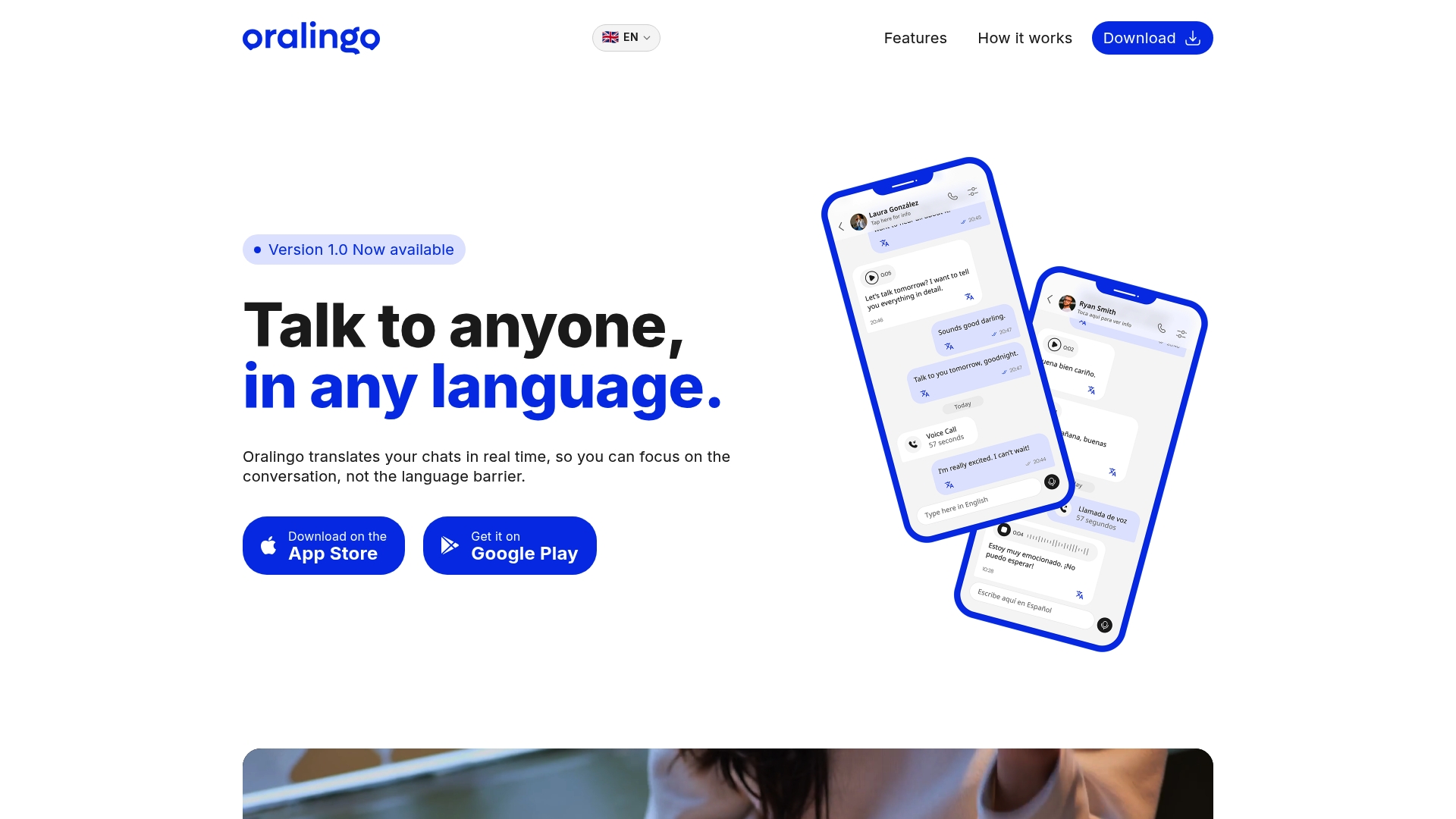
Oralingo supports over 100 languages with a 99% accuracy rate and keeps every conversation end-to-end encrypted. Whether you are coordinating with a grandparent overseas, chatting in a family group, or just trying to stay close across a language gap, Oralingo makes it easy to talk to anyone in any language. The hands-free voice mode means you do not even need to type. Just talk, and let the conversation flow.
FAQ
What is receptive bilingualism in children?
Receptive bilingualism means a child understands a language but does not actively speak it. It is a normal phase in multilingual development, not a sign of failure or delay.
Why do multilingual children refuse to speak the minority language?
Language refusal is usually driven by social belonging and identity, not inability. Children speak the language that feels most useful and safe in their current social environment.
How can multilingual families get better healthcare communication?
Families should request a professional interpreter at every medical appointment rather than relying on family members or machine translation. Professional interpreters act as cultural mediators, not just translators, which improves both safety and trust.
Does raising children with multiple languages cause confusion or delays?
Decades of research show that bilingualism does not cause developmental delays. Temporary language mixing is normal and resolves as children develop stronger command of each language.
What is the best way to support multilingual children at school?
Parents can advocate for bilingual resources, communicate the child's language background to teachers, and build minority language routines at home through low-pressure activities like reading, cooking, and family calls.