
BLUF: The most common expat communication mistakes are assuming "yes" means agreement, over-apologizing instead of clarifying, leaning on literal translation for serious matters, and rambling in meetings instead of structuring updates. Fix them with short scripts, written confirmations, and a translation tool built for real conversation, not just single words.
Here's the fast list. Each one has a one-line fix you can use today.
- Assuming "yes" means "yes" — Ask a follow-up question that requires a specific answer, not a nod.
- Over-apologizing for accents or delays — Swap "sorry" for a direct request with a deadline.
- Rambling in meetings — Cap your update at 60 to 90 seconds using a simple structure.
- Trusting literal translation for anything official — Verify with a written copy or a certified interpreter.
- Reading silence as agreement — Pause and invite a direct response before moving on.
- Copying local body language too fast — Watch first, mirror slowly, and confirm through words too.
- Making a joke that doesn't land — Skip humor until you know the local comfort zone.
- Assuming shared references — Explain the reference instead of assuming everyone gets it.
Cultural differences in directness and decision-making explain most of these misfires, and short, structured updates reduce confusion in mixed-culture workplaces. A tool like Oralingo, which translates messages before they display and supports over 100 languages, helps close the gap while you build these habits.
Key Takeaways
Most expat communication failures come from assuming shared meaning where none exists, and the fix is almost always a short script, a written confirmation, or a direct clarifying question.
| Point | Details |
|---|---|
| Structure your updates | Cap meeting updates at 60 to 90 seconds using a yesterday, today, blocker format. |
| Confirm in writing | Send a short recap email after any verbal agreement, naming owner and deadline. |
| Verify high-stakes translation | Use certified interpreters for contracts, health, and official appointments, not literal translation alone. |
| Watch before you mirror | Observe local body language and personal space norms before adopting them yourself. |
| Ask instead of assuming | Flag unfamiliar idioms, humor, or references directly rather than nodding along. |
Table of Contents
- Common Expat Mistakes in Local Communication, Explained
- How to Handle High-Stakes Appointments Without Getting Burned
- Daily Habits and Tools That Cut Down on Mistakes
- Your Pre-Meeting Checklist
- Why Idioms and Slang Trip Up Even Confident Speakers
- Why Humor Doesn't Always Translate
- A Small Mistake That Taught a Big Lesson
- Sources
Common Expat Mistakes in Local Communication, Explained
Knowing the list matters less than knowing why each mistake happens and what to say instead. Here's the breakdown, mistake by mistake, with a script you can use the next time it comes up.
-
Misreading direct versus indirect styles. Some cultures say what they mean bluntly. Others wrap requests in context and expect you to read between the lines. If a colleague says "that could be difficult" instead of "no," you're dealing with an indirect style, and pushing harder will backfire. Cultural patterns around directness, silence, and disclosure shape how people push back, agree, or say no without ever using the word. The fix: when you're unsure which style you're facing, ask a clarifying question. "Does that mean it's not possible, or does it need adjustment?" gets you further than repeating your original ask louder.
-
Staying quiet in meetings when you should speak up. Many expats hold back because they don't want to interrupt or sound unprepared in a second language. That silence often gets read as disengagement. Use a simple structure: what you did, what you're doing now, and where you're stuck, delivered in 60 to 90 seconds. It's short enough that a language barrier won't derail it and clear enough that nobody has to guess your point.
-
Hearing feedback as personal criticism. Direct feedback in a new culture can sting more than it's meant to. Feedback lands better when you affirm the relationship before delivering the substance: "I appreciate how you handled the client call. One thing to adjust next time is the pricing detail." That order matters more than the words themselves.
-
Sending vague requests padded with apologies. "Sorry to bother you, but maybe when you have time, could you possibly look at this?" buries the actual ask. Replace it with a direct one: "Can you review the draft by Thursday at noon? I'll need your notes to finalize it." Name the owner and the deadline every time.
-
Trusting literal translation for anything that matters. Machine or word-for-word translation works fine for small talk, but it drops nuance, tone, and legal specifics fast. If the stakes are high, verify in writing and escalate to a professional when the topic touches contracts, health, or official paperwork.
-
Missing body language cues. Personal space, eye contact, and gesture norms vary more than most expats expect, and common faux pas around gestures and space are an easy way to cause unintended offense. Watch before you act, mirror gradually, and let locals set the pace rather than importing your home country's habits.
-
Skipping written confirmation. Verbal agreements get remembered differently by everyone in the room. Send a short recap after any decision: "Confirming what we agreed: you'll send the contract by Friday, and I'll respond within 48 hours." It takes thirty seconds and prevents weeks of confusion.
Pro Tip: Keep a folder of these scripts in your phone's notes app. When a tense moment hits, you won't be composing a diplomatic sentence from scratch under pressure.
How to Handle High-Stakes Appointments Without Getting Burned
Contracts, medical visits, and government appointments are where a language slip actually costs money or health, and language barrier challenges at local services highlight why written information paired with a certified interpreter beats improvising every time.
Before you go:
- Write down the key facts you need to convey (symptoms, dates, amounts, prior history).
- List your questions in advance so nerves don't erase them mid-conversation.
- Bring copies of any relevant documents, translated if possible.
During and after:
- Ask directly for written confirmation of anything agreed verbally.
- Request copies of every form you sign or receive.
- For legal or medical matters, ask whether a certified interpreter is available. Don't rely on a friend or app alone.
- Send a short follow-up message afterward: "Confirming what we discussed today: [summary]. Please let me know if I misunderstood anything." That single email catches errors before they become expensive.
Daily Habits and Tools That Cut Down on Mistakes
Small, consistent practice beats occasional cramming. A personal phrase kit and short daily practice build the kind of confidence that gets you through unscripted moments.
- Run a 10 to 15 minute role play each day covering a task you'll actually face, like a banking call or a landlord conversation.
- Keep a phrase bank for recurring systems: banking terms, health forms, housing vocabulary.
- Practice the "yesterday, today, blocker" update format until it's automatic, not something you have to translate in your head first.
- Save an emergency card with your address, allergies, and emergency contact in both languages.
Translation apps help, but only if you use them with judgment. Skip humor and slang when translating, since both lose meaning fast, and double-check anything formal against a second source. How translation apps handle real conversations varies a lot depending on the tool.
This is where Oralingo fits into the routine. It translates messages before they display, so the conversation flows without the stop-and-start feeling of copying text into a separate app. The hands-free voice mode lets you speak naturally in a call or in person, and support for over 100 languages covers most situations an expat runs into, from grocery store small talk to a landlord negotiation. Every conversation is end-to-end encrypted, which matters if you're discussing anything personal, medical, or financial. Try it for a quick low-stakes chat first, like scheduling a repair, before leaning on it for anything formal.
Pro Tip: Test any translation tool on a low-stakes conversation before you trust it for something important. You'll learn its quirks without any real risk.
Your Pre-Meeting Checklist
Stop: over-apologizing, rambling past 90 seconds, assuming a nod means agreement.
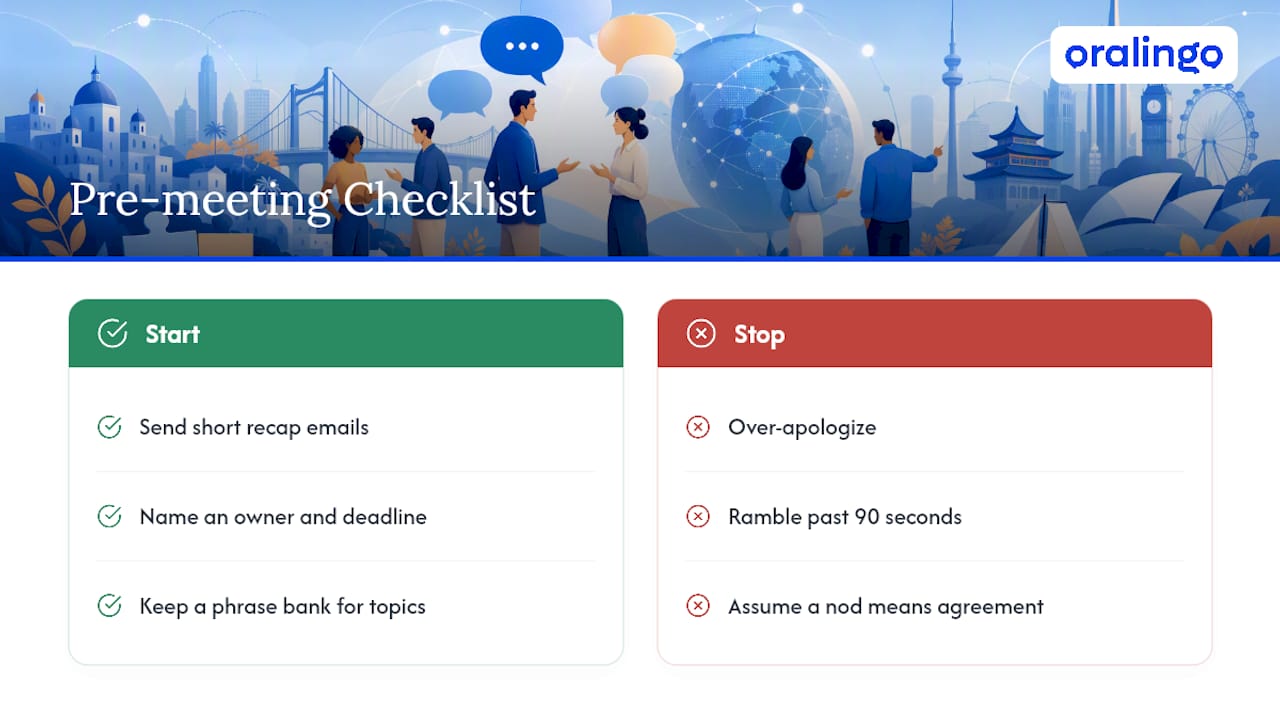
Start: sending short recap emails, naming an owner and deadline on every request, keeping a phrase bank for recurring topics.
One-line template: "Confirming what we agreed: [action], owned by [name], due [date]. Let me know if I got anything wrong."
Why Idioms and Slang Trip Up Even Confident Speakers
Fluent grammar doesn't protect you from idioms. "Break a leg," "under the weather," or a regional slang term can leave you nodding along to something you don't understand at all, and locals rarely stop to explain since the phrase feels obvious to them. This is one of the more common expat language barriers because textbooks teach vocabulary, not the shortcuts native speakers actually use.

The fix isn't memorizing every idiom in advance, since that list never ends. Instead, flag confusion the moment it happens: "That's a new expression for me, what does it mean?" Most people are happy to explain, and asking signals genuine interest rather than ignorance. Keep a running note of phrases you hear repeatedly at work or in your neighborhood, since local slang tends to repeat in the same contexts: the same three phrases at the pharmacy, the same handful at the office. Over a few months, that short list covers most of what you'll actually encounter.
Regional variation adds another layer. An expression common in one city might sound dated or confusing two hours away. When in doubt, ask a colleague who grew up locally rather than guessing from an app's dictionary entry, since slang shifts faster than any translation database can track.
Why Humor Doesn't Always Translate
A joke that kills at home can fall flat, confuse, or even offend somewhere new, and sarcasm is the riskiest form of all. Sarcasm depends on tone, timing, and shared cultural context to signal "I don't mean this literally." Strip away that shared context, and the listener hears only the literal words, which can sound rude or bizarre out of nowhere.
Self-deprecating humor travels a little better than sarcasm in most places, but even that has limits. Some cultures read it as oversharing or as fishing for reassurance rather than as lighthearted honesty. The safest approach when you're new somewhere: hold off on jokes with people you don't know well yet, and pay attention to what locals joke about with each other before testing your own material. Once you've watched a few exchanges, you'll have a much better sense of where the line sits.
If a joke does fall flat, don't overexplain it. A quick "guess that one didn't translate" and moving on works better than a long defense of why it was actually funny. Humor recovers fast when you don't dwell on the miss.
A Small Mistake That Taught a Big Lesson
A common cross-cultural misstep, like asking a question that seems harmless at home but lands as intrusive abroad, tends to repeat until someone corrects it directly. One fix that works: after any awkward moment, ask a local friend or colleague what went wrong instead of guessing. That single habit, asking rather than assuming, does more to prevent repeat mistakes than any phrasebook. Start there. Ask more, assume less, and confirm in writing when it counts.
— Poul
Sources
You mention a childhood TV show, a political event, or a brand name assuming everyone in the room knows it, and you get blank stares. This happens constantly to expats because so much of casual conversation runs on cultural shorthand: references to shows, historical moments, or common sayings that feel universal but aren't.
The confusion usually isn't obvious in the moment. People tend to nod rather than admit they missed the reference, which means you can walk away from a conversation thinking you connected when you actually lost half the room. Build the habit of a one-sentence explanation whenever you reference something outside pure current events: "It's like a show from my country about a family running a hotel," rather than just the title. It takes five extra seconds and prevents a quiet gap in understanding that neither side notices until later.
The same applies in reverse. When a local reference goes over your head, ask about it rather than laughing along. That curiosity often opens up better conversations than the original comment would have, and it builds the kind of cultural fluency that no phrasebook teaches.
- How to respect cultural differences in crucial conversations — Crucial Learning
- Cross-cultural communication patterns — PBS
- Workplace communication abroad: meetings, emails, chat, and feedback for expats — Abblino
- How to handle language barriers when abroad — ExpatsWorld