
You can start building friendships today without fluent language by joining a recurring activity, attending a language exchange, using a translation app in voice mode, asking one follow-up question, and inviting someone to a low-effort repeat meetup. No fluency required. Just start.
Do these five things today:
- Join a recurring activity (sports club, art class, co-working space) that meets weekly so you see the same faces without forcing conversation.
- Find a language exchange in your area or online where the structure does the social work for you.
- Turn on voice mode in a real-time translation app so you can speak naturally without stopping to type.
- Ask one follow-up question after any interaction, even just "Same time next week?" in the local language.
- Send a short message within 24 hours of meeting someone new to confirm their name and suggest a next step.
Try this for one week. You will have at least one new contact and probably one real conversation.
Table of Contents
- How do you make friends abroad without a shared language?
- How do you turn a one-time meeting into a real friendship?
- Can learning together speed up social bonding?
- What cultural etiquette and safety basics should you know?
- How long does it take to make friends abroad, and what does it cost?
- Why do these tactics work, and how do you use a translation app effectively?
- Key Takeaways
- What actually works when you arrive knowing no one
- Oralingo keeps the conversation going when words fall short
- Useful sources
How do you make friends abroad without a shared language?
The three fastest techniques are nonverbal warmth, a translation aid in voice mode, and a handful of micro-phrases. Together, they lower the barrier on first contact so much that language stops being the obstacle.
Nonverbal signals that reliably communicate friendliness:
- Smile with your eyes, not just your mouth. A genuine smile is recognized across cultures.
- Keep your posture open: arms uncrossed, body angled toward the person, no phone in hand.
- Mirror the other person's pace and energy. If they speak quietly, match it.
- Nod slowly when they speak. It signals you are listening, even when you understand nothing.
Universal micro-phrases worth learning in the local language:
- "Hello / Good morning" (always)
- "Thank you" (use it constantly)
- "Sorry, my [language] is not good yet"
- "Want coffee?" or "Want to join us?"
- "Same team?" (for sports or group activities)
- "What is that called?" (points to something nearby)
These six phrases cover a surprising number of first-contact moments. Research on overcoming language barriers in structured settings confirms that short sentences and checking understanding reduce friction and improve outcomes. The same principle applies at a pickup basketball game or a community art class.
Two ultra-short example scripts:
Social setting (café or co-working space): Smile, point to the empty chair, say "OK?" Wait for a nod. Sit. After a few minutes, hold up your phone showing a translated message: "I just moved here. Still learning the language. Nice to meet you." Then say their name back to them when they introduce themselves.
Activity-based setting (sports or class): Make eye contact, give a thumbs-up after a good play or a shared task, say "Good!" in the local language. After the session, say "Same next week?" with a questioning look. That one question creates a follow-up without any pressure.

For a deeper look at communicating with locals without speaking their language, the same nonverbal-first approach works across dozens of cultural contexts.
Pro Tip: Ask a question that only needs a yes or no answer. "Same time Thursday?" is easier to answer than "Would you like to meet again sometime?" The simpler the ask, the lower the social risk for both of you.
How do you turn a one-time meeting into a real friendship?
The answer is manufactured repetition. Friendship is a repetition project: proximity and recurring contact are what turn a pleasant stranger into someone you actually know. The follow-up is where most people drop the ball.
Step-by-step checklist for the 48 hours after meeting someone:
- Confirm their name before you leave. Repeat it once in conversation so it sticks.
- Send a short message within 24 hours. Keep it simple: "Great to meet you at [activity] today. I'm [name]."
- Suggest one specific low-effort next step. Not "let's hang out sometime" but "Are you going again Thursday?"
- Show up consistently to the recurring activity for at least four weeks. Consistency signals reliability.
- Escalate slowly. Coffee after class is the natural next step before a full evening out.
Message templates:
New acquaintance (after a class or club): "Hi, it's [name] from [activity]. Good to meet you. Are you coming back next week?"
Activity partner (after a few sessions): "Hey, a few of us are grabbing coffee after class on Thursday. Want to join?"
Translated voice message: Record a short audio message in your language, let the app translate it before sending. Keep it under 15 seconds. Tone carries even across languages.
Low-stakes invitation scripts:
- "Coffee after?" (said right after the activity ends, no planning required)
- "I found a good place nearby. Want to check it out Saturday morning?"
- "There's a group meetup at [venue] on Friday. Come if you're free."
Short, specific, low-commitment. That combination gets a yes far more often than an open-ended invitation.
Can learning together speed up social bonding?
Yes, and it works faster than most people expect. Language tandems and structured exchange formats create a predictable framework that reduces pressure and accelerates both language practice and social bonding. Doing a tandem twice weekly is enough to feel a real shift within a month.
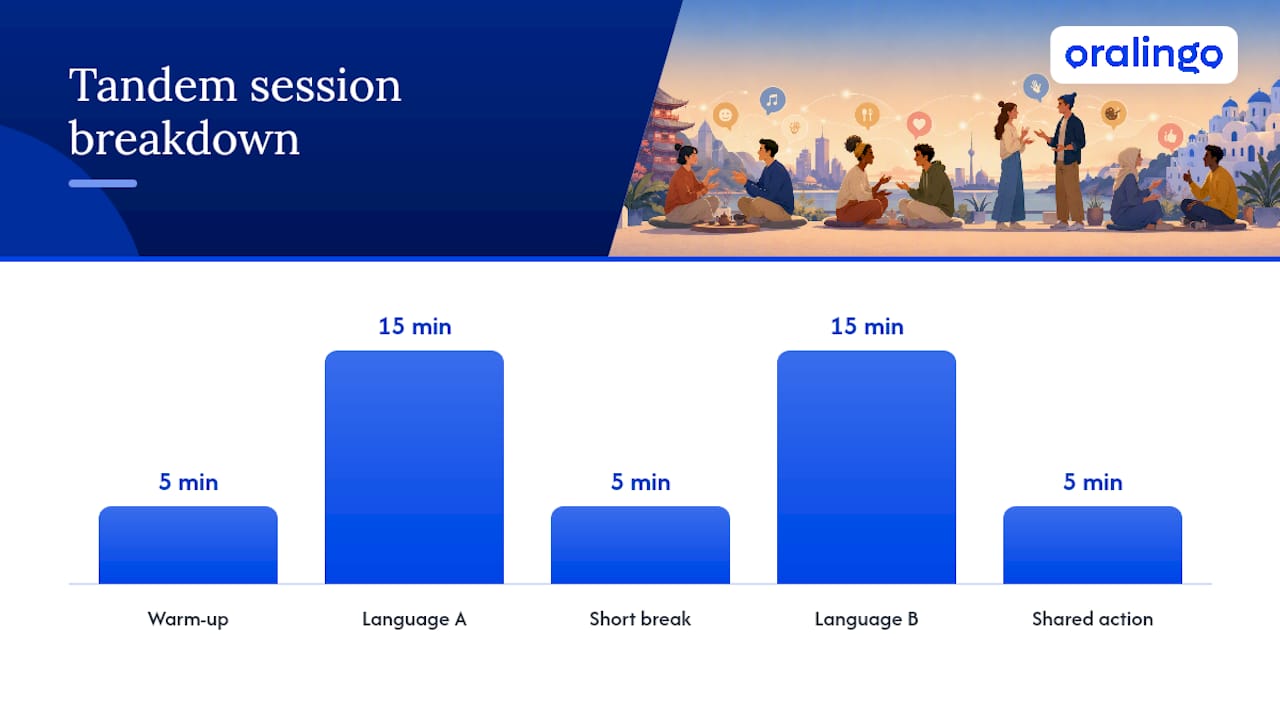
How to structure a tandem session:
A tandem works on reciprocity: you spend equal time in each person's target language. A clean 30/30 split keeps it fair and removes the awkwardness of one person always struggling.
Example 45-minute session plan:
- 0–5 min: Warm-up. Greet each other in both languages. Share one thing that happened this week. No corrections yet.
- 5–20 min: Language A (your partner's language). You speak, they gently correct. Use a simple prompt: "Tell me about your favorite place in this city."
- 20–25 min: Short break. Grab a drink, switch seats, relax.
- 25–40 min: Language B (your language). Your partner speaks, you correct. Use the same prompt so you can compare answers.
- 40–45 min: Shared action. Pick one word or phrase you both want to remember. Write it down together. This small ritual creates a shared memory.
Rules that make tandems work:
- Correct gently, not constantly. One or two corrections per session is enough.
- Use translation tools to check a word, not to replace speaking. The goal is practice, not perfect output.
- Set a recurring calendar invite so neither person has to re-negotiate the time each week.
Pro Tip: Keep a shared note (Google Docs or a paper notebook you both write in) with new words and inside jokes from each session. That note becomes a record of your friendship, not just your language progress.
For running mixed-language sessions with more than two people, the same structure scales well. See how study groups communicate across languages for a practical group format.
What cultural etiquette and safety basics should you know?
Observe first, act second. Before approaching anyone in a new cultural context, spend five minutes watching how locals greet each other, how close they stand, and whether they make sustained eye contact. Those three signals alone will tell you most of what you need to know.
Dos and don'ts for cross-cultural contact:
- Do default to formal address (titles, last names) until invited to use first names.
- Do ask permission before taking photos or touching someone's belongings.
- Do match the energy of the group. Loud and enthusiastic works in some cultures; quiet and measured works in others.
- Don't assume direct eye contact is friendly everywhere. In some cultures, sustained eye contact reads as confrontational.
- Don't ask about salary, relationship status, or religion early. These are personal topics in most cultures.
- Don't interpret silence as rudeness. Many cultures use silence comfortably; filling it with nervous chatter can feel intrusive.
Safety checklist for meeting new people:
- Meet for the first time in a public place (café, park, co-working lobby).
- Tell a friend or housemate where you are going and when you expect to be back.
- Keep the first meeting short (30–60 minutes). A coffee is lower stakes than a dinner.
- Trust your instincts. If something feels off, it is fine to leave early.
Cultural observation prompts:
Watch how people in a group end conversations (handshake, hug, bow, nod?). Notice whether people arrive on time or whether lateness is normal. See whether people eat together or separately during breaks. These small details tell you how to fit in before you say a word.
For a fuller breakdown of travel language barrier dynamics, including cultural context for common misunderstandings, that guide covers the most frequent friction points by region.
How long does it take to make friends abroad, and what does it cost?
Expect your first friendly acquaintances within two to four weeks if you join a recurring activity immediately. Deeper friendships, the kind where you call each other without a reason, typically take three to twelve months depending on how often you see each other and how much effort you put into follow-ups.
About 50% of expats report significant loneliness during their first year abroad, and the research is clear: joining recurring group activities within your first two weeks meaningfully improves outcomes. Waiting a month to "settle in" before socializing is the single most common mistake.
| Metric | What the research shows |
|---|---|
| Loneliness in year one | About 50% of expats report significant loneliness in their first year |
| Recommended start window | Join recurring activities as soon as possible after arrival | | Timeline to acquaintances | Two to four weeks with consistent attendance | | Timeline to deeper friendship | Three to twelve months depending on frequency and follow-up | | Hybrid social circle benefit | Mixed local/expat networks reduce stress and improve life satisfaction |
Typical costs for recurring activities:
- Free: Volunteering, language exchange meetups, community sports leagues, university clubs (if enrolled)
- Low ($5–$20/week): Drop-in fitness classes, community art workshops, casual sports leagues
- Moderate ($50–$150/month): Co-working space membership, structured language classes, gym with group classes
Co-working memberships and weekly sports clubs offer the best return on that investment because they combine routine, proximity, and natural small-talk opportunities in one place.
Energy management for introverts:
- Schedule social activities on alternating days so you have recovery time.
- Choose activities with a clear end time so you know when you can leave.
- Set a weekly social goal (two interactions, not ten) and track it simply.
- Give yourself permission to skip one session without guilt. Consistency over months matters more than perfect attendance.
Why do these tactics work, and how do you use a translation app effectively?
The combination of recurring contact, shared activities, and small language investment produces the largest gains in connection. Three research frameworks explain why.
Acculturation theory (supported by Dr. Charlotte Russell's work) shows that newcomers who maintain parts of their original identity while adopting local practices report lower stress and higher satisfaction. A mixed social circle is not a compromise; it is the optimal strategy.
Third-space theory explains why co-working spaces and clubs outperform cold approaches: people linger, return on a schedule, and share a context that makes conversation natural. The approach is easier because the environment does part of the work.
Repetition and proximity are the core mechanics of friendship formation. Sociological research consistently shows that unplanned repeated contact, the kind that happens when you attend the same weekly event, is what converts acquaintances into friends. You cannot manufacture chemistry, but you can manufacture the conditions for it.
Ethical guidelines for using translation tools:
- Tell the person you are using a translation app. Most people find it charming, not off-putting.
- Use voice mode so the conversation flows rather than stopping to type.
- Let the app handle accuracy, but stay present in the conversation. Eye contact and body language still carry the emotional weight.
- Choose an app with end-to-end encryption so private conversations stay private.
- Avoid over-reliance: use the tool to start and sustain conversations, not to replace the effort of learning a few local phrases.
Oralingo features that fit social use:
- Hands-free voice mode: speak naturally during an ice-breaker or group activity without looking at a screen.
- Pre-delivery translation: your message is translated before it appears, so the conversation flows without awkward pauses.
- Tone and context preservation: the app keeps the warmth and intent of what you said, not just the literal words.
- End-to-end encryption: follow-up messages and personal conversations stay confidential.
- 100+ languages: covers most destinations without switching apps.
A brief workflow for introducing a translation app at a meetup:
Say (in simple English or with a gesture toward your phone): "My [language] is still learning. Can I use this?" Show them the app. Let them speak into it. When they see their words come back in your language accurately, the app becomes a shared tool, not a barrier. That moment of "oh, it works!" is itself an ice-breaker.
For more on how translation apps work in real conversations, including practical UX tips for live social settings, that guide covers the mechanics in plain terms.
Key Takeaways
Recurring contact, shared activities, and a simple follow-up habit are the three things that reliably turn strangers into friends when you don't share a language.
| Point | Details |
|---|---|
| Start early | About 50% of expats feel lonely in year one; joining recurring activities early cuts that risk. |
| Repetition builds friendship | Attend the same weekly event consistently; follow up within 24 hours of every new meeting. |
| Shared activity beats small talk | Sports, classes, and volunteering create bonds through action, not fluent conversation. |
| Hybrid social circle works best | Mix local and same-culture friends to reduce stress and accelerate adjustment. |
| Oralingo supports the process | Use Oralingo's hands-free voice mode and pre-delivery translation to keep conversations natural at meetups and in follow-up messages. |
What actually works when you arrive knowing no one
The conventional wisdom says "just put yourself out there." That advice is not wrong, but it is incomplete in a way that sets people up to feel like they failed. The real insight from the research is that context does most of the work, not courage.
Most people who successfully build friendships abroad did not do it by being unusually outgoing or by mastering the local language first. They did it by showing up to the same place, at the same time, week after week, until the repetition made connection almost inevitable. The awkward silences got shorter. The shared jokes got more specific. The language gap shrank because both sides were motivated to close it.
What surprises most people is how little language you actually need in the first month. A smile, a thumbs-up, "same time Thursday?" and a translated follow-up message will carry you further than six months of grammar study. The emotional honesty of showing up consistently communicates more than vocabulary ever could.
One unexpected lesson: small rituals matter enormously. Grabbing coffee after the same weekly class, writing new words in a shared notebook during a tandem, texting a photo of something funny you both saw at the market. These tiny repeated moments are what friendship is actually made of, in any language.
Start with one recurring activity this week. Follow up once. Show up again. That is the whole plan.
Oralingo keeps the conversation going when words fall short
Real-time translation changes what's possible in those first conversations abroad. Oralingo translates your messages before they appear, so the exchange feels natural rather than halting. You focus on the person in front of you, not on finding the right word.
For social use specifically, Oralingo's hands-free voice mode means you can speak during a group activity or a walk without stopping to type. The app preserves tone and context so a warm message arrives warm, not clinical. And because every conversation is end-to-end encrypted, your follow-up messages and personal exchanges stay between you and the person you're getting to know.
Use it to break the ice at a meetup, send a natural follow-up after a tandem session, or just say "same time next week?" in someone's language without rehearsing it for ten minutes first. It supports over 100 languages, so it travels with you wherever you go.
Download Oralingo and try the free tier at your next meetup. Test voice mode once. You'll see immediately how much easier the first conversation becomes.
Useful sources
-
How to make friends in a new city — The Travel Psychologist: Dr. Charlotte Russell's acculturation framework explaining why a mixed social network reduces stress and improves life satisfaction for newcomers.
-
How to Make Friends Abroad: Beating the Expat Loneliness Problem — WhereNext: Reports that around 50% of expats experience significant loneliness in year one and recommends joining recurring group activities within the first two weeks.
-
Make friends when you don't speak the language — FaceDragons: Practical third-space theory applied to friendship formation; argues that timing and context matter more than language fluency.
-
Building Friendships Abroad When Everyone Starts As A Stranger — Expat Network: Explains the repetition mechanics of friendship and why recurring activities and consistent follow-up are the core strategy.
-
Making Friends Abroad: Practical Guide — Study Abroad Blog: Covers language tandem formats, session structures, and how reciprocal exchange accelerates both language learning and social bonding.
-
Overcoming language barriers in healthcare — NCBI/PMC: Healthcare research on structured interpretation and plain-language techniques; the short-sentence and check-understanding principles transfer directly to social settings.
-
How to overcome language barriers: 6 effective strategies — InterExchange: Practical strategies including daily short practice and conversation groups that build social confidence faster than passive study.