
What is a travel language barrier, and why does it matter?
A travel language barrier is any communication difficulty that arises when you and a local don't share the same language, dialect, or cultural frame of reference. It's not just about missing vocabulary. It shows up in a Tokyo noodle shop when you can't read the menu, at a train station in Budapest when the departure board makes no sense, and in a pharmacy in Lisbon when you need to explain a medication. The gap between what you mean and what the other person understands can range from mildly awkward to genuinely stressful.
These barriers affect your trip in practical and emotional ways. Getting lost because you misread directions, accidentally ordering something you can't eat, or feeling isolated because you can't connect with anyone around you are all real consequences. Language barrier challenges in tourism extend beyond inconvenience, touching medical access, safety, and the depth of cultural experience you actually get.
Here's what a travel language barrier typically involves:
- Linguistic gaps: You don't speak the local language, or your proficiency is too limited for real conversation.
- Dialect and accent differences: Even within a single language, regional speech can be hard to follow.
- Cultural mismatches: Gestures, formality levels, and social norms vary widely and affect how communication lands.
- Jargon and slang: Informal or specialized language can confuse even fluent speakers.
- Emotional impact: Anxiety, frustration, and isolation are common when you can't communicate freely.
Cultural understanding sits alongside language as a core part of effective communication. You can know the words and still miss the meaning if you don't understand the context behind them.
What causes language barriers when you travel?
Language barriers don't have a single source. They come from several overlapping causes, and recognizing them helps you prepare for the right challenges.
Linguistic differences are the most obvious cause. If you speak only English and your host speaks only Mandarin, the gap is absolute. But even partial proficiency creates problems. You might understand written French reasonably well yet struggle completely with a fast-spoken Parisian accent. Proficiency is not binary.

Regional accents and dialects complicate things further. Spanish spoken in Mexico City sounds different from Spanish in Buenos Aires or Madrid. In Ireland, regional accents and dialects vary so much between counties that even native speakers sometimes struggle. If you've learned textbook Spanish, a thick Andalusian accent can feel like a different language entirely.
Cultural differences create barriers that go beyond words. In some cultures, saying "yes" signals politeness rather than agreement. In others, direct eye contact reads as confrontational. These perceptual gaps cause misunderstandings even when both parties technically share a language.
Jargon and slang trip up travelers constantly. The word "gas" in Ireland means "funny," not fuel. "Vacation" draws blank stares in many European countries where "holiday" is the standard term. Slang is hyper-local and shifts fast.
Common scenarios where these causes collide:
- Ordering food when the menu is in an unfamiliar script
- Asking for directions and receiving a rapid, accented response you can't follow
- Trying to explain a medical condition to a pharmacist or doctor
- Negotiating a taxi fare without a shared number system
- Checking into a guesthouse where no staff member speaks English
How to overcome language barriers before and during your trip
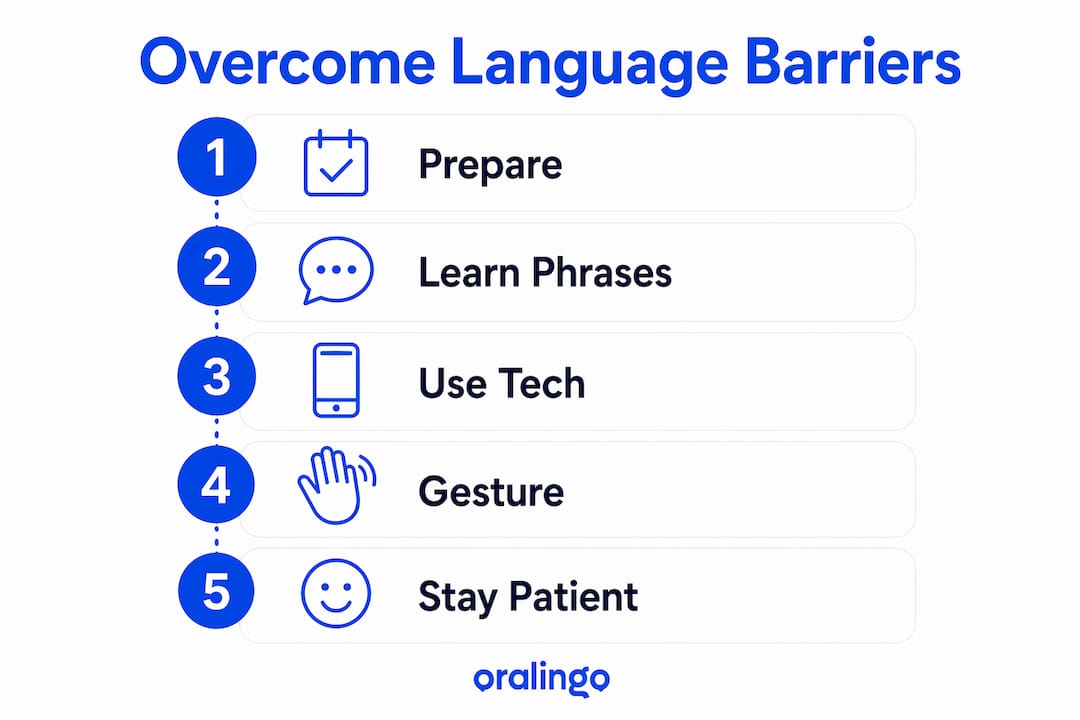
Preparation does most of the heavy lifting. The travelers who handle communication gaps best are the ones who put in an hour or two before they fly, not the ones who improvise everything on arrival.
Learn key phrases with real pronunciation. Knowing "merci" is useless if you say it wrong. Practice with a language app or audio guide so the sounds come out recognizable. Mispronunciation doesn't just cause confusion; it can accidentally offend. Saying "merci beaucoup" incorrectly, for instance, can produce something that sounds like a crude phrase to a native French speaker.
Prepare a phrasebook or phone notes for emergencies. Write out phrases for the situations that matter most: "I need a doctor," "I am allergic to nuts," "Where is the nearest hospital?" Save them as screenshots so they're accessible without a signal. This takes ten minutes and can matter enormously in a crisis.
Use gestural and non-verbal communication. Gestural communication is far more powerful than most travelers realize. ASL interpreter Anna Mindess, who has traveled extensively using hand-based communication, demonstrates this clearly: in a Beijing noodle shop, she pointed to a picture on the wall, outlined the size of bowl she wanted, shook her head at peppers, and nodded at garlic. The entire transaction worked without a single spoken word.
Simplify your speech. When speaking English with someone who learned it from a book, speak slowly and clearly, choose easy words, and drop contractions. "Do not" lands better than "don't." "I want water" is clearer than "Could I grab some water?"
- Start every interaction with a local greeting, even a clumsy one.
- Point at objects, pictures, or your phone screen when words fail.
- Carry a card with your medical information translated into the local language.
- Write down your destination address and show it rather than saying it.
- Learn numbers 1–20 in the local language; hand-gestured numbers vary by culture.
Pro Tip: Before you gesture, check whether that gesture is appropriate locally. A thumbs-up reads as an insult in parts of the Middle East and West Africa. An open hand or a nod is almost always safe.
How does technology help (and sometimes hurt) with language barriers?
Translation apps have genuinely changed what's possible for travelers. Google Translate covers more than 130 languages, works offline once you download the language pack, and includes a camera mode that reads menus and signs in real time. Download the language packs before you fly. Airport Wi-Fi is unreliable, and roaming data may not activate immediately.
Camera mode handles printed text well, including menus, transit signs, and supermarket labels. It struggles with handwritten or stylized signage. Speech translation works best for short, clear phrases in quiet environments. It fails in noisy markets, restaurants with background noise, or when you speak in long, complex sentences. The fix is simple: one idea, then pause. "Where is the bathroom?" translates well. A rambling, multi-clause question does not.
"Real-time translation tech has its uses, but it cannot replace the joy of making meaning in a new language." — Bernardette Holmes, MBE, multilingualism campaigner
That tension is real. A 2025 Preply poll found that one-third of Americans intentionally choose travel destinations to avoid foreign languages, nearly 25% resort to speaking "slower and louder" when abroad, which rarely helps, and 17% choose American fast-food chains overseas just to sidestep unfamiliar menus. Technology could address all of this, but only if travelers actually use it well.
The limitations of apps are real. Over-reliance on them removes the human element from communication and can open the door to misunderstandings. A phrase that looks correct on your screen may sound strange or even offensive when spoken aloud. For high-stakes situations like medical emergencies, legal issues, or payment disputes, double-check any translation before acting on it.
For ongoing conversations, real-time chat translation tools go further than standard apps by translating messages before they appear, keeping the conversation flowing naturally rather than stopping it for a lookup.
Key strengths and limits of translation technology:
- Strengths: Offline text translation, camera-based menu reading, voice input for simple phrases, wide language coverage
- Limits: Fails in noisy environments, struggles with accents and dialects, misses cultural nuance, removes human warmth from interaction
Practical tips for communicating abroad without speaking the local language
You don't need fluency to get through most travel situations. You need a small, well-chosen set of tools and the right attitude.

Start with a greeting in the local language. Five phrases handle the majority of social interactions: hello, please, thank you, excuse me, and "I don't speak [language]." Saying these in the local language signals respect and changes how people respond to you. The difference between a hostile and a helpful interaction often comes down to which language you open with.
Use simple, clear sentences. Avoid idioms, contractions, and slang. Travel writer Rick Steves advises travelers to use internationally understood words rather than American ones. Say "toilet" instead of "restroom." Say "holiday" instead of "vacation." These small swaps prevent blank stares and wasted minutes.
Point, show, and draw. Pointing at a menu item, showing a photo of your destination on your phone, or sketching a quick diagram on paper all work. Written text is more reliable than spoken language across most linguistic gaps. Hotel staff in many countries hand foreign guests a card with the hotel's name and address in the local language for exactly this reason.
Carry a translated medical card. If you have any health condition or allergy, carry a printed card that names it in the local language. Something like "I have a life-threatening nut allergy. Is this food safe?" takes two minutes to prepare and can prevent a serious situation.
Be patient and stay calm. Stress narrows your thinking and makes communication harder. When something goes wrong, stop, breathe, and use your phone. Tourist police exist in many countries, including Thailand, Greece, Turkey, and Egypt, and are trained to help foreign visitors. Large hotel concierges almost always have someone who can communicate in English.
- Ask "Do you speak English?" before launching into a question.
- If you don't understand, say "Slowly, please" in the local language.
- Confirm understanding by asking the same question two different ways.
- Never pretend to understand when you don't; it creates bigger problems later.
What experts say about communicating across language gaps
The most useful perspective on travel communication doesn't come from tech companies. It comes from people who have spent years navigating language gaps in real situations.
ASL interpreter Anna Mindess draws directly from Deaf community techniques for cross-cultural communication. At international Deaf conferences, attendees whose sign languages are mutually incomprehensible find ways to communicate through topic-comment structure, contrasting features, and physical demonstration. These techniques work for hearing travelers too. Establish the topic first with a gesture or a prop, then add the question. Mime "massage," wait for a nod, then rub your fingers together to ask about price. It's slower than talking, but it works.
Multilingualism campaigner Bernardette Holmes, MBE, makes a point worth sitting with: learning a language produces "stronger executive functioning, enhanced attentional control, greater cognitive flexibility and working memory." Translation apps are useful, she says, but they can't replicate that. The cognitive benefits of language learning are a reason to keep studying even when tech can handle the basics.
Expert tips for building better travel communication skills:
- Use Duolingo, Memrise, or Pimsleur to learn 30–50 words before a long trip.
- Practice pronunciation out loud, not just by reading silently.
- Watch local TV or listen to local music to tune your ear to the rhythm of a language.
- Learn numbers and food categories first; they come up constantly.
- Seek out multilingual traveler resources to build a communication plan before you fly.
For travelers who want real-time support during conversations, Oralingo translates messages instantly before they appear, covering over 100 languages with a 99% accuracy rate. Its hands-free voice mode means you can talk naturally without stopping to type, and every conversation stays end-to-end encrypted. You focus on the person in front of you. Oralingo handles the language. For AI-powered event discovery that works across language contexts, EventHound AI is worth exploring as a companion tool for international trips.
Oralingo makes every conversation easy, wherever you are
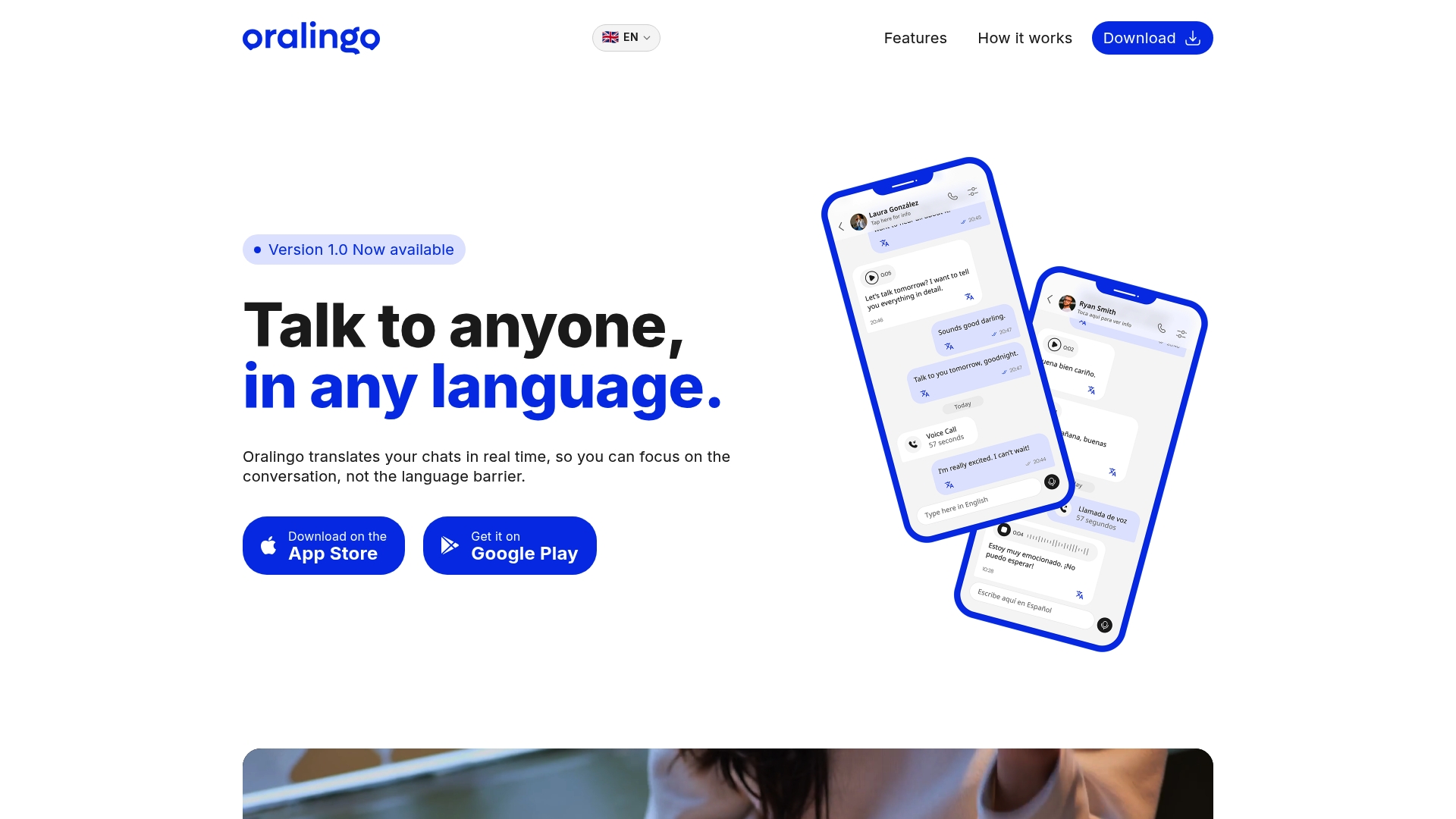
Language shouldn't stop you from connecting with people. Oralingo translates your chats in real time, before the message even appears, so conversations feel natural and uninterrupted. With support for over 100 languages, a 99% accuracy rate, and end-to-end encryption on every chat, you can talk to anyone, anywhere, with confidence.
Start talking with Oralingo today and leave the language barrier behind.
Key Takeaways
Overcoming a travel language barrier requires preparation, cultural awareness, and the right combination of human skill and technology.
| Point | Details |
|---|---|
| Prepare before you fly | Save emergency phrases, download offline language packs, and carry a translated medical card. |
| Gestures fill the gap | Non-verbal communication, drawing, and pointing work reliably when words fail. |
| Tech has real limits | Translation apps fail in noisy settings and with complex sentences; use them for short, clear phrases. |
| Simple English travels further | Avoid idioms and contractions; use "toilet" not "restroom," "holiday" not "vacation." |
| One-third avoid the challenge | A 2025 Preply poll found one-third of Americans choose destinations to sidestep foreign languages, nearly 25% rely on slow/loud speech abroad, and 17% choose American fast-food chains to avoid foreign menus. Preparation removes that need. |