
Language barriers in business are defined as any communication obstacle that prevents people from exchanging information clearly across different languages, dialects, or cultural frameworks. The four main categories are linguistic, cultural, technical, and organizational barriers. Each type creates distinct problems, and each requires a different fix. Deficient language skills cost the British economy nearly £50 billion annually, roughly 3.5% of GDP, while American businesses lose over £1.7 billion each year due to cultural and language misunderstandings. Those numbers show that the types of language barriers in business are not soft HR concerns. They are measurable financial risks.
1. Linguistic barriers: vocabulary, grammar, and pronunciation
Linguistic barriers are the most visible category of business communication challenges. They occur when people speak different languages, use different dialects, or apply grammar rules that shift meaning in ways the other person does not catch.
The most common linguistic friction points include:
- Vocabulary gaps: A word that means one thing in American English can mean something entirely different in British English or Australian English. "Table a proposal" means to postpone it in the US but to bring it forward in the UK.
- Grammar and syntax differences: Non-native speakers often omit articles or invert sentence structure, which can make a request sound blunt or confusing to native speakers.
- Idiomatic expressions: Phrases like "hit the ground running" or "circle back" are opaque to speakers who learned formal English but not its informal register.
- Jargon and technical vocabulary: Every industry has its own shorthand. When a finance team uses terms like "EBITDA normalization" with an operations team, comprehension drops fast.
Accent and pronunciation differences can hinder comprehension even among speakers of the same language. A strong regional accent in a video call can cause a listener to miss key details, not because the speaker lacks skill, but because the listener's ear is not calibrated to that sound pattern.
Pro Tip: Record a short sample of your team's written and spoken communication, then ask a colleague from a different region or country to flag any phrase they found unclear. You will find linguistic friction points faster than any formal audit.

2. Cultural and pragmatic barriers beyond words
Cultural barriers are the most underestimated category of language difficulties in teams. They operate beneath the surface of vocabulary and grammar, shaping how people signal agreement, express disagreement, and interpret silence.
The most common cultural friction points include:
- Direct versus indirect communication: American and German business cultures favor direct, explicit statements. Japanese, Korean, and many Middle Eastern cultures rely on implicit signals and context.
- Silence as a signal: In high-context cultures, silence after a proposal signals hesitation or disagreement, but in low-context cultures, silence is often read as consensus. That single misread can send a project in the wrong direction.
- Politeness norms: What reads as polite hedging in one culture reads as evasion or incompetence in another.
- Urgency signals: "As soon as possible" means different things in different cultures. In some contexts it means within the hour. In others it means within the week.
"Most perceived language barriers are actually culture barriers involving different frameworks of communication, such as how disagreement is expressed, silence interpreted, and urgency signaled. Even when a common language is spoken, cultural norms shape meanings; silence or agreement in meetings can mask dissent, leading to flawed assumptions and implementation failures."
The practical implication is clear. You cannot fix a cultural barrier with a grammar course. Employees with imperfect language proficiency can effectively participate through increased social interaction and socialization, rather than formal language training alone. Informal communication builds the shared context that makes cultural signals readable. For teams managing live multilingual negotiations, a real-time multilingual negotiation guide can help you prepare for exactly these cultural friction points.
3. Technical and company-specific language barriers
Technical barriers arise when domain-specific vocabulary creates confusion, even among fluent speakers of the same language. Law, medicine, finance, and IT each carry their own internal language. When those languages collide in a cross-functional team, communication breaks down fast.
The most common technical language friction points include:
- Specialized terminology: A legal team discussing "indemnification clauses" with a product team that has no legal background creates a comprehension gap that slows decisions.
- Acronyms and abbreviations: Company-specific jargon, acronyms, and technical terms create barriers even when employees share a common language, causing confusion for new or less familiar team members.
- Hybrid terminology: Global companies often create their own internal vocabulary, mixing English with local language terms or inventing new phrases. New employees, especially international hires, face a steep learning curve with no glossary to guide them.
Insufficient onboarding amplifies this problem. A new hire from Brazil joining a US tech company faces two simultaneous challenges: learning the company's internal acronyms and translating them into a second language. That double load slows productivity and increases error rates.
Pro Tip: Build a living glossary for your team. List every acronym, technical term, and internal phrase with a plain-language definition. Share it in your onboarding materials and update it quarterly. This single document reduces technical language friction faster than any training session.
4. Organizational and technological barriers in global teams
Organizational barriers are structural. They come from how companies are built and how they communicate internally, not from any individual's language ability.
The table below shows the most common organizational and technological barriers, along with their typical effects on teams.
| Barrier type | How it shows up | Effect on teams |
|---|---|---|
| Departmental silos | Different teams use different terminology for the same process | Misaligned decisions and duplicated work |
| Virtual platforms | Text-only channels strip out tone and nonverbal cues | Misinterpretations and perceived aggression |
| Asynchronous communication | Time zone gaps mean delayed clarification | Errors compound before anyone catches them |
| Language proficiency gaps | Managers and team members operate at different complexity levels | Key information gets lost or oversimplified |
| Platform language mismatch | Software interfaces in one language, team in another | Errors in data entry and process execution |
Text-only communication platforms increase the risk of passive-aggressive misinterpretations and employee disengagement due to the loss of tone and nonverbal cues. A message that reads as curt in Slack may have been written in a rush with no negative intent. The receiver, lacking any tonal context, reads hostility into it. That friction reduces morale and productivity but stays invisible until project delays make it visible.
Measuring linguistic compatibility between managers and team members can pinpoint bottlenecks and target training before delays occur. Reducing that gap improves project delivery and cuts misunderstandings at the source. For teams using digital tools to manage cross-language collaboration, resources on cross-language brainstorming offer practical frameworks for structuring those interactions.
5. The "Silence Syndrome" and policy-driven barriers
One of the least discussed types of communication barriers is the one created by the company itself. Enforcing English-only corporate language policies can backfire by causing employee silence and reduced knowledge sharing, a phenomenon researchers call the "Silence Syndrome."
The Silence Syndrome works like this. A company mandates English as the corporate language to create consistency. Employees who are not fully confident in English start to self-censor. They stop raising concerns in meetings. They avoid asking clarifying questions. They skip informal conversations where critical knowledge gets shared. The policy intended to reduce language barriers ends up creating a deeper one.
The fix is not to abandon a shared corporate language. It is to pair that policy with active socialization mechanisms: informal team channels, buddy systems, and low-stakes conversation opportunities where employees can build confidence without fear of judgment. Language diversity in business is a resource when managed well. It becomes a liability only when the organizational structure suppresses it.
6. Comparison of language barrier types and targeted interventions
Understanding which type of barrier you face determines which intervention actually works. Training a team on grammar will not fix a cultural misread. Deploying a translation tool will not resolve a policy-driven silence problem.
| Barrier type | Common example | Best intervention |
|---|---|---|
| Linguistic | Vocabulary gaps, accent misunderstandings | Language training, plain-language writing guides |
| Cultural | Silence misread as agreement, indirect refusals | Cross-cultural communication workshops, socialization |
| Technical | Acronyms, domain jargon, hybrid terminology | Team glossaries, structured onboarding |
| Organizational | Silos, text-only platforms, proficiency gaps | Linguistic compatibility audits, real-time translation tools |
| Policy-driven | Silence Syndrome from English-only mandates | Informal communication channels, socialization programs |
Identifying the barrier type precisely also improves training ROI. A company spending budget on language courses for a team that actually has a cultural communication problem will see little return. Matching the intervention to the barrier type is the most cost-effective approach to overcoming language barriers in any organization.
For written communication specifically, tools that translate business emails in real time can close linguistic and technical gaps without requiring formal training cycles. A business email translation guide covers the practical steps for doing this at scale.
Key takeaways
The most effective approach to overcoming language barriers in business is to identify the specific barrier type first, then apply the intervention matched to that category.
| Point | Details |
|---|---|
| Four core barrier types | Linguistic, cultural, technical, and organizational barriers each require a different solution. |
| Cultural barriers run deeper | Silence, urgency signals, and indirect communication cause more hidden damage than vocabulary gaps. |
| Policy can create barriers | English-only mandates trigger the Silence Syndrome, reducing knowledge sharing across teams. |
| Measure linguistic compatibility | Auditing the gap between manager and team language complexity prevents costly project delays. |
| Match intervention to barrier | Training, glossaries, socialization, and translation tools each target a different barrier type. |
Why language barriers persist even when everyone speaks English
I have worked with multinational teams where every person spoke English fluently, and communication still failed regularly. The reason was never vocabulary. It was always the invisible layer underneath: the assumptions each person brought about what a nod means, what silence signals, or what "we'll look into it" actually commits to.
The business world has spent decades treating language barriers as a language proficiency problem. Buy a course, pass a test, problem solved. That framing misses the point entirely. Businesses often mistake language proficiency as the only key to effective collaboration, overlooking the role of social interaction and informal communication. The teams I have seen communicate best across languages are not the ones with the highest test scores. They are the ones that created space for informal connection, where people could ask "wait, what did you mean by that?" without it feeling like an admission of failure.
The other thing most articles get wrong is the direction of the problem. Companies focus on getting non-native speakers up to speed. The more productive question is whether the native speakers are communicating clearly. Plain language, shorter sentences, and fewer idioms benefit everyone. They are not a concession to lower proficiency. They are a sign of professional discipline.
Language diversity in business is a genuine competitive advantage when you treat it as one. The teams that get this right do not just avoid miscommunication. They access a wider range of perspectives, catch more blind spots, and build stronger client relationships across borders. The barrier is real. So is the opportunity on the other side of it.
— Poul
How Oralingo helps your team communicate across languages
Real-time translation changes the equation for multilingual business teams. Oralingo translates messages instantly before they are displayed, so your team reads every message in their own language without any delay or interruption.
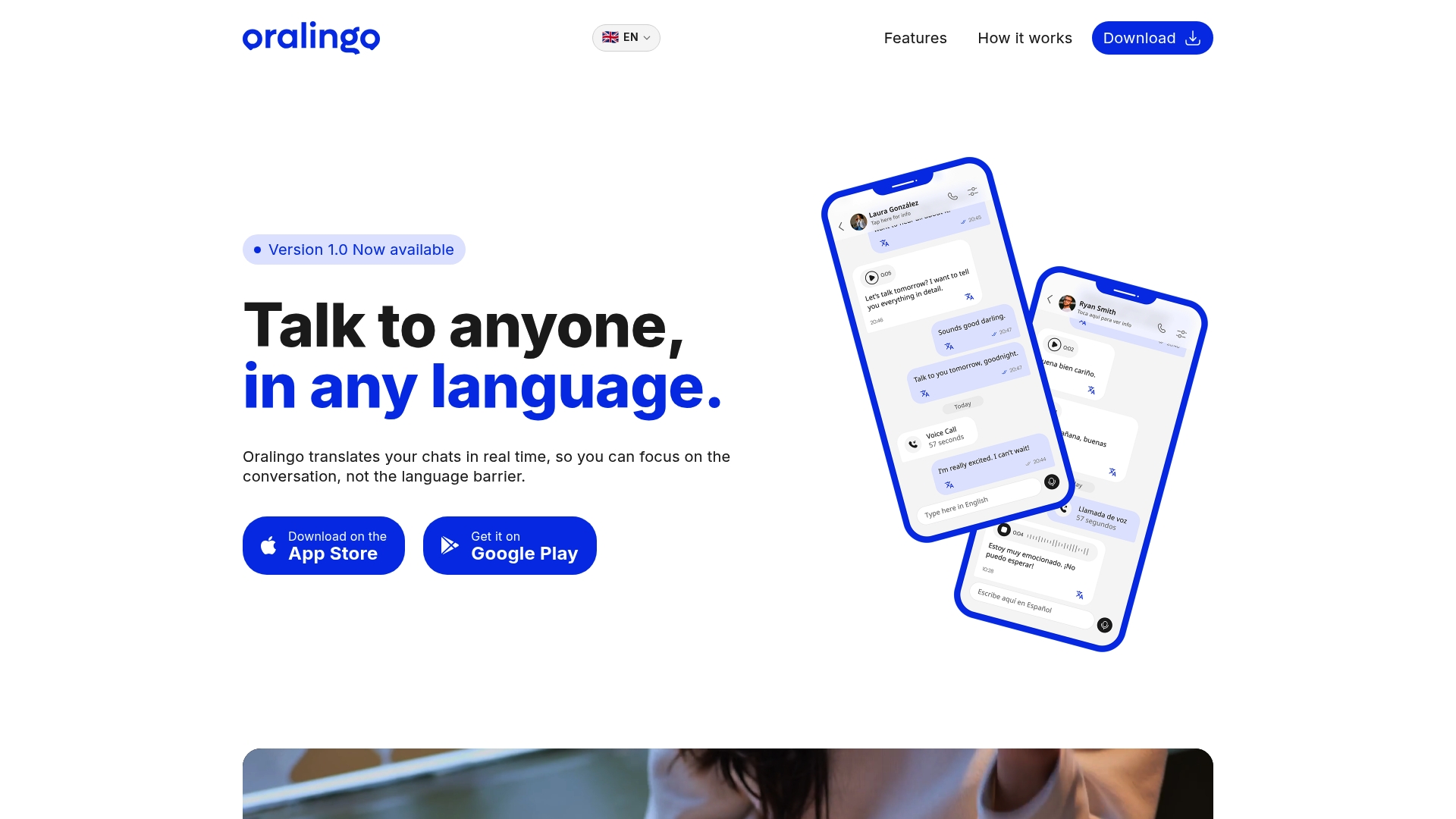
Oralingo supports over 100 languages with a 99% accuracy rate, and its hands-free voice mode means your team can talk naturally without stopping to type translations. Every conversation is end-to-end encrypted, so sensitive business discussions stay private. Whether your team is spread across five countries or you are closing a deal with a client who speaks a different language, Oralingo keeps the conversation moving. Talk to anyone, in any language and focus on the work, not the words.
FAQ
What are the main types of language barriers in business?
The four main types are linguistic barriers (vocabulary, grammar, accent), cultural barriers (communication styles, silence, indirect speech), technical barriers (jargon, acronyms, domain terminology), and organizational barriers (silos, text-only platforms, policy-driven silence).
How do cultural barriers differ from linguistic barriers?
Linguistic barriers involve the mechanics of language, such as vocabulary and grammar. Cultural barriers involve the unspoken rules of communication, including how silence, disagreement, and urgency are expressed, which can cause misunderstandings even when everyone speaks the same language fluently.
What is the Silence Syndrome in business communication?
The Silence Syndrome occurs when English-only corporate language policies cause employees with lower language confidence to stop sharing knowledge and raising concerns. The policy intended to create consistency instead reduces communication and hides critical information.
How can businesses measure language barriers in their teams?
Businesses can assess linguistic compatibility by auditing the gap between manager and team member language complexity. Reducing this gap through targeted training or plain-language guidelines improves project delivery and cuts misunderstandings.
Do translation tools solve all types of language barriers?
Translation tools effectively address linguistic barriers, especially in written and real-time communication. They do not resolve cultural or policy-driven barriers, which require socialization programs, cross-cultural training, and changes to how teams communicate informally.