
Cross-cultural communication barriers are the specific obstacles that arise when people from different cultural backgrounds try to exchange information, even when they share a common language. Researcher LaRay Barna identified six primary stumbling blocks that explain why these breakdowns happen so consistently: language differences, nonverbal misinterpretations, assumption of similarity, preconceptions and stereotypes, tendency to evaluate, and high anxiety. Each one can derail a conversation on its own. Together, they create real friction in international business meetings, multilingual team chats, and everyday cross-cultural dialogue.
Here is a quick look at all six:
- Language differences — vocabulary, idioms, and syntax that don't translate cleanly
- Nonverbal misinterpretations — gestures, eye contact, and facial expressions read differently across cultures
- Assumption of similarity — expecting others to think and communicate the way you do
- Preconceptions and stereotypes — judging someone's message through a cultural filter before they finish speaking
- Tendency to evaluate — measuring another culture's communication style against your own as the standard
- High anxiety — emotional stress that makes every other barrier worse
Table of Contents
- What are the main types of cross-cultural communication barriers?
- How do cultural differences shape the way people communicate?
- How does linguistic prejudice hurt team communication?
- What are the most effective strategies for overcoming these barriers?
- Why does cultural awareness training actually matter?
- Real-world cases where communication barriers caused serious problems
- Key Takeaways
What are the main types of cross-cultural communication barriers?
Each of Barna's six stumbling blocks shows up differently in real conversations, and recognizing them is the first step to getting past them.
- Language differences go deeper than vocabulary. Even when everyone on a global team speaks English, language barriers regularly affect international collaboration for 72% of professionals surveyed across 28 countries. Idioms, humor, and indirect phrasing create gaps that a dictionary can't close. Understanding the full scope of these gaps is covered in detail in this guide to types of language barriers in business.
- Nonverbal misinterpretations are surprisingly common. A thumbs-up is friendly in the U.S. but offensive in parts of the Middle East. Sustained eye contact signals confidence in Western cultures but can feel aggressive in many East Asian contexts. These silent signals carry enormous weight.
- Assumption of similarity is a quiet trap. You assume your colleague shares your communication norms, so you don't explain your expectations. They assume the same. Nobody flags the mismatch until something goes wrong.
- Preconceptions and stereotypes cause you to interpret someone's message based on what you expect from their culture, not what they actually said. That mental shortcut blocks genuine understanding.
- Tendency to evaluate means judging another person's communication style as rude, aggressive, or evasive, when it is simply different. Assuming your own style is the right one leads directly to conflict.
- High anxiety compounds everything. When people feel uncertain or out of their depth in a cross-cultural exchange, that stress triggers and worsens every other stumbling block on this list.
How do cultural differences shape the way people communicate?
Beyond Barna's framework, broader cultural patterns create their own communication challenges. Understanding these patterns helps you read situations more accurately.
High-context vs. low-context cultures is one of the most practical distinctions you can learn. In low-context cultures like the U.S. and Germany, people say what they mean directly. In high-context cultures like Japan and France, meaning is embedded in tone, context, and relationship history. A Japanese colleague's polite non-answer may actually be a firm "no." A French counterpart's formal manner isn't coldness; it's professional respect.
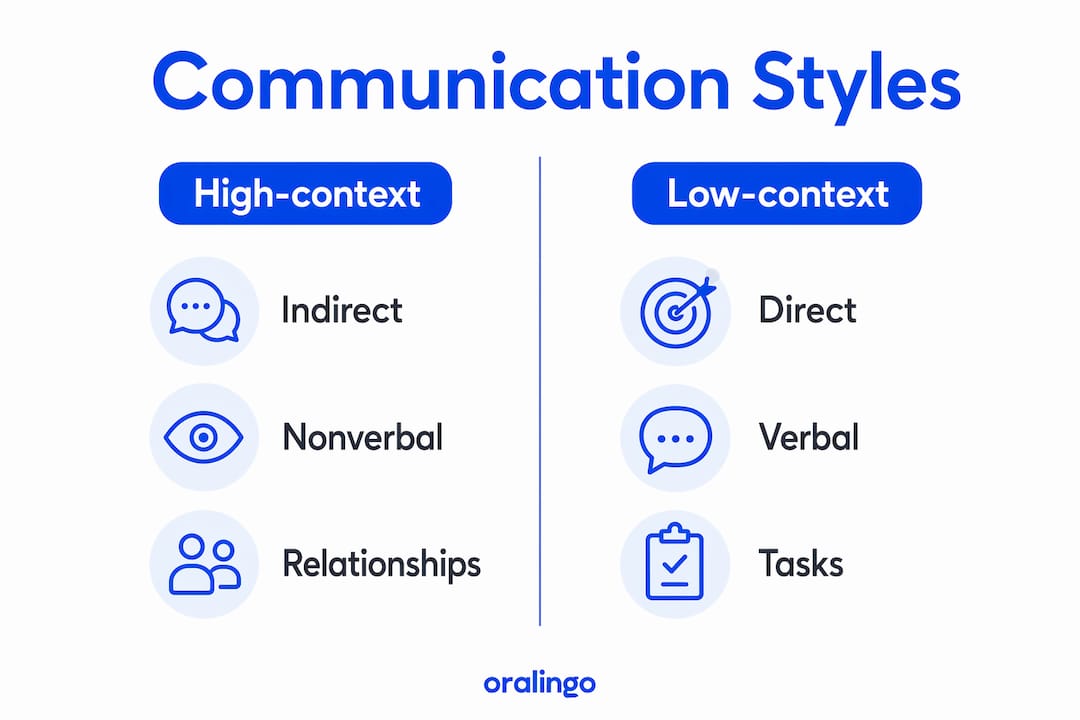
Direct vs. indirect communication styles create friction in mixed teams. Direct communicators value clarity and speed. Indirect communicators prioritize harmony and face-saving. Neither approach is wrong, but when they collide without awareness, the direct speaker seems blunt and the indirect speaker seems evasive.
Power distance shapes who speaks, how, and to whom. In high power-distance cultures, employees rarely challenge a manager's decision openly. Addressing a senior colleague by first name without permission can genuinely offend. In low power-distance cultures, flat hierarchies are the norm and formality can feel condescending.

Volume and assertiveness get misread constantly. Raised voices signal conflict in some cultures and enthusiasm in others. A quiet, measured tone reads as calm authority in one context and lack of confidence in another. These misreadings happen fast in real-time conversations, which is exactly why having accurate, instant translation matters so much.
Conflict and emotional expression also vary widely. Mediterranean and Latin American cultures often express disagreement openly and with visible emotion. Northern European and East Asian cultures tend toward restraint. When these styles meet, one side reads the other as either aggressive or disengaged.
How does linguistic prejudice hurt team communication?
Linguistic prejudice, bias based on a person's accent, dialect, or fluency level, quietly damages team cohesion in ways that are easy to miss. A team member with a strong accent or non-native grammar may be perceived as less competent, even when their ideas are sharper than anyone else's in the room. That perception silences people.
In practice, this plays out in meetings where native speakers dominate the conversation, interrupt more, and get credited for ideas that non-native speakers raised first but expressed less fluently. The result is a team that thinks it is collaborating but is actually filtering out some of its best thinking.
Linguistic prejudice also erodes trust. When someone feels their voice is discounted because of how they sound rather than what they say, they stop contributing fully. That disengagement is hard to reverse. Addressing it requires more than good intentions. It requires cultural intelligence and empathy built into how a team actually runs.
Pro Tip: In multilingual meetings, rotate who summarizes key decisions at the end. This gives non-native speakers a structured moment to contribute and signals that every voice counts, regardless of accent or fluency.
What are the most effective strategies for overcoming these barriers?
Overcoming cultural communication issues takes more than awareness. It takes deliberate practice and the right tools.
- Build cultural intelligence (CQ). Cultural intelligence predicts collaboration success more reliably than language fluency alone. CQ means reading cultural cues, adjusting your style, and staying curious rather than defensive.
- Set explicit communication norms. Don't assume everyone shares the same expectations for response times, meeting formats, or feedback styles. Write them down. Teams that establish clear communication protocols reduce misunderstandings significantly.
- Practice active listening. Slow down. Ask clarifying questions. Resist the urge to fill silence, especially with colleagues from high-context cultures where pauses carry meaning.
- Suspend judgment. When a colleague's communication style feels off, pause before reacting. Ask yourself whether you're evaluating their style against your own cultural standard.
- Manage anxiety proactively. Acknowledge that cross-cultural conversations can feel uncertain. Naming that discomfort, rather than pushing through it, helps everyone relax and communicate more openly.
- Adapt to hierarchy and context. If you're working with a high power-distance culture, mirror their formality. If you're in a high-context environment, pay attention to what isn't being said.
Pro Tip: When you're in a real-time multilingual conversation, use Oralingo's instant chat translation to stay focused on what's being communicated, not on decoding the language. With support for over 100 languages and a 99% accuracy rate, it removes the language layer so you can focus on the cultural one.
Why does cultural awareness training actually matter?
Cultural awareness training isn't a nice-to-have for global teams. It's a practical necessity. Active engagement and education about diverse communication styles build inclusion far more effectively than passive exposure or top-down mandates. When people understand why a colleague communicates differently, they stop reading that difference as a problem.
Training also helps teams treat cultural diversity as a strategic resource rather than a source of friction. Organizations that take this approach consistently report better collaboration outcomes. Creating psychologically safe spaces for cultural learning, where people can ask questions and make mistakes without fear, accelerates that shift. Competence training also reduces the anxiety that Barna identifies as a core barrier, making every other strategy work better.
Real-world cases where communication barriers caused serious problems
These aren't hypothetical scenarios. Communication breakdowns across cultures have produced costly, sometimes catastrophic, real-world consequences.
International project teams regularly report that language barriers mask deeper cultural conflicts. In a study of 352 professionals across 28 countries, participants consistently noted that even when teams shared a common working language, the real friction came from unstated assumptions about directness, decision-making, and feedback. One international project manager described it plainly: "We all spoke English, so we thought communication would be fine. But the real problems came from different expectations of directness, decision-making, and feedback."
Virtual teams face a compounded version of this. Remote collaboration strips out nonverbal cues, and for colleagues from high-context cultures, that loss is severe. The same study found that virtual communication creates a "double barrier" effect, where cultural communication barriers are amplified by the absence of in-person signals. Underparticipation, misread tone, and broken trust follow.
Healthcare settings show some of the highest stakes. Research published in PubMed highlights that cross-cultural communication failures contribute directly to health disparities, with unconscious bias and inadequate cultural competence leading to misdiagnosis and reduced patient trust. The fix, according to that research, requires intentional training and a cultural humility framework, not just translation.
These cases share a common thread: the surface problem looks like language, but the deeper issue is cultural. Solving it means addressing both, which is exactly what cross-cultural relationship communication strategies are built to do.
Ready to remove the language layer from your cross-cultural conversations? Oralingo translates your chats instantly, before the message even appears, so you can focus on connecting, not decoding.
Talk to anyone, in any language with Oralingo's real-time translation across 100+ languages.
Key Takeaways
Cross-cultural communication barriers persist even when teams share a common language, making cultural intelligence the most reliable predictor of collaboration success.
| Point | Details |
|---|---|
| Barna's six stumbling blocks | Language, nonverbal cues, assumed similarity, stereotypes, evaluation bias, and anxiety are the core barriers. |
| 72% face language issues | Language-related problems regularly affect international collaboration for 72% of professionals surveyed across 28 countries, often masking deeper cultural conflicts. |
| Cultural intelligence beats fluency | CQ predicts collaboration success more reliably than language fluency alone. |
| Linguistic prejudice silences teams | Accent and fluency bias reduces participation and erodes trust, regardless of a speaker's actual competence. |
| Psychological safety accelerates learning | Teams that create safe spaces for cultural learning achieve better cross-cultural communication outcomes. |