
You can express emotions reliably to a partner who speaks a different language, and you don't need fluency to do it. Three moves work fastest: use short, rehearsed phrases instead of improvising in the moment, build shared rituals that let you decode actions as feelings, and use real-time translation tools like Oralingo for the moments words alone can't carry. Research from a Birkbeck study on multilingual couples found that many eventually adopt their partner's language as their emotional default, so this gets easier over time, not harder.
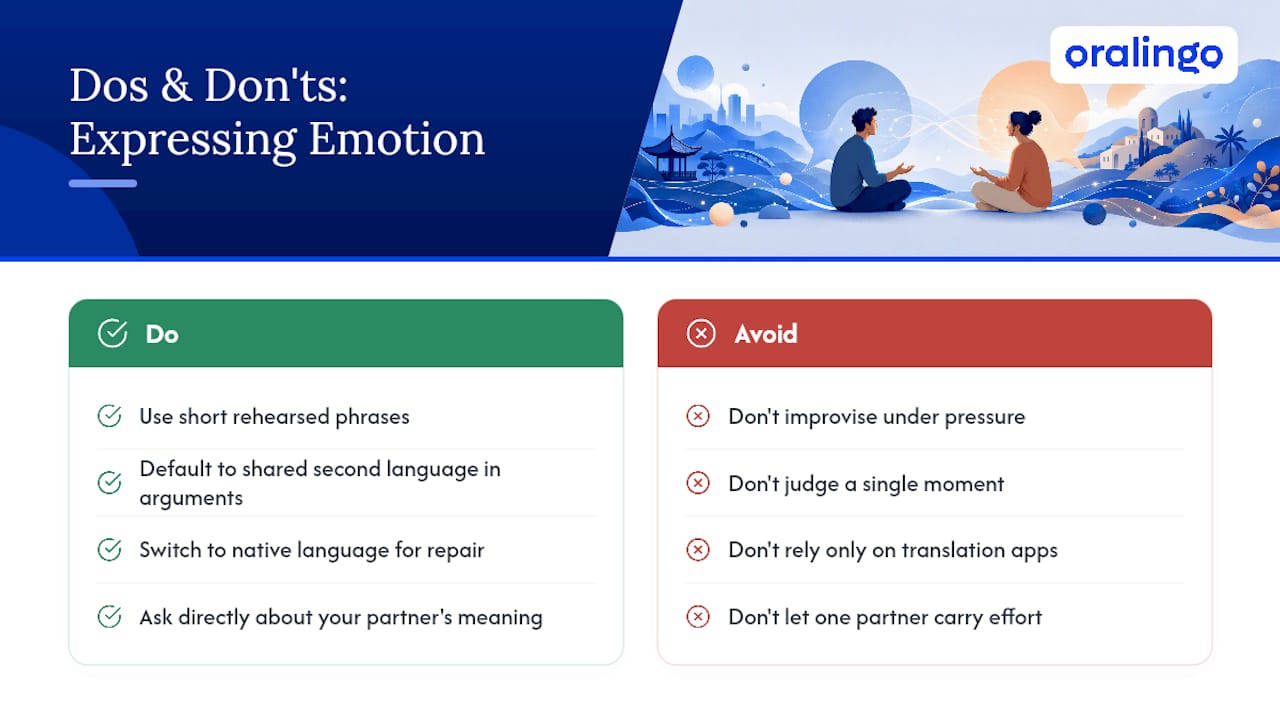
- Rehearse it. Practice one apology line and one comfort line until they're automatic.
- Decode it. Notice what your partner does, not just what they say, before assuming they're withholding.
- Translate it, selectively. Reach for a tool like Oralingo when precision matters more than practice.
Key Takeaways
Expressing emotion across a language gap works best when you combine rehearsed phrases, cultural decoding skills, shared habits, and selective use of translation tools rather than relying on any single fix.
| Point | Details |
|---|---|
| Rehearse short scripts | Practice one apology and one comfort phrase until they come out automatically under stress. |
| Decode actions, not just words | Check for pattern and timing before reading silence or chores as emotional signals. |
| Share the language workload | Rotate translation duties and trade mini-lessons weekly so one partner isn't carrying it alone. |
| Watch for deeper red flags | Repeated misunderstanding or unequal burden may call for a bilingual counselor, not another script. |
| Use Oralingo for precision moments | Its pre-delivery translation and encrypted hands-free voice mode help with urgent or emotionally loaded messages without replacing shared language work. |
Table of Contents
- How Do You Express Emotions to a Partner Who Speaks a Different Language?
- How Do Cultural Differences Change What Counts as an Emotional Signal?
- How Can Couples Build Fair Habits Around Language Differences?
- When Should You Use Real-Time Translation Tools for Emotional Messages?
- When Is a Language Gap a Sign of a Deeper Problem?
- What Actually Helps Bilingual Couples Long-Term
- A Practical Way to Bridge Emotional Moments Without Skipping the Real Work
- Frequently Asked Questions
- Sources
How Do You Express Emotions to a Partner Who Speaks a Different Language?
The fastest fix isn't a bigger vocabulary. It's a small set of phrases you've said enough times that they come out smoothly, even when you're upset. Cross-cultural linguistics research shows emotional words don't map cleanly between languages, so waiting for the "perfect" translation often means saying nothing at all. Scripts solve that.
Here are starter phrases for five common intentions. Pick the version that fits your partner's culture and directness style, not just the dictionary definition.
- I love you / I miss you: a direct statement works for most partners, but a softer version ("I keep thinking of you today") lands better with partners from more indirect communication cultures.
- I'm hurt: try "That landed wrong for me" before "You hurt me." It names the impact without assigning blame first.
- I need help: "Can you slow down with me for a second?" is easier to act on than "I don't understand."
- I need time: "I want to answer this well, so give me a minute" beats silence, which often gets misread as anger.
A short repair script helps more than winging it. Open with a clarifier ("I want to say this right, so bear with me"), state the feeling in one sentence, then close with a repair line ("Tell me if that came out wrong"). Note which language to lean on for each part. Many couples default to their shared second language for the opening, since switching to a non-native language can lower emotional intensity just enough to keep a hard conversation calm, then switch to a mother tongue for the sincere part.
Voice and text carry emotion differently. A quick reference:
- Voice messages preserve tone, pacing, and warmth, so use them for reassurance, comfort, or anything that needs to sound like you.
- Text works better for clarity, especially when a translation app is doing the heavy lifting and you want the wording exact.
- Translate before sending anything emotionally loaded in text. A literal auto-translation of a joke or an apology can flatten the intent completely.
Pro Tip: Set a two-minute timer once a week and take turns saying one feeling out loud in your partner's language, even badly. The goal isn't accuracy. It's building a shared script you both reach for automatically when things get tense.
How Do Cultural Differences Change What Counts as an Emotional Signal?
Some partners say "I love you" daily. Others show it by quietly refilling your coffee for six years straight and never saying it once. Neither is more loving. Cross-cultural research on emotional expression shows individualistic cultures tend toward direct verbal statements, while collectivist cultures often express care through context and action. Misreading that gap is one of the most common sources of hurt in multilingual relationships.
Before assuming silence means distance, check what's actually happening around you:
- Chores and errands: Does your partner handle things without being asked, especially when you're stressed?
- Food: Cooking your favorite dish, or remembering how you take your coffee, often functions as a direct emotional statement in food-forward cultures.
- Time: Showing up early, staying late, or rearranging a schedule can be the loudest "I care" a low-verbal-expression partner offers.
- Silence: Is it withdrawal, or is it processing? Timing and pattern tell you more than the silence itself.
Before reacting to any single moment, run a quick check: does this fit a pattern, does the timing make sense, and what's the most generous interpretation available? One missed "I love you" means nothing. Six months of quiet, consistent effort means something specific.
Pro Tip: Test your read directly instead of guessing. Ask, "When you do X, is that your way of showing you care?" One honest answer settles months of misinterpretation.
How Can Couples Build Fair Habits Around Language Differences?
Language work becomes resentment when one partner carries it alone. Reporting on intercultural couples found the communication burden often falls disproportionately on the less-proficient partner, and that mutual language learning strengthens the relationship instead of just easing logistics. Fairness has to be built in on purpose.
- Trade mini-lessons weekly. Each partner teaches five words or phrases in their own language, no pressure, ten minutes tops.
- Rotate who translates. During disagreements, alternate who explains their point in the shared language first, so the effort isn't always the same person's job.
- Schedule a short check-in. A five-minute weekly conversation just to ask "did anything get lost this week?" catches small misunderstandings before they compound.
A sample week might mix one language night (cooking a dish from your partner's culture while practicing phrases), one shared playlist swap, and one check-in conversation. Small, concrete promises work better than vague intentions: "I'll always explain slang the first time I use it" or "During arguments, we default to whichever language feels calmer for both of us."
Pro Tip: Keep learning goals tiny and time-boxed, like five new words a week, instead of open-ended commitments to "get better at the language." Open-ended goals turn into guilt. Time-boxed ones turn into habits.
When Should You Use Real-Time Translation Tools for Emotional Messages?
Translation tools help most when the moment needs precision fast and hurts when they replace the slower work of learning each other. A voice memo through a translation app preserves tone and pacing better than typed text, which strips out warmth. Pre-translating a text before sending gives you a chance to catch a phrase that reads coldly in the other language, something raw auto-translate frequently gets wrong on idioms and emotional nuance.
Before sending anything sensitive through a tool, run this check:
- Is the app end-to-end encrypted, so a private message stays private?
- Does it preserve tone and context, or does it just swap words literally?
- Would this message land better as voice than text?
Oralingo was built around exactly that gap. It translates messages before they display, so a text lands sounding like you, not like a machine. Its hands-free voice mode supports over 100 languages, and every conversation is end-to-end encrypted. A short apology sent across time zones, a daily "thinking of you" voice note, or a message meant to de-escalate an argument are the moments this kind of tool earns its place, not a replacement for the phrases and rituals you're building together.
When Is a Language Gap a Sign of a Deeper Problem?
Sometimes a translation issue isn't really about translation. Watch for these patterns:
- The same misunderstanding keeps repeating, even after you've addressed it directly.
- One partner always absorbs the communication effort, and it's starting to breed quiet resentment.
- Conflict escalates into shame or withdrawal instead of resolving, regardless of which language you use.
Therapists note that which language a partner reaches for often reveals emotional position and power, not just convenience. Someone who always retreats to their native language during conflict may be protecting themselves, not shutting you out.
If these patterns persist, pause and name what's happening out loud (meta-communication), consider a bilingual counselor who understands both cultural contexts, and start building a shared emotional lexicon deliberately rather than hoping it develops on its own.
What Actually Helps Bilingual Couples Long-Term
The couples who adapt fastest aren't the most fluent ones. They're the most curious ones, willing to ask "what did you mean by that" instead of guessing. Curiosity paired with small shared rituals, a weekly check-in, a repeated phrase, a running list of words that don't translate, does more than any app or class alone.

Respect language fatigue when it shows up. Some nights, reaching for a tool instead of forcing a hard conversation in your second language is the kinder choice, not the lazy one.
A Practical Way to Bridge Emotional Moments Without Skipping the Real Work
Oralingo exists for the exact gap this guide describes: the moment you have the feeling but not the words, in either language, fast enough. It translates messages before they display, so what your partner reads sounds like you rather than a stiff, literal conversion. The hands-free voice mode covers more than 100 languages and keeps every conversation end-to-end encrypted, which matters when the messages are personal.
Picture the moments this guide already covered: a 2 AM reassurance text across time zones, an apology you need to get right the first time, a daily "thinking of you" voice note sent on your commute. Oralingo handles the translation layer so the tone survives the trip. It's not a substitute for the phrases, rituals, or check-ins you're building with your partner. It's the tool you reach for when those aren't quite fast enough. Try the free version of Oralingo and see how it fits into your next difficult or tender conversation.
Frequently Asked Questions
How do I express emotions to a partner who speaks a different language without sounding awkward? Start with a short, rehearsed phrase rather than improvising. A line you've practiced, even a simple one, sounds far more natural under pressure than a spontaneous attempt in an unfamiliar language.
What's the best way to communicate feelings in different languages during an argument? Many couples default to their shared second language to keep intensity manageable, since processing emotion in a non-native language can lower its intensity slightly, then switch to a native language for the sincere repair.
Can translation apps actually help with emotional expression with a foreign partner? Yes, particularly for precise or urgent messages. Tools that preserve tone, like Oralingo's real-time translation, work best alongside shared language learning, not instead of it.
How do I know if my partner's actions mean what I think they mean? Check for pattern and timing rather than judging one moment alone, and ask directly. A single question like "is this your way of showing care?" resolves more than weeks of guessing.
When should a couple consider therapy for language-related conflict? If the same misunderstanding keeps recurring, if one partner always carries the communication effort, or if conflict repeatedly escalates into shame or withdrawal, a bilingual counselor can help address what the language gap is actually revealing.
Sources
- Birkbeck e-print on multilingual emotional expression
- The Linguistic Expression of Emotion: A Cross-Cultural Analysis (EGJLLE)
- When love speaks more than one language: bilingual couples therapy (Welldoing)
- Phys
- Emotional words mean different things in different languages (Scientific American)