
Real-time translation is the technology that lets couples who speak different languages talk, share emotions, and build genuine intimacy without waiting for a human interpreter. Understanding how real-time translation supports romantic communication matters more than ever, because AI-driven translation has made cross-language romance accessible to anyone with a smartphone. The technology works by converting spoken or written words into another language instantly, before the other person even finishes reading. That speed changes everything about how couples connect.
How does real-time translation bridge language gaps in romantic relationships?
Real-time AI translation has democratized international dating, enabling couples with fewer than 200 common words to form real, lasting relationships. That figure is striking. It means two people can fall in love without sharing a fluent language, relying on technology to carry the emotional weight of their words.
Modern translation apps support 50+ languages with idiom recognition and opt-in toggles that respect partial language proficiency. Idiom recognition matters because romantic language is full of expressions that break down under literal translation. Saying "I have butterflies" should not arrive as a description of insects.
The opt-in toggle feature deserves attention. If your partner speaks some of your language, you can turn translation off for those words and let them shine through naturally. This avoids the patronizing feeling of translating things your partner already understands.
- Choose a tool with idiom and slang support, not just word-for-word conversion.
- Use opt-in toggles to honor the words your partner already knows in your language.
- Test the tool with a few playful messages before relying on it for serious conversations.
- Look for apps that support both text and voice, so you can switch modes naturally.
Pro Tip: Before your first big conversation in a new language, send a few test messages with local expressions or pet names to check how the tool handles them. A tool that mangles your nickname is not the right fit.
What emotional and cultural nuances do modern translation tools preserve?
Advanced translation tools preserve tone, humor, and cultural context, which are the building blocks of romantic intimacy. A message that arrives cold and formal when it was sent warm and playful can damage trust. Contextual memory features store personal nicknames, shared dialects, and relationship-specific references so conversations stay warm over time.

The difference between a generic translation and a relationship-focused one is significant. Generic tools treat every sentence the same way. Relationship-focused tools learn that when you call your partner "mi sol," that phrase should never be translated as "my sun" in a flat, dictionary tone.
| Feature | Generic translation tools | Relationship-focused tools |
|---|---|---|
| Tone preservation | Minimal | Active, context-aware |
| Nickname and dialect memory | Not available | Stored and applied consistently |
| Idiom handling | Literal conversion | Cultural equivalent used |
| Humor recognition | Rarely accurate | Improved with context learning |
| Personalization over time | Static | Evolves with the relationship |
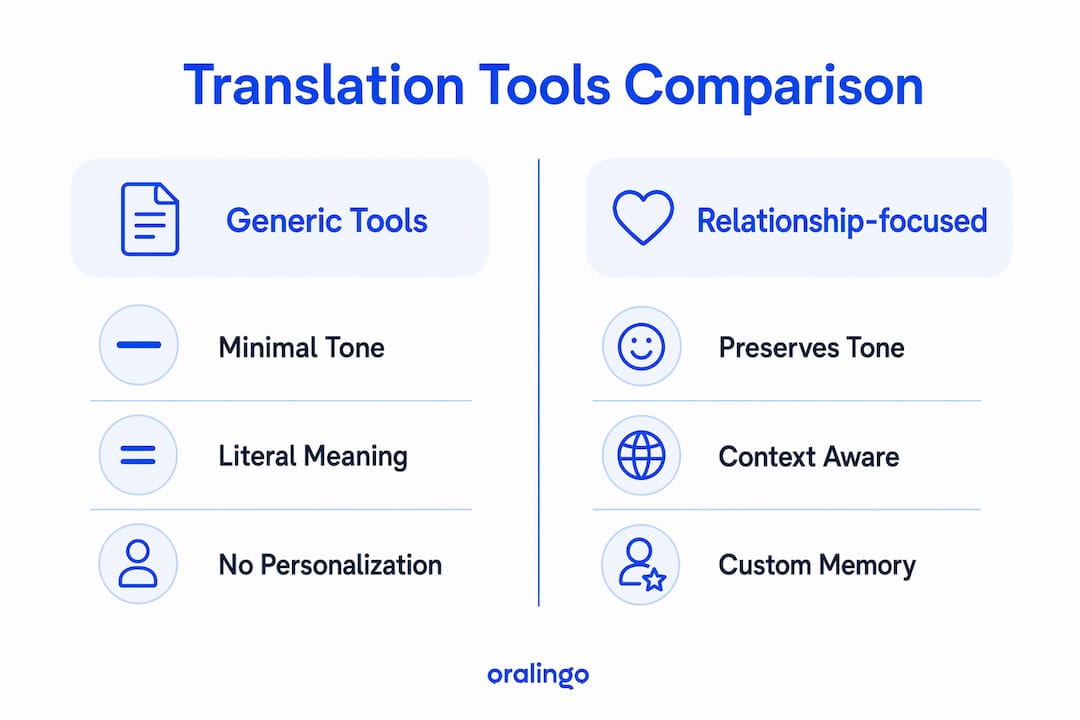
Personalized memory features prevent translations from sounding "stiff and textbook polite," which is the exact opposite of what romantic communication needs. Couples who use these features report that their conversations feel natural, not mechanical.
Successful long-term couples also invent communication shorthand to navigate the moments when literal translation fails. A private term that both partners understand instantly cuts through any awkwardness. This shorthand becomes part of the relationship's own language, something no app can replicate but a good app can support.
Pro Tip: Create a shared list of your private terms and nicknames, then add them to your translation app's custom dictionary if the feature is available. This keeps your conversations personal, not generic.
How does real-time translation change interactions with extended family?
Cross-cultural romance does not stop at the couple. It extends to parents, grandparents, siblings, and cousins who may speak only one language. Two-way translation reduces embarrassment and promotes family inclusion by letting everyone communicate in their own language without anyone feeling left out.
Older relatives often feel the most excluded in multilingual family settings. They cannot follow fast conversations, and polite smiles replace real connection. Real-time video and SMS translation extend communication beyond app users, supporting elderly relatives with simple phones who do not need to download anything or connect to WiFi.
"When both sides of the family can speak freely, the whole dynamic shifts. Grandparents stop nodding politely and start actually talking." This shift from passive presence to active participation is one of the most underrated benefits of translation technology in relationships.
The practical benefits for family communication include:
- Direct messaging with in-laws in their native language, without a partner acting as interpreter.
- Group chats where each member reads messages in their own language automatically.
- Voice calls where translation happens in real time, so conversations feel natural.
- SMS translation that works on basic phones, removing the need for smartphones or data plans.
Real-time translation applications encourage longer, more spontaneous conversations among cross-lingual families. Jokes land better. Emotional moments get shared instead of lost. That depth of connection strengthens the couple's relationship too, because family acceptance matters.
What are the limitations of real-time translation in romantic relationships?
Real-time translation is a support tool, not a replacement for active listening and nonverbal cues. This distinction is critical. A translated message tells you what someone said. It does not tell you how their voice sounded or what their face looked like when they said it.
Nonverbal cues like tone and facial expressions carry emotional meaning that even top AI translation can miss. A partner who says "I'm fine" with a tight smile is communicating something very different from the words. No translation app catches that.
Here are the most common limitations couples face and how to address them:
- Background noise disrupts voice translation. Use text mode in loud environments like restaurants or crowded spaces.
- Literal translations miss sarcasm and irony. Develop a signal with your partner, such as an emoji, to flag when you are joking.
- Translation lag can interrupt emotional moments. Practice pausing naturally after each thought to give the app time to process.
- Cold or formal output can feel distant. Choose tools with tone settings and test them with emotional messages before relying on them.
- Technology cannot replace clarification. Couples spend significant time ensuring understanding beyond translation, and those clarification sessions build trust.
The goal is to use translation as a starting point, then follow up with attentiveness. Ask your partner to confirm they understood the feeling behind your words, not just the words themselves.
How to effectively integrate real-time translation into daily romantic communication
The best approach to multilingual conversation combines the right tool with consistent habits. Technology alone does not build intimacy. The way you use it does.
- Pick a tool with contextual memory. Apps that learn your relationship's vocabulary over time produce warmer, more personal results than static tools.
- Balance translation with language learning. Use the app for full conversations, but also spend 10 minutes a day learning words in your partner's language. It shows effort, and effort communicates love.
- Keep voice mode available. Text translation is great for planning and detail. Voice mode is better for emotional conversations where tone matters.
- Use translation toggles thoughtfully. Turn off translation for words your partner already knows in your language. It honors their effort and keeps the conversation natural.
- Stay spontaneous. Send a funny voice message, a quick photo caption, or a short poem. Translation technology works best when you use it freely, not just for serious topics.
Instant message translation works best when both partners understand its role: a tool that removes friction, not one that does the emotional work for you. The warmth, the humor, and the patience still come from you.
Key takeaways
Real-time translation supports romantic communication most effectively when couples combine accurate, context-aware tools with active emotional effort, shared shorthand, and genuine attentiveness to nonverbal cues.
| Point | Details |
|---|---|
| Language gaps are bridgeable | Couples with fewer than 200 shared words can form lasting relationships using AI translation. |
| Tone and context preservation matter | Relationship-focused tools store nicknames and dialects to keep conversations warm, not generic. |
| Family inclusion is a real benefit | Two-way translation lets in-laws and elderly relatives communicate directly without an interpreter. |
| Technology has real limits | Nonverbal cues and emotional tone require human attentiveness that no app can replace. |
| Habits amplify the technology | Pairing translation tools with language learning and shared shorthand deepens intimacy over time. |
What I've learned about love, language, and technology
I used to think that a language barrier was a dealbreaker in romance. After spending years writing about communication technology and talking to couples who navigate it every day, I changed my mind completely.
The couples who make it work are not the ones with the best translation app. They are the ones who treat the app as a starting point and then do the harder work: paying attention, asking follow-up questions, learning a few words in their partner's language just to show they care. The technology removes the biggest obstacle. The relationship still has to be built by hand.
What surprises me most is how translation technology changes family dynamics. A grandmother who spent years nodding politely at family dinners suddenly has real conversations with her grandchild's partner. That shift is not small. It changes how the whole family sees the relationship.
My honest advice: do not wait until you are fluent to say something meaningful. Use the tool, say the thing, and trust that the feeling behind the words will come through. It usually does.
— Poul
Oralingo: built for couples who want real connection
Couples who want their conversations to feel natural, warm, and private need a tool designed for exactly that.
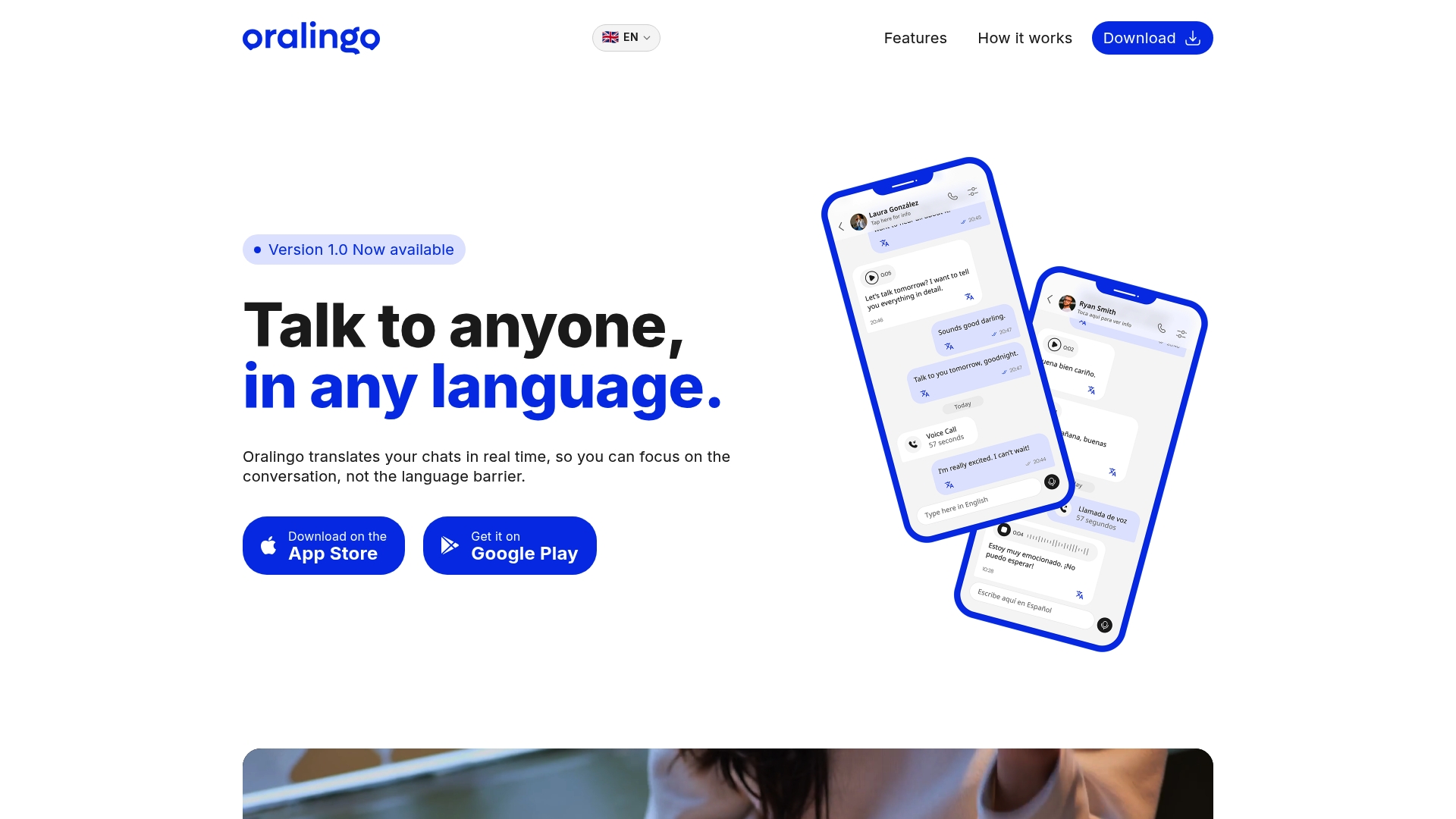
Oralingo translates messages instantly before they appear on screen, so conversations flow without interruption. It supports over 100 languages with a 99% accuracy rate, and its hands-free voice mode means you can talk without stopping to type. Every conversation is end-to-end encrypted, so what you share stays between you. Whether you are texting your partner across time zones or chatting with their family in a group message, Oralingo keeps the connection real. Try Oralingo and focus on the conversation, not the language.
FAQ
What is real-time translation in a romantic relationship?
Real-time translation converts one partner's spoken or written words into the other's language instantly, allowing couples to communicate without a shared fluent language. It works for both text and voice conversations.
Can translation apps preserve emotional tone between partners?
Advanced tools with contextual memory store nicknames, dialects, and shared references to keep translations warm and personal rather than formal or cold.
How does real-time translation help with extended family communication?
Two-way translation lets in-laws and older relatives communicate directly in their own language, removing the need for a partner to act as interpreter and enabling genuine family connection.
What are the biggest limitations of translation apps for couples?
Translation apps cannot capture nonverbal cues like facial expressions or vocal tone. Couples should supplement app use with attentiveness and regular clarification to ensure emotional understanding.
How do couples use translation technology most effectively?
The most effective couples pair translation tools with language learning, shared shorthand, and consistent habits like voice mode for emotional conversations and text mode for detailed planning.