
Translation is the primary tool that makes cross-time-zone communication work. When your team spans New York, London, and Tokyo, the problem is rarely just the clock. It's that messages written in one language, shaped by one culture, land in another inbox hours later with no chance for quick clarification. Understanding how translation bridges time zone communication means recognizing that language and time are two sides of the same barrier. Solve both together, and global teams move faster, with fewer misunderstandings and less friction.
How does translation bridge time zone communication in async workflows?
Time zone differences can delay responses by hours or even days when teams rely on live interaction. That delay compounds when a message also needs translation before it can be understood. The fix is not faster replies. It's messages that work on their own.
Translation, in the technical sense, converts words from one language to another. Localization goes further. It adapts tone, cultural references, idioms, and examples so the message reads naturally to the recipient. The American Translators Association (ATA) positions translators as cultural consultants, not just word converters. That distinction matters enormously in async communication, where there is no live back-and-forth to catch a misread phrase.

Localized messages reduce the need for follow-up questions. A translated email that uses culturally familiar examples and the right level of formality gets acted on faster than a literal word-for-word translation. For global teams, this is the difference between a project moving forward overnight and stalling for another 24 hours.
Here is what makes async translation work:
- Write standalone messages. Include full context, options, and next steps so the recipient can act without waiting for a reply.
- Localize, not just translate. Adjust tone and examples for the target culture, not just the target language.
- Use translated self-service resources. FAQs, knowledge bases, and onboarding docs in the recipient's language reduce dependency on live support.
- Avoid idioms that don't travel. Phrases like "circle back" or "ballpark figure" confuse non-native readers even after translation.
Pro Tip: Before sending an async message to a multilingual contact, read it as if you just woke up and have no context. If you need to ask a question to act on it, rewrite it until you don't.
What strategies combine translation with sync and async workflows?
Effective communication across time zones requires a structure, not just good intentions. The most productive global teams combine synchronous overlap windows with asynchronous follow-ups. Translation supports both modes, but it plays a different role in each.
Synchronous windows are the short periods when two or more time zones overlap during business hours. These windows are best used for decisions, not updates. Keep them short, use real-time interpreting when needed, and record everything.
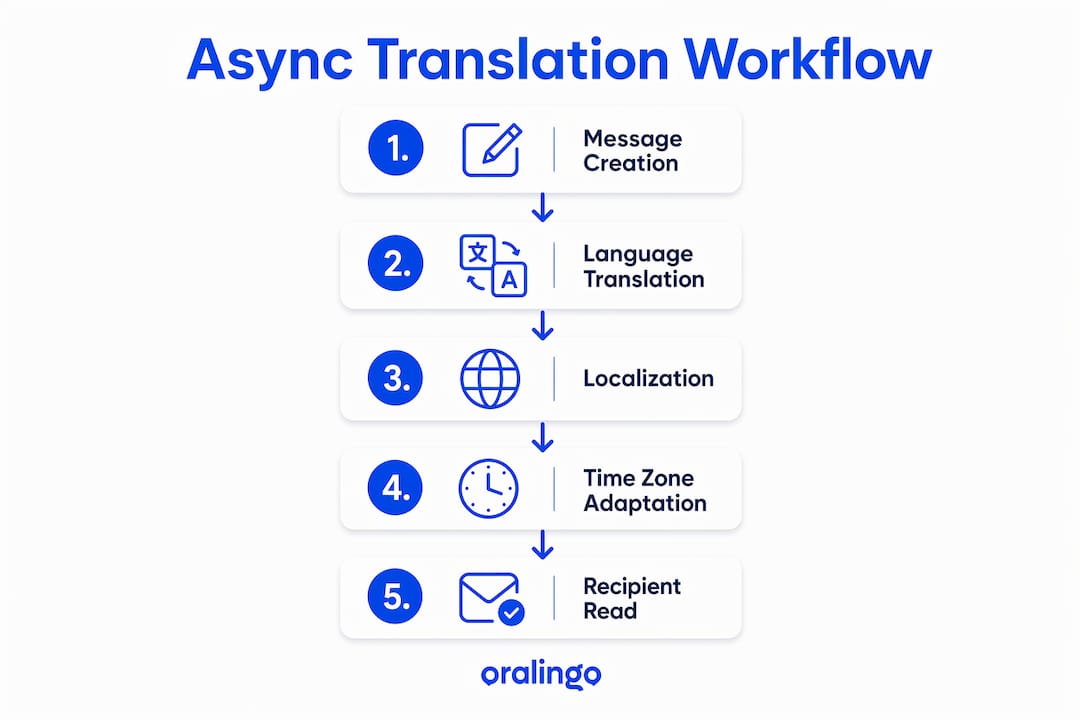
Asynchronous communication carries the rest of the workload. Translated messages, recorded meetings with translated transcripts, and localized documentation all serve as durable records that any team member can access on their own schedule.
A practical workflow looks like this:
- Identify your overlap window. Even a one-hour overlap between distant zones is enough for a focused sync call.
- Record and transcribe every meeting. Translated transcripts let team members in other time zones catch up without waiting for a summary.
- Set tiered response norms. Define what "urgent" means in hours, not feelings. A 24-hour standard for non-urgent messages and a 2-hour window for urgent ones removes ambiguity.
- Write async messages as standalone documents. Every message should contain enough context to act on independently.
- Use translation at every handoff. When work moves from one region to another, translate the handoff note. Don't assume shared language.
Pro Tip: Set your response-time norms in writing and share them with every new team member. Misaligned urgency expectations are one of the most common causes of friction in global teams, and they are entirely preventable.
How does real-time interpreting support live multilingual calls?
When your overlap window arrives and you need a live conversation across languages, real-time interpreting is the solution. Two formats dominate: simultaneous and consecutive.
Simultaneous interpreting happens while the speaker talks. The interpreter works in real time, and the listener hears the translation with almost no delay. Simultaneous interpreting saves roughly 50% of event time compared to consecutive interpreting. That efficiency matters when your overlap window is only 60 minutes.
Consecutive interpreting means the speaker pauses after each segment while the interpreter translates. It is easier to manage without specialized equipment, but it doubles the meeting length.
Remote interpreting via phone or video removes the need for interpreters to be physically present. This makes it practical for global teams with narrow time zone overlap and no budget for travel.
| Format | Speed | Equipment needed | Best use case |
|---|---|---|---|
| Simultaneous | Real-time | Audio relay or app | Conferences, live meetings |
| Consecutive | Slower | None required | Small meetings, negotiations |
| Remote simultaneous | Real-time | Video platform | Distributed global teams |
Key considerations when choosing a format:
- Simultaneous interpreting requires skilled professionals with high cognitive load capacity. Interpreters typically work in pairs and rotate every 20–30 minutes.
- Consecutive interpreting works well for multilingual negotiation where precision matters more than speed.
- Remote formats give you access to interpreters in any language without geographic constraints.
What are best practices for date and time localization?
Translation handles language. Date and time localization handles scheduling. Both are required for effective communication across time zones, and most teams get the second one wrong.
The single most important rule: store timestamps in UTC internally and convert them to the user's local time zone only at the point of display. This is not a preference. It is the only approach that survives daylight saving time changes, locale differences, and software updates without breaking.
Static UTC offsets fail. A message that says "3 PM UTC+1" is wrong for half the year in regions that observe daylight saving time. A system that stores UTC and converts dynamically is always correct.
Beyond timestamps, urgency cues need explicit definition in translated messages. What reads as "soon" in one culture may mean tomorrow. What reads as "when you get a chance" in another may mean immediately.
| Localization element | Common mistake | Correct approach |
|---|---|---|
| Time display | Static UTC offset | Dynamic local time conversion |
| Date format | MM/DD/YYYY assumed universal | Use locale-specific format |
| Urgency language | Vague terms like "ASAP" | Explicit hour-based deadlines |
| Meeting invites | Single time zone listed | Show sender and recipient time zones |
Best practices for scheduling in multilingual teams:
- Always include both time zones in meeting invites sent across regions.
- Define response-time tiers in your team's communication guide and translate that guide into every language your team uses.
- Avoid phrases like "end of day" without specifying whose day.
- Use calendar tools that display events in each participant's local time automatically.
How do integrated tools like Oralingo support cross-time-zone teams?
Technology closes the gap between good intentions and consistent execution. For multilingual teams, the right tools embed translation directly into the communication workflow rather than treating it as a separate step.
Oralingo translates messages instantly before they are displayed, so conversations flow without interruption. That capability matters most in async workflows, where a delayed translation is just another delay on top of the time zone gap. Oralingo supports over 100 languages with a 99% accuracy rate, which means your team is not choosing between speed and quality.
Real-time chat translation for global teams also reduces the cognitive load on non-native speakers. When every message arrives in your language, you spend your energy on the work, not on decoding the message.
Practical benefits of integrated translation tools:
- Async message clarity. Translated messages arrive complete and readable, reducing the back-and-forth that eats up overlap windows.
- Voice mode for hands-free communication. Oralingo's voice mode lets professionals communicate verbally without typing, which is useful during calls or when multitasking across time zones.
- End-to-end encryption. Every conversation stays private, which matters for business discussions crossing international borders.
- Consistent terminology. Integrated tools apply the same translations across a conversation, preventing the confusion that comes from inconsistent phrasing.
For teams managing cross-language brainstorming or complex project handoffs, having translation built into the messaging layer removes one of the most common friction points in global collaboration.
Key takeaways
Translation and time zone management work together: clear, localized messages that include full context are the foundation of effective global communication across non-overlapping work hours.
| Point | Details |
|---|---|
| Localize, don't just translate | Adapt tone and cultural context so messages are understood, not just readable. |
| Write standalone async messages | Include all context and next steps so recipients can act without waiting for a reply. |
| Use UTC for all timestamps | Store times in UTC and convert to local time at display to prevent scheduling errors. |
| Define response-time tiers | Set explicit hour-based norms for urgent and non-urgent messages to prevent misaligned expectations. |
| Match interpreting format to context | Use simultaneous interpreting for speed in live meetings and consecutive for precision in negotiations. |
The part most global teams skip
I've worked with professionals across a dozen industries who invest heavily in translation tools and still end up with frustrated teams. The pattern is almost always the same. They translate the words but ignore the urgency norms.
A message that says "please review when possible" means something very different to a team member in São Paulo than it does to one in Seoul. Neither interpretation is wrong. They're just shaped by different professional cultures. When that message crosses a 13-hour time zone gap, the ambiguity compounds. By the time the misunderstanding surfaces, two days have passed and someone is annoyed.
The fix is not more technology. It's agreed standards, written down, translated into every language your team uses, and revisited every quarter. Technology like Oralingo handles the linguistic layer well. The cultural and procedural layer still requires human judgment.
My honest recommendation: treat your communication norms document as a living product. Version it. Update it when friction appears. Translate it before you need it, not after a problem surfaces. The teams that do this consistently outperform those that rely on goodwill and context alone.
The async-first mindset is the right default for global teams. But async only works when every message is complete, localized, and tied to a clear timeline. Translation is the tool that makes that possible. The norms are what make it reliable.
— Poul
Oralingo: real-time translation for global professionals
Communicating across languages and time zones gets easier when translation is built into every message, not added as an afterthought.
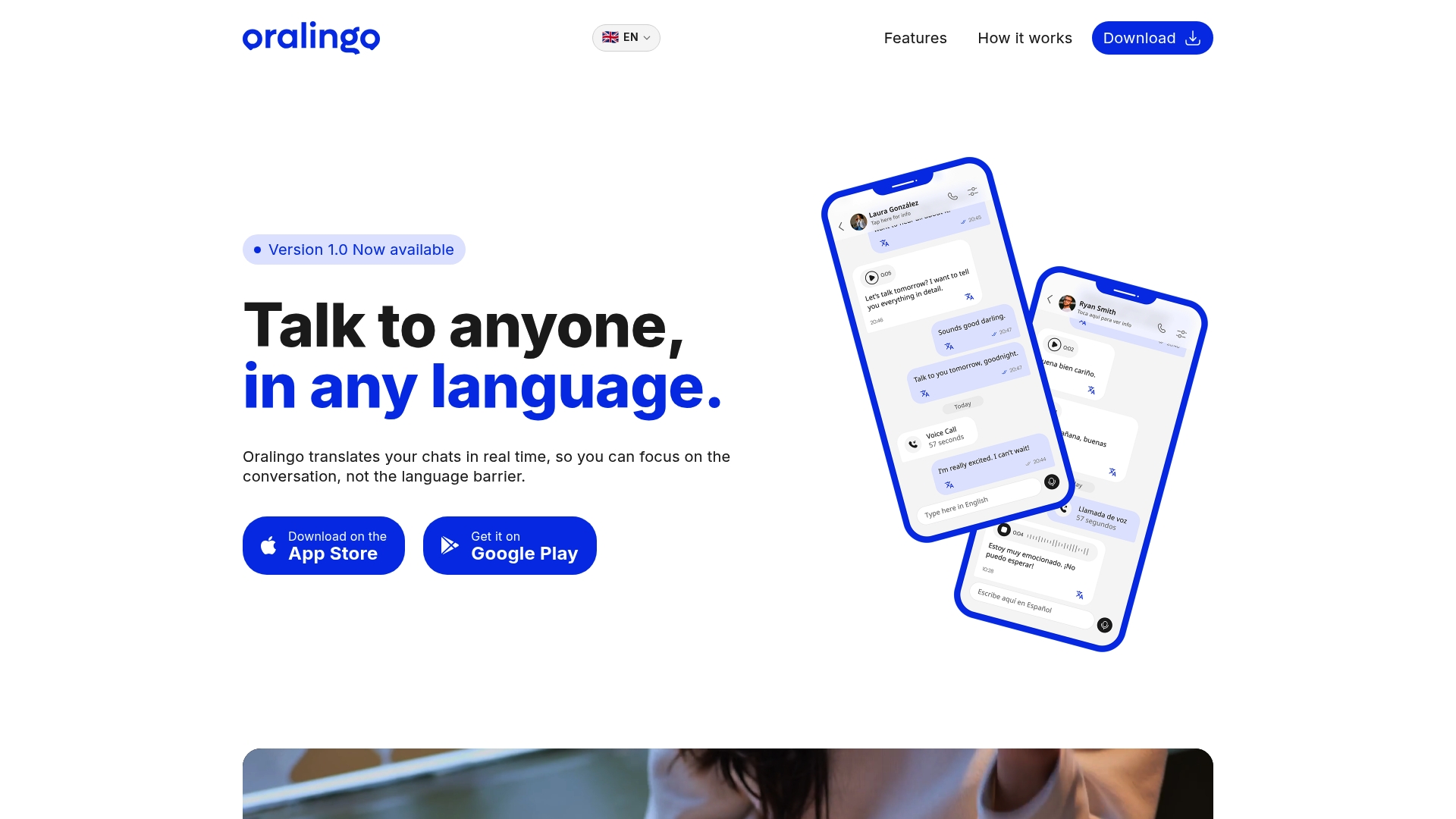
Oralingo translates your messages instantly before they appear, so your contacts read in their language without any delay. With support for over 100 languages, a 99% accuracy rate, and end-to-end encryption, it fits naturally into professional workflows. The hands-free voice mode lets you communicate verbally without typing, which is practical during busy workdays that span multiple time zones. Whether you're managing a distributed team or staying in touch with international partners, Oralingo gives you the tools to communicate clearly, every time.
FAQ
What is the difference between translation and localization?
Translation converts text from one language to another. Localization adapts tone, cultural references, and examples so the message feels natural to the recipient's culture, not just readable.
How does async communication work across time zones?
Async communication relies on standalone translated messages that include full context and next steps, so recipients can act without waiting for a live reply.
Why should teams store timestamps in UTC?
UTC storage with local-time display is the only method that handles daylight saving time and locale differences correctly. Static offsets break when time rules change.
When should you use simultaneous vs. consecutive interpreting?
Use simultaneous interpreting for conferences and live meetings where speed matters. Use consecutive interpreting for negotiations or small meetings where precision is the priority.
How does Oralingo help with time zone communication?
Oralingo translates messages instantly before they are displayed, supporting both async and live communication across over 100 languages with a 99% accuracy rate and end-to-end encryption.