
Multilingual contract communication is the process of ensuring contractual agreements are clearly understood and legally valid across multiple languages and jurisdictions. This discipline combines bilingual contract design, certified translation, and terminology consistency to reduce disputes and speed up negotiations. Language barriers in contracts are not just a translation problem. They are a legal risk. Professionals who treat cross-language agreements as a core part of their contract communication strategies gain a measurable advantage in international deals.
What is multilingual contract communication, and why does it matter?
Multilingual contract communication is defined as the structured exchange of contractual terms across two or more languages, designed to preserve legal meaning and mutual understanding in every version. The industry standard term for this practice is "cross-jurisdictional contract localization," though professionals use both terms interchangeably. The goal is not just translation. It is legal equivalence.
Three core pillars support effective multilingual agreements. First, bilingual contract design ensures both parties read terms in their own language simultaneously. Second, certified translation provides a signed declaration of accuracy that courts and regulatory bodies accept. Third, centralized terminology management prevents the same legal concept from appearing under two different names in two different versions of the same contract.

Understanding contract language across borders requires you to account for more than vocabulary. Legal systems differ fundamentally. A term like "force majeure" carries different weight in a common law jurisdiction like the United States than in a civil law jurisdiction like France. Professionals who ignore this distinction create contracts that look valid but fall apart under scrutiny.
How do bilingual dual-column layouts improve negotiation speed?
Bilingual dual-column contracts place each language version side by side on the same page. This layout lets both parties read, compare, and negotiate terms without switching between separate documents. The result is faster alignment and fewer misunderstandings.
Dual-column layouts reduce negotiation times by nearly 33%. That figure reflects a structural advantage. When both parties see the same clause in their own language at the same time, they spend less time asking for clarification and more time reaching agreement.
The psychological benefit is equally significant. Bilingual layouts create perceived fairness by removing the sense that one party's language dominates the deal. This matters most in cross-cultural negotiations where trust is still being established. A party that sees its own language given equal visual weight is more likely to engage openly.
Practical benefits of dual-column contract layouts include:
- Faster clause-by-clause review during live negotiation sessions
- Immediate visual identification of translation gaps or inconsistencies
- Reduced reliance on external interpreters during redlining calls
- Clearer audit trail when disputes arise over specific terms
Pro Tip: Treat the dual-column format as a standard risk management tool from the first draft, not as a courtesy added at signing. Introducing it early sets a tone of transparency that carries through the entire negotiation.
Why is certified translation mandatory for legally valid contracts?
Machine translation fails contracts in a specific and dangerous way. It produces text that reads correctly at the surface level but misses the jurisdictional nuance that gives legal terms their meaning. Machine translation is actively discouraged for definitive contracts because it creates severe legal risks that only become visible when a dispute reaches court.
Certified translation solves this problem through accountability. A certified translation includes a signed declaration of accuracy, giving the document formal legal standing before courts and regulatory bodies. Sworn translation, used in many civil law countries, goes one step further by requiring a government-authorized translator. Both formats carry legal weight that informal translation cannot match.
The risks of skipping certified translation are concrete:
- Contracts may be declared unenforceable in the target jurisdiction
- Courts may default to one language version, disadvantaging the other party
- Ambiguous terms can be interpreted against the drafting party
- Regulatory filings using uncertified translations may be rejected outright
Professional translators adapt legal terms to the differences between civil law and common law systems. This is not a stylistic preference. It is a technical requirement. A translator without legal expertise may produce a grammatically correct document that is legally incoherent in the target system.
Pro Tip: Never use a general-purpose translation service for contract work. Require translators to demonstrate both linguistic fluency and documented experience in the relevant legal system.
How do centralized glossaries and translation memory tools maintain consistency?
Terminology inconsistency is one of the most common and costly problems in multilingual agreements. When the same legal concept appears under different names in different sections or different language versions, courts face ambiguity. That ambiguity becomes a liability.
Centralized translation workflows using approved glossaries and translation memory tools deliver 100% terminology consistency across a contract. Translation memory software stores previously approved translations of specific terms and phrases. Every time a translator encounters that term again, the approved version appears automatically. This eliminates drift across long documents and across multiple contracts within the same deal.
The table below shows how different approaches to terminology management compare in practice.
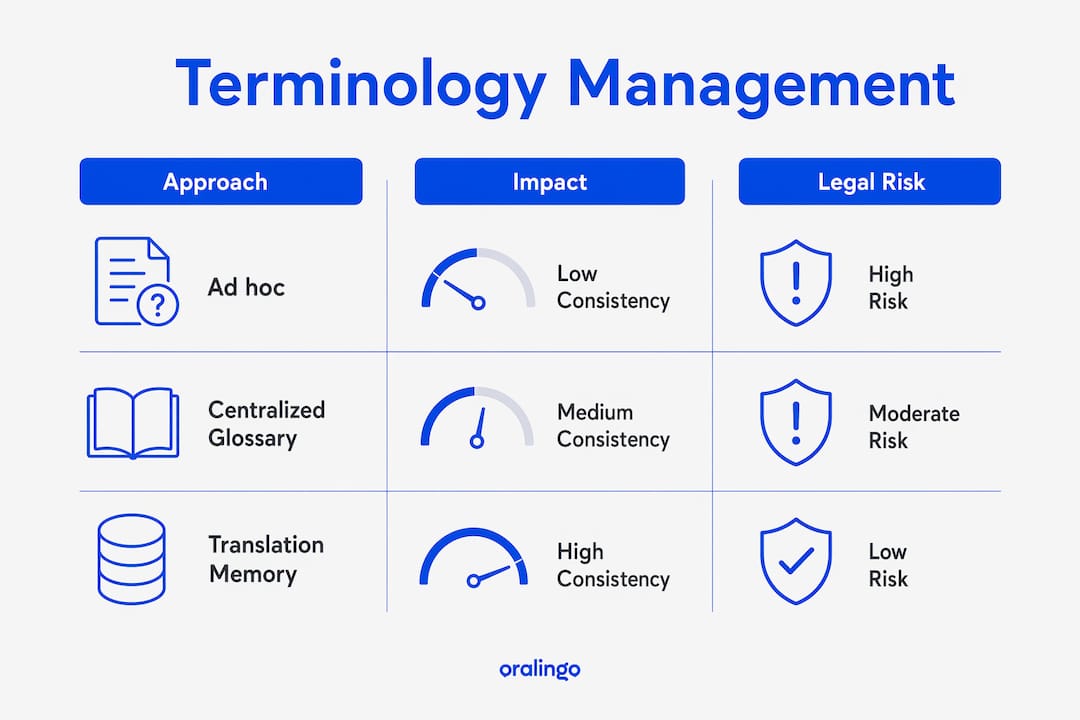
| Approach | Consistency level | Legal risk | Best use case |
|---|---|---|---|
| Ad hoc translation per clause | Low | High | Short, informal agreements |
| Shared style guide only | Moderate | Moderate | Single-language-pair deals |
| Centralized glossary with review | High | Low | Multi-jurisdiction contracts |
| Translation memory with glossary | Highest | Lowest | Ongoing legal operations |
Integrating translation memory tools into legal workflows also preserves company-specific terminology across multiple contracts. This matters when your organization signs dozens of agreements per year. A term defined one way in a master service agreement must appear identically in every related statement of work. Translation memory makes that consistency automatic rather than manual.
Adapting terminology across legal systems adds another layer. Common law concepts like "consideration" or "estoppel" have no direct civil law equivalent. A centralized glossary flags these terms and provides approved explanatory translations rather than leaving the choice to individual translators.
What contract clauses govern language authority in multilingual agreements?
A governing language clause is the single most important clause in any multilingual contract. It designates one language version as the authoritative text in case of conflict between versions. Without it, courts struggle to reconcile linguistic discrepancies, and the resulting litigation is expensive for both parties.
A well-drafted governing language clause does three things. It names the authoritative language explicitly. It specifies the jurisdiction whose courts will interpret that language. It addresses what happens if a translation error creates a material difference between versions.
Dual-language clauses take a different approach. Rather than designating one version as authoritative, they declare both versions equally valid. This approach signals parity and builds trust, but it also increases litigation risk if the two versions ever conflict. A carefully defined "prevalence of language" clause controls which version wins in that scenario, especially when one party has more negotiating power.
Key clauses to include in every multilingual agreement:
- Governing language clause: Names the authoritative language version
- Dual-language clause: Declares both versions equally binding, where appropriate
- Prevalence clause: Resolves conflicts when dual-language versions diverge
- Dispute resolution clause: Specifies the language of arbitration or litigation proceedings
- Translation accuracy clause: Assigns responsibility if a translation error causes harm
Conducting bilingual live redlining sessions with screen-sharing helps document agreed interpretations in real time. This practice creates a record of intent that supports the governing language clause if a dispute arises later.
Key Takeaways
Effective multilingual contract communication requires bilingual design, certified translation, centralized terminology management, and explicit governing language clauses working together as a single risk-management system.
| Point | Details |
|---|---|
| Bilingual layouts speed deals | Dual-column contracts cut negotiation time by nearly 33% through clarity and perceived fairness. |
| Certified translation is non-negotiable | Only certified or sworn translations carry formal legal standing before courts and regulators. |
| Terminology consistency prevents disputes | Centralized glossaries and translation memory tools eliminate ambiguity across all contract versions. |
| Governing language clauses are foundational | Every multilingual contract needs an explicit clause naming the authoritative language version. |
| Technology supports but does not replace expertise | Translation memory tools work best when paired with legally trained human translators. |
Why I treat multilingual contract design as risk management, not paperwork
Most professionals treat translation as the last step before signing. That is the wrong order. By the time a contract reaches the translation stage, the structure, the clause hierarchy, and the terminology choices are already locked in. If those choices were made without multilingual readers in mind, the translation will carry those problems forward.
Overly legalistic early communications actively harm collaboration in cross-border deals. I have seen negotiations stall not because the parties disagreed on substance, but because aggressive legal language in one version read as hostile to the other party's team. The fix was not legal. It was communicative.
Plain language drafting combined with visual structure strengthens contract clarity across languages more reliably than any single translation technique. Short sentences, defined terms, and consistent formatting reduce the cognitive load on translators and on the parties reading the final document. This is not about dumbing down the contract. It is about making precision easier to achieve.
My recommendation is simple. Bring your translator into the drafting process, not the signing process. A legally trained translator who reviews clause structure early will catch ambiguities before they become disputes. That conversation costs far less than arbitration.
— Poul
How Oralingo supports multilingual contract communication
Professionals managing contracts across languages need real-time communication tools that keep pace with negotiations. Oralingo translates messages instantly before they are displayed, so you can discuss contract terms, clarify clause intent, and confirm interpretations without stopping to switch apps or wait for a response.
Oralingo supports over 100 languages with a 99% accuracy rate, making it a reliable tool for multilingual negotiation workflows where speed and accuracy both matter. Its hands-free voice mode lets you talk through contract details naturally, and end-to-end encryption keeps every conversation confidential. When your deal spans time zones and languages, Oralingo keeps the conversation moving.
FAQ
What is multilingual contract communication?
Multilingual contract communication is the process of drafting, translating, and managing contracts so they are legally valid and clearly understood in two or more languages. It combines bilingual design, certified translation, and terminology consistency.
Why can't I use machine translation for contracts?
Machine translation misses jurisdictional nuance and creates legal risks that only appear in court. Certified translation, which includes a signed declaration of accuracy, is required for legal enforceability across jurisdictions.
What does a governing language clause do?
A governing language clause designates one language version of a contract as the authoritative text. It prevents costly litigation by giving courts a clear reference point when language versions conflict.
How do translation memory tools help with contracts?
Translation memory tools store approved translations of specific legal terms and apply them automatically throughout a document. This delivers consistent terminology across all versions and reduces ambiguity.
When should I involve a translator in the contract process?
Involve a legally trained translator during drafting, not at the signing stage. Early involvement catches structural ambiguities before they become translation problems or legal disputes.