
When schools and families don't speak the same language, children pay the price. Multilingual family communication is the intentional practice of connecting schools with families who use multiple languages at home, so every child gets the support they need to succeed academically and socially. It's not just a courtesy. Under the Every Student Succeeds Act (ESSA), schools have a federal obligation to communicate meaningfully with all families, regardless of the language they speak.
The stakes are real. Multilingual children show improved multitasking, focus, and self-control compared to monolingual peers. And yet, a large portion of the global population lacks access to education in their home language, which correlates directly with higher dropout rates and lower literacy. For educators and school administrators in the United States, where classrooms reflect extraordinary linguistic diversity, getting family communication right is one of the most direct levers you have for improving student outcomes.
Here's what strong multilingual family engagement looks like in practice:
- Families receive school communications in their home language, not just English
- Educators treat home language use as a resource, not a barrier
- Schools build trust by honoring cultural norms alongside linguistic ones
- Technology fills gaps when in-person interpreters aren't available
- Federal compliance is treated as a floor, not a ceiling
What federal law requires for multilingual family communication in U.S. schools
ESSA doesn't just encourage family engagement. It mandates it. Schools receiving Title I funding must provide parents with timely, understandable information about their child's academic progress, and that information must be in a language parents can actually understand. Title III adds further requirements for English Learner (EL) programs, including notifying families about their child's placement and the right to opt out.

Civil rights law reinforces this. Under Title VI of the Civil Rights Act, schools that receive federal funding cannot discriminate based on national origin, which courts and the Department of Education have interpreted to include language access. Failing to provide meaningful communication to families with limited English proficiency can constitute a civil rights violation.
Recommended practices for staying compliant and genuinely inclusive:
- Use certified interpreters for parent-teacher conferences, IEP meetings, and disciplinary hearings. Relying on students to interpret for their own parents is both ethically problematic and legally risky.
- Translate core documents into the primary languages spoken in your school community. This includes enrollment forms, report cards, school handbooks, and emergency notices.
- Conduct a home language survey at enrollment to identify every family's preferred language for communication.
- Train staff on the legal requirements and on how to request interpretation services quickly.
- Document your outreach efforts to demonstrate good-faith compliance during audits or complaints.
The WIDA Consortium provides frameworks specifically designed to help schools support multilingual learners and their families, including guidance on culturally responsive communication that goes well beyond minimum legal requirements.
Practical templates and tools educators can use right now
Good intentions don't close language gaps. Consistent, ready-to-use tools do. The most effective schools build a small library of communication templates in multiple languages and update them regularly, rather than scrambling to translate documents one at a time.
- Translated welcome letters that introduce the school, key contacts, and the family's rights under ESSA and Title III
- Home language surveys that ask families which language they prefer for written communication, phone calls, and in-person meetings
- Phone script templates for common outreach calls, such as attendance follow-ups or event reminders, adapted for cultural directness norms that vary by community
- Progress report cover letters in the family's home language that explain how to read the report and who to contact with questions
- Event invitation templates with culturally appropriate phrasing, not just word-for-word translations
The table below summarizes the most useful template types, their primary purpose, and when to deploy them.
| Template Type | Primary Purpose | Best Use Case |
|---|---|---|
| Welcome letter (translated) | Introduce school and family rights | Start of year or new enrollment |
| Home language survey | Identify language preferences | Enrollment and annual update |
| Phone script | Consistent outreach in home language | Attendance, events, urgent notices |
| Progress report cover letter | Explain academic data clearly | Report card distribution |
| Event invitation | Build participation and belonging | Back-to-school night, family workshops |
| IEP/meeting notice | Legal notification in accessible language | Special education, EL placement meetings |
Pro Tip: Don't just translate. Localize. A Spanish-speaking family from Mexico and one from Puerto Rico may use different vocabulary and have different expectations around formality. When possible, have a community member from the same cultural background review your templates before you send them.
Tracking family language preferences in your student information system, rather than on a paper form that gets lost, means every teacher who contacts a family starts from the same accurate baseline.
How technology helps you reach multilingual families more effectively
Technology has changed what's possible for schools with limited translation budgets. You no longer need to wait days for a translated document or pay for an interpreter for every brief check-in call. Real-time translation tools now support over 100 languages, and many are accessible directly from a smartphone.
Here's how schools are using technology to close communication gaps:
- Real-time chat translation apps translate messages instantly before they're displayed, so a teacher can send a message in English and a parent reads it in Somali, Haitian Creole, or Mandarin without either party noticing the switch. Oralingo does exactly this, with support for over 100 languages and a 99% accuracy rate, and every conversation is end-to-end encrypted for privacy.
- Voice messaging with captions works well for families who are more comfortable speaking than reading. A short voice note with auto-generated captions in the family's language carries both information and warmth that a formal letter can't.
- Video messages from teachers or principals, with translated subtitles, build a personal connection that text alone rarely achieves. Families who have never set foot in the school can still recognize a familiar face.
- Messaging platforms families already use, like WhatsApp, meet families where they are. Digital multilingual family communication thrives on these platforms, and schools that use them see higher response rates than those relying solely on email or paper notices.
- Reusable message banks let schools build a library of pre-translated common messages, from "Your child had a great day" to "Please call the office," that any staff member can send quickly and accurately.
Pro Tip: Before adopting any new communication platform, ask families which apps they actually use. A tool that works perfectly in English may have poor language support for less common languages. Test it with a real message in the target language before rolling it out school-wide.
For a deeper look at how real-time translation bridges generational and linguistic gaps within families, the connection to school communication is direct and practical.

What research says about multilingual family engagement and student success
The evidence connecting family language engagement to student outcomes is consistent and strong. Children who receive support in their home language alongside the language of schooling develop stronger literacy skills, higher academic engagement, and a more secure sense of identity.
UNESCO research links mother-tongue-based support directly to higher literacy and academic engagement. The flip side is equally clear: when children cannot access education in a language they understand, dropout risk rises. This isn't a soft finding. It's a pattern documented across countries and school systems.
Key research insights educators and parents should know:
- Multilingual children develop stronger problem-solving abilities and self-control, disproving the persistent myth that learning two or more languages causes confusion or delays
- Family language choice reflects emotional identity and cultural belonging, not just practical communication. When schools dismiss home languages, they inadvertently signal that a family's identity doesn't belong in the school
- Code-switching, the fluid movement between languages within a conversation, is a positive and sophisticated multilingual strategy, not a sign of confusion or incomplete learning
- Parents' language ideologies shape children's multilingual habits more than explicit rules do. Schools that honor home-based language practices see better engagement from both children and parents
- Plurilingual education, which recognizes and builds on all the languages a child brings to school, strengthens democratic participation and intercultural competence alongside academic skills
The research also points to something schools often overlook: multilingual families develop unique communication styles, sometimes blending languages in ways that carry specific emotional meaning. Educators who recognize these patterns as assets, rather than problems to fix, build far stronger relationships with families.
How schools and educators actively support multilingual family communication
Schools set the tone. When a principal greets families in their home language, even imperfectly, it signals something important: you belong here. That signal travels fast in a community.
Educators play a direct role by learning a few key phrases in the languages their students speak at home. It's not about fluency. It's about respect. A teacher who says "buenos días" or "xin chào" at drop-off is communicating something that no translated letter can fully replicate.
Structurally, schools can build multilingual communication into their systems rather than treating it as an add-on. This means hiring bilingual family liaisons, training all staff on how to access interpretation services, and scheduling family events at times that work for working parents. The Michigan Department of Education's guidance on engaging multilingual families offers a practical framework for building these systems at the school and district level.
Schools also benefit from creating multilingual family advisory groups. When parents who speak languages other than English have a formal seat at the table, communication gaps get identified and fixed faster than any top-down audit can manage.
How multilingual family communication shapes children's educational outcomes
The connection between family engagement and academic achievement is one of the most replicated findings in education research. When families can communicate with schools in a language they understand, they participate more, advocate more effectively, and support learning at home with greater confidence.
For multilingual learners specifically, the benefits compound. Children whose families stay engaged throughout their schooling show stronger reading and math outcomes, lower rates of chronic absenteeism, and higher graduation rates. The mechanism is straightforward: when parents understand what's happening at school, they can reinforce it at home.
Using home languages for play and cultural activities strengthens family bonds and builds the kind of confidence children carry into the classroom. A child who feels secure in their linguistic identity takes more academic risks. They ask more questions. They participate more. These aren't abstract benefits. They show up in grades, attendance records, and teacher observations.
Social-emotional development follows the same pattern. Multilingual children who feel their home language is valued at school report higher belonging and lower anxiety. That sense of belonging is one of the strongest predictors of long-term school engagement.
Why cultural sensitivity changes everything in multilingual family communication
Language and culture are inseparable. Translating a document into Spanish doesn't automatically make it culturally appropriate for a family from Guatemala, Mexico, or Spain. Each community carries different norms around authority, directness, family roles, and the appropriate way to communicate with schools.
Some families come from educational systems where questioning a teacher's decision is considered disrespectful. Others expect a much more collaborative relationship. Some cultures prioritize collective family decision-making, meaning a school that only contacts the mother may be missing the people who actually make decisions about a child's education.
Practical ways to build cultural awareness into your communication:
- Ask families directly how they prefer to receive information and who should be included in school communications
- Avoid idioms, acronyms, and education jargon even in translated materials. "RTI," "504 plan," and "benchmark assessment" don't translate meaningfully without explanation
- Recognize that silence or a polite "yes" in some cultural contexts means "I heard you," not "I agree." Follow up with open-ended questions
- Celebrate multilingualism publicly in the school, through signage, events, and curriculum, so families see their languages reflected in the school environment
Plurilingual repertoires are dynamic and personal. The Council of Europe's framework on plurilingual education notes that individuals use different languages for different purposes and relationships, and that this fluidity is a strength, not a deficit. Schools that understand this stop trying to separate a child's languages and start seeing the whole linguistic person.
Strategies that actually build trust with multilingual families
Trust doesn't come from a single translated newsletter. It builds through consistent, respectful contact over time, especially contact that isn't only about problems.
The most effective schools reach out to multilingual families proactively, before anything goes wrong. A quick message celebrating a child's progress, sent in the family's home language, does more for the relationship than three formal letters about attendance ever will.
Concrete strategies that work:
- Start with listening. Hold informal family conversations at the start of the year, in the family's preferred language, focused entirely on the family's hopes and concerns for their child. Don't bring a checklist.
- Be consistent. Families who receive communication only when there's a problem quickly learn to dread contact from the school. Regular, positive outreach changes that pattern.
- Use community connectors. Bilingual parent volunteers, community liaisons, and cultural brokers can reach families that formal school communication never touches. These relationships are built on shared experience, not institutional authority.
- Acknowledge barriers openly. If your school has historically communicated only in English, say so and explain what's changing. Families notice the shift and appreciate the honesty.
- Follow through. If you tell a family you'll send information in their language, do it. Broken promises, even small ones, erode trust faster than language barriers do.
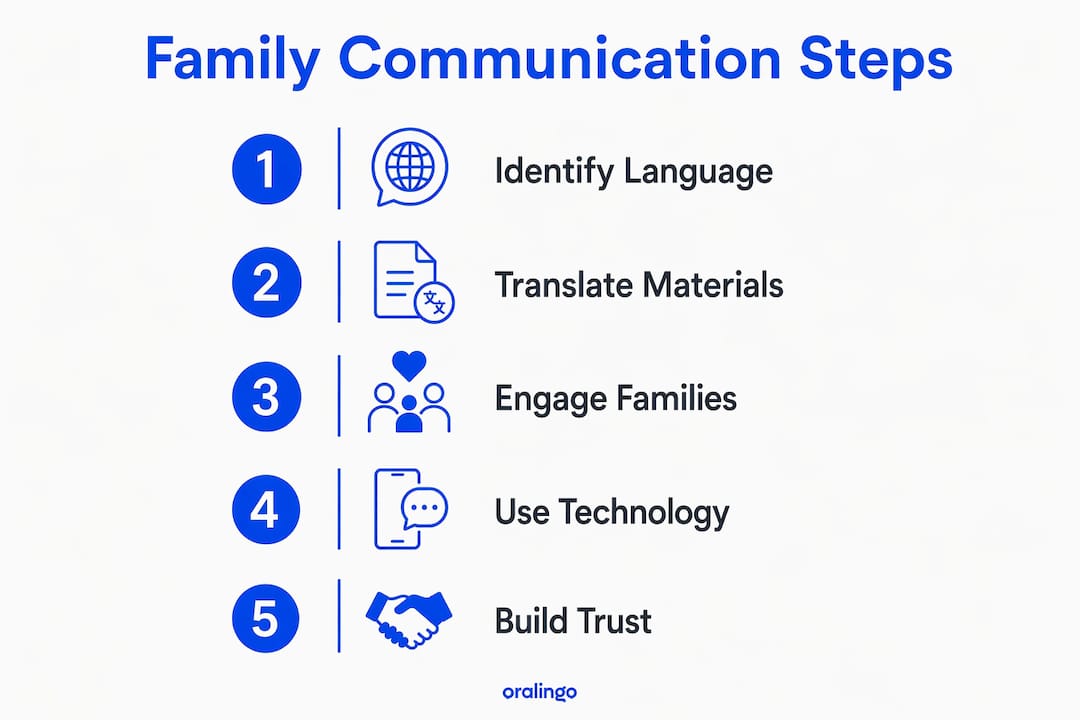
For a practical checklist covering multilingual communication steps you can apply right away, the framework translates directly to school-family relationships.
Common challenges that get in the way of multilingual family communication
Knowing what to do is one thing. Doing it consistently, across a whole school or district, is another. The barriers are real, and naming them clearly is the first step toward solving them.
Limited resources. Many schools lack the budget for professional interpreters or translated materials in every language their families speak. When a school serves families speaking 20 different languages, even well-funded districts struggle to provide consistent support across all of them.
Staff capacity and confidence. Teachers and administrators who have never worked with multilingual families often feel uncertain about how to communicate across language barriers. Without training and clear systems, they default to English-only communication and hope for the best.
Technology gaps. Not every family has reliable internet access or a smartphone. A school that relies entirely on digital communication will miss the families who need outreach most. Paper, phone calls, and in-person contact still matter.
Distrust of institutions. Some multilingual families, particularly those with undocumented members or those who have experienced discrimination, are cautious about engaging with schools. This isn't apathy. It's a rational response to past experience. Schools that understand this invest in building safety and trust before they ask for engagement.
Inconsistent follow-through. A school that translates its welcome letter but nothing else sends a clear message about its actual priorities. Families notice when the effort stops after the first impression. Addressing common challenges multilingual families face requires sustained commitment, not one-time gestures.
Try Oralingo to remove language barriers instantly
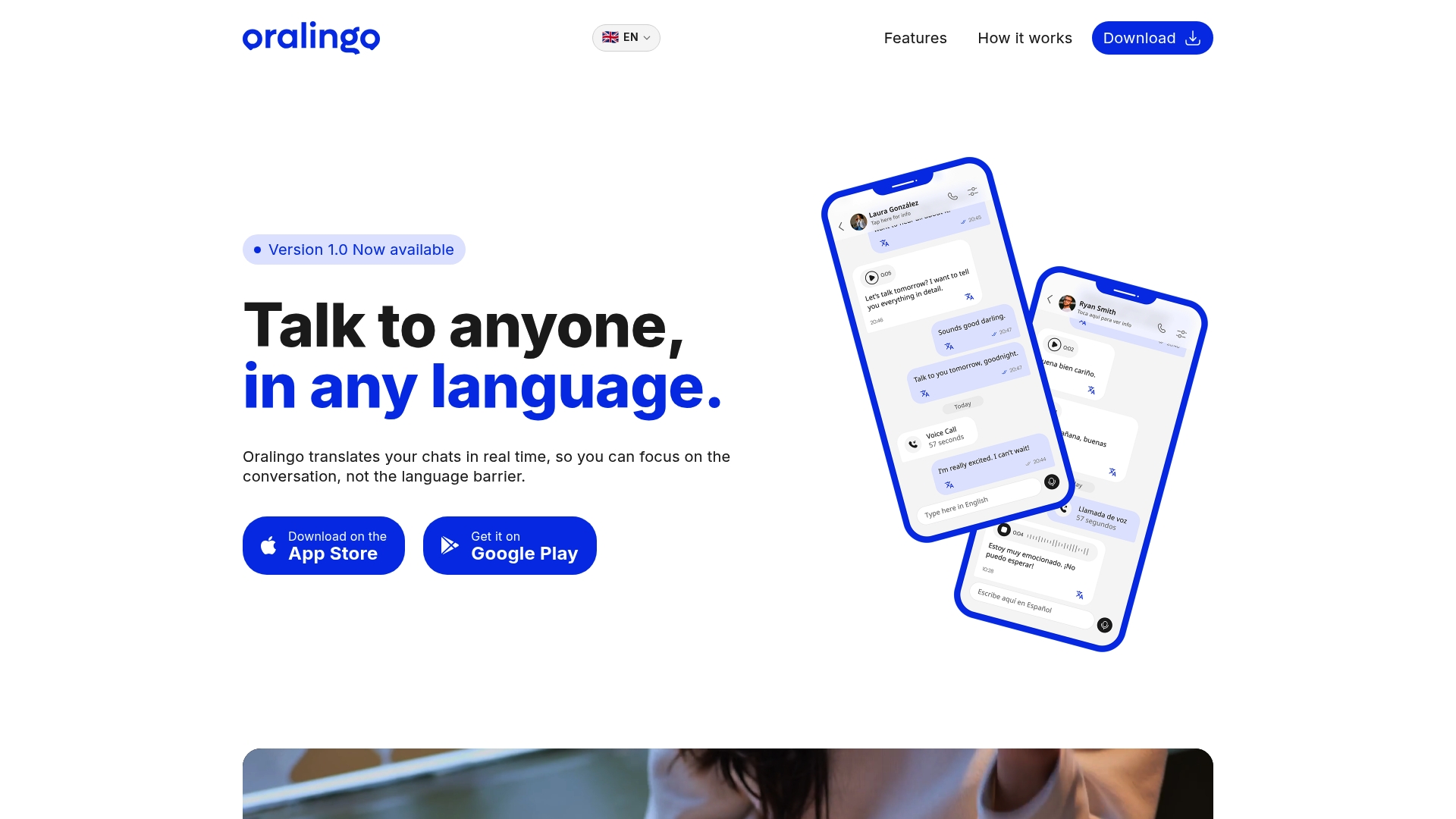
Real-time translation shouldn't require a budget line or a scheduling request. Oralingo translates messages instantly before they're displayed, so you can chat with any family in any language without interruption. With support for over 100 languages, a 99% accuracy rate, and end-to-end encryption on every conversation, it's built for exactly the kind of sensitive, trust-building communication that schools need.
Whether you're a teacher sending a quick update or a parent trying to understand a school notice, Oralingo keeps the focus on the conversation, not the language gap. Start talking today and see how easy it is to connect.
Key Takeaways
Effective multilingual family communication requires legal compliance, cultural respect, consistent outreach, and practical tools working together to support every child's educational success.
| Point | Details |
|---|---|
| Federal law sets the floor | ESSA and Title VI require schools to communicate meaningfully with families in a language they understand. |
| Home language is an asset | Children exposed to multiple languages develop stronger problem-solving skills and self-control than monolingual peers. |
| Cultural sensitivity matters | Translating a document is not enough; communication must reflect cultural norms around authority, family roles, and directness. |
| Technology closes gaps | Real-time translation apps supporting 100+ languages let schools reach families instantly without waiting for interpreters. |
| Trust requires consistency | Proactive, positive outreach in the family's home language builds the trust that makes all other engagement possible. |