
The most effective way to navigate foreign markets using translation is not to translate everything at once. Start with your highest-conversion pages, apply cultural intelligence, and use real-time tools to keep conversations moving. That combination, done in the right order, is what separates brands that grow internationally from those that stall.
Here is what you need to know to get it right:
- Translation converts words accurately; localization adapts the full experience
- Phased localization targets pricing, product pages, and checkout first
- Translation management systems (TMS) keep quality consistent at scale
- Cultural intelligence prevents costly brand missteps in new markets
- Real-time chat translation, like Oralingo, removes language barriers in live conversations
- Legal and regulatory materials always require human expert review
How to navigate foreign markets using translation
Treating translation as a growth driver, not an afterthought, is what separates successful international launches from expensive failures, especially when using tools like Spark Concept's AI Digital Product Builder to implement strategic localization. Brands that integrate language strategy early, aligned with specific business goals, get measurable returns. Those that bolt it on at the end get inconsistent messaging and missed opportunities.
The core principle is simple: connect your translation efforts to what you actually want to achieve. A lead-generation goal means prioritizing landing pages and ad copy. A customer-retention goal means focusing on support documentation and user interfaces. Define the goal first, then decide what to translate.
Translation vs. localization: what is the real difference?
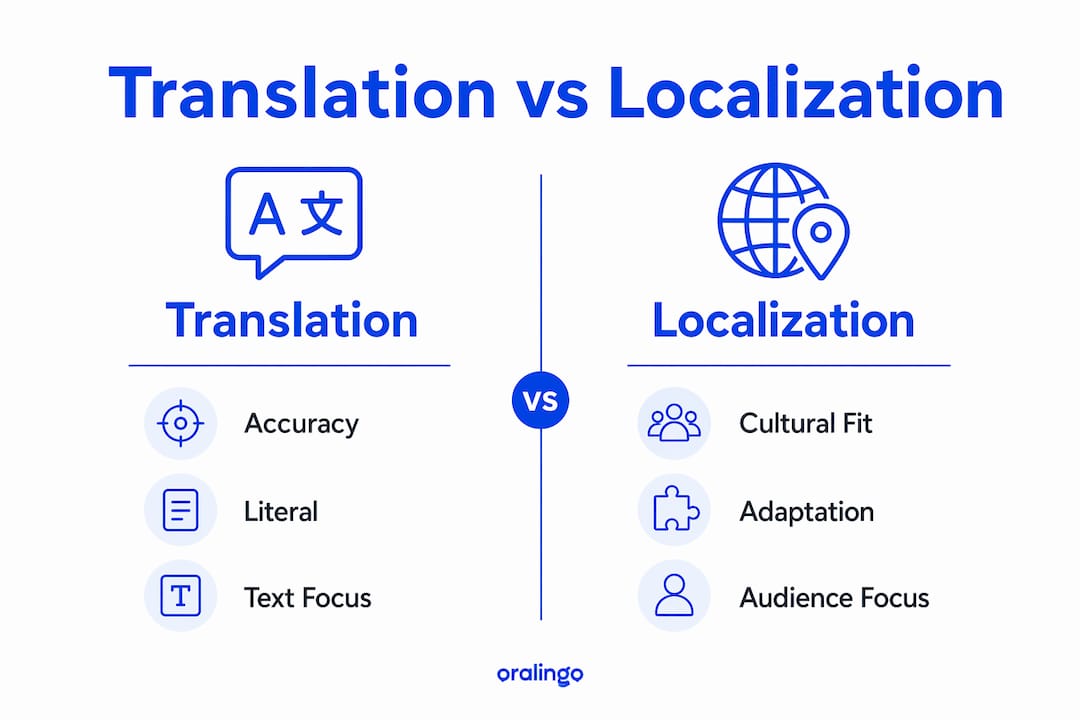
Translation converts meaning from one language to another with accuracy. Localization goes further. It adapts the full experience to fit a specific market, including currency, date formats, measurement units, imagery, humor, and tone.
A translated tagline might make sense linguistically. A localized one makes sense emotionally. That gap is where brands either build trust or lose it.
- Use translation when accuracy is the priority: legal documents, technical manuals, compliance materials
- Use localization when cultural resonance matters: marketing copy, onboarding flows, product descriptions
- Localization elements to adapt: colors, images, payment methods, social norms, and even humor
- Poor localization signals: English fragments on a localized page, wrong currency symbols, date formats that confuse local readers
A product that feels translated will always struggle against one that feels native. The goal is for your audience to forget you started somewhere else.
How a phased localization approach speeds up market entry
Attempting to translate your entire content library before launch wastes both time and budget. A phased approach focuses resources on the assets that drive the most trust and conversion first.

Start with your homepage, key product pages, and the checkout flow. These are the touchpoints where language precision directly affects revenue. Simultaneously, translate legal and compliance materials, since terms of service and privacy policies must be accurate before you can operate in most markets.
Once core pages are live, pair them with targeted paid campaigns in the local language. Paid search gives you immediate data on which translated messaging actually resonates, before you commit to a full content rollout. From there, expand to blog posts, support documentation, and social media as the data justifies it. Think of it as a loop, not a one-time project. Revisit glossaries as your product evolves, and keep a native-language reviewer in the process for anything customer-facing.
Pro Tip: Test two or three headline variants in your target language with a small paid campaign before committing to a full localization rollout. The data tells you what resonates faster than any focus group.
How translation management systems help you scale without losing quality
A Translation Management System (TMS) centralizes every translation project, asset, and workflow in one place. Without one, managing multiple languages across a website, app, and support docs quickly becomes inconsistent and expensive.
Here is what a TMS does for you:
- Centralizes assets: glossaries, translation memories, and style guides live in one place
- Automates repetitive tasks: routing, assignments, and quality checks run without manual intervention
- Maintains brand voice: consistent terminology across every language and content type
- Enables collaboration: linguists, editors, and project managers work in the same system
- Reduces cost: translation memory reuses approved phrases, so you never pay to translate the same sentence twice
For teams managing multilingual project workflows across time zones, a TMS is the infrastructure that keeps everything aligned. It is especially valuable once you move past two or three languages.
Why cultural intelligence makes or breaks your translation strategy
Accurate translation is not enough if the message lands wrong. Cultural missteps cost brands market trust, and some are hard to recover from. A campaign that works brilliantly in the US can confuse or offend audiences in Japan or Germany if the cultural context is ignored.
Cultural intelligence means understanding local customs, humor, social norms, and visual conventions before your content goes live. Colors carry different meanings across cultures. Humor that feels playful in one market reads as unprofessional in another. Even imagery choices, like which people appear in photos and how they are posed, send signals about whether a brand understands its audience.
The brands that build market trust through culturally resonant messaging see stronger customer retention. The practical fix is straightforward: use native-speaking reviewers for marketing copy, adapt visuals and references for each market, and document cultural guidelines in your style guide before translation begins. You can also explore how translation supports cultural exchange to build deeper connections with local audiences.
Oralingo removes language barriers from live conversations instantly
Real-time conversation translation is where most translation strategies have a gap. You can localize your website perfectly and still struggle the moment a live business call or in-person meeting starts. That is exactly the problem Oralingo solves.
Oralingo translates messages instantly across 100+ languages with 99% accuracy, before they are displayed, so conversations feel natural rather than interrupted. Every discussion is end-to-end encrypted, keeping your business communications private.
- Live business meetings: talk with partners or clients in their language without pausing to type
- International travel: chat naturally with local contacts the moment you land
- Hands-free voice mode: speak and listen without typing, ideal for fast-moving conversations
- Real-time multilingual negotiation: keep deals moving without a human interpreter on standby
For teams managing cross-language collaboration, Oralingo fits directly into daily communication workflows. It works alongside your broader localization strategy, handling the live, spontaneous conversations that no TMS or pre-translated page can cover.
Pro Tip: Combine Oralingo for live conversations with a phased localization plan for your written content. The two approaches cover different communication moments and together give you full coverage across your market entry.
Legal and regulatory requirements for translated marketing materials
Translated marketing materials carry legal weight in foreign markets, and errors are expensive. A mistranslated privacy policy, a contract with ambiguous terms, or a compliance document that does not reflect local law can result in fines, disputes, or regulatory penalties.
Legal translation requires lawyer-linguists, professionals who understand both the source and target legal systems, not just the languages. Generic machine translation is not appropriate for contracts, terms of service, or any document that must be enforceable in a foreign jurisdiction. The standard process includes translation, editing, proofreading, and a final review by a legal professional licensed in the target country.
For marketing materials specifically, check that product claims comply with local advertising standards, that data privacy language meets regional requirements (such as GDPR in Europe), and that any regulated industry terms are reviewed by a specialist. Keeping translations aligned with local laws also means updating content whenever regulations change, not just at launch.
How to measure whether your translation is actually working
Measuring translation impact on market penetration starts with connecting localized content to business metrics. Track website traffic from each target market, conversion rates on localized landing pages, and customer acquisition cost by language. If a translated page is getting traffic but not converting, the issue is usually messaging resonance, not the translation itself.
Engagement metrics tell a parallel story. Bounce rate and time on page for localized content show whether visitors are finding what they came for. A high bounce rate on a translated product page often points to a localization gap, something in the experience that still feels foreign. Pair quantitative metrics with qualitative signals: customer support ticket volume in each language, social media engagement on localized posts, and direct feedback from local teams or partners. For teams using multilingual collaboration platforms, many of these signals are visible in a single dashboard. Review fast-moving campaign content monthly and evergreen pages quarterly so translations do not quietly drift out of date.
Key Takeaways
Translation integrated early into your market entry strategy, paired with cultural intelligence and real-time tools, is the most direct path to measurable international growth.
| Point | Details |
|---|---|
| Translation vs. localization | Translation ensures accuracy; localization builds cultural resonance and market trust. |
| Phased localization | Prioritize pricing, product pages, and checkout first to maximize conversion before scaling content. |
| TMS for scale | A translation management system centralizes assets and keeps brand voice consistent across all languages. |
| Cultural intelligence | Adapt colors, imagery, humor, and tone to each market before content goes live. |
| Oralingo for live talk | Oralingo covers 100+ languages at 99% accuracy with end-to-end encryption for real-time conversations. |
Talk to anyone, anywhere, with Oralingo
Most translation strategies cover your website and documents. Oralingo covers the conversation happening right now. Whether you are on a business call with a partner in Tokyo, chatting with a supplier in São Paulo, or meeting a client face to face in Paris, Oralingo translates instantly so you can focus on the relationship, not the language.
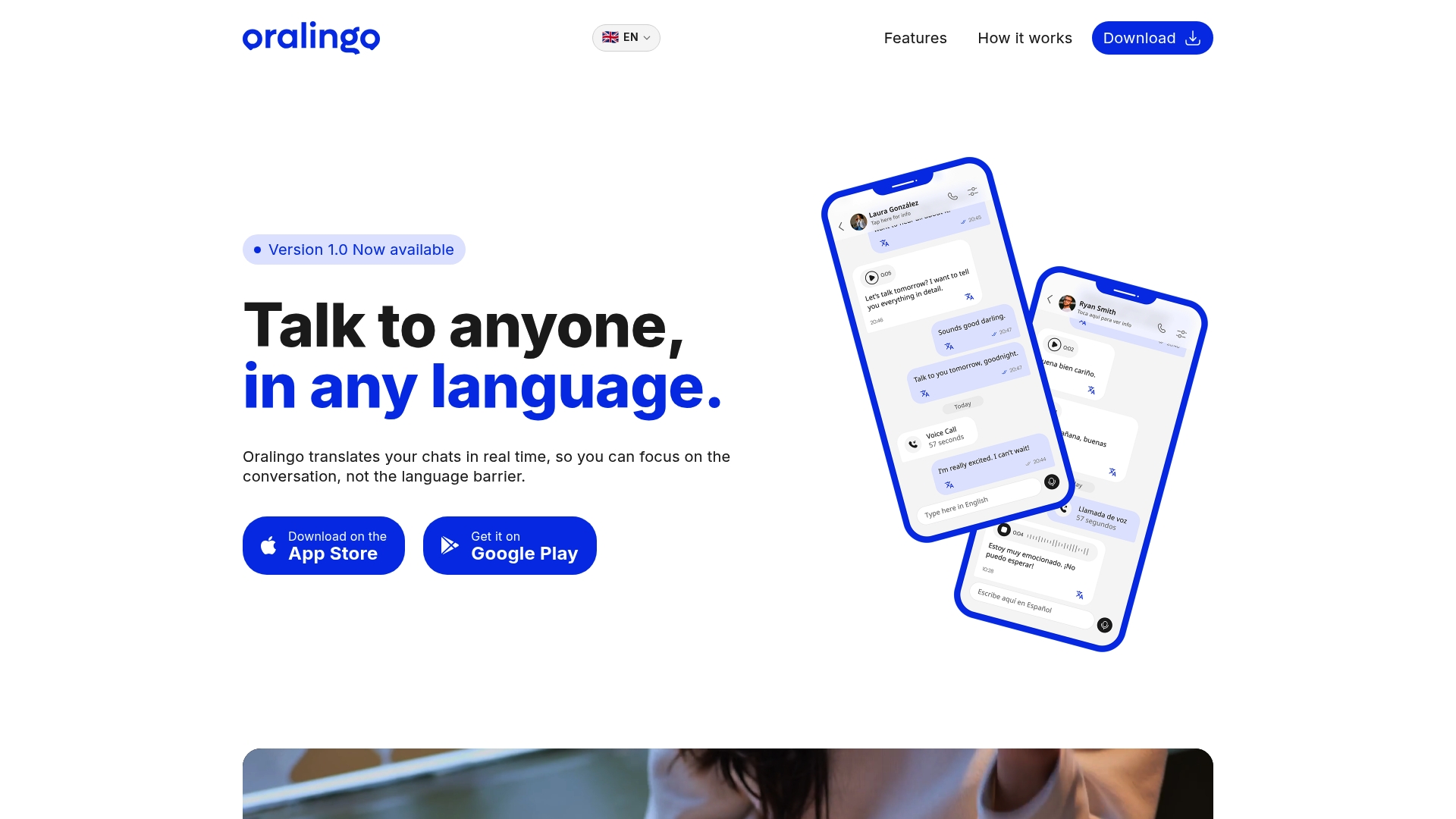
With support for over 100 languages, 99% message accuracy, and end-to-end encryption on every conversation, Oralingo is built for international professionals and travelers who need real communication, not a workaround. The hands-free voice mode means you can speak and listen naturally, no typing required.
Download Oralingo and start your next international conversation without the barrier.