
Multilingual collaboration platforms are software solutions that enable teams to communicate, manage content, and run projects across language barriers without manual translation steps. The four main types of multilingual collaboration platforms are multi-messenger aggregators, localization management platforms (LMPs), translation management systems (TMS), and AI-powered real-time translation tools. Each type solves a different problem. Choosing the wrong one costs your team time, money, and trust. This guide breaks down each category so you can match the right platform to your team's actual needs.
1. Types of multilingual collaboration platforms: an overview
Global teams face a clear problem: language fragmentation slows decisions and creates errors. The four platform categories covered here each address a specific layer of that problem. Multi-messenger aggregators fix the app-switching problem. LMPs fix the content workflow problem. TMS platforms fix the vendor coordination problem. AI real-time translation tools fix the live meeting problem. Understanding which layer your team struggles with most is the fastest way to narrow your choice.
2. Multi-messenger aggregators with built-in translation
Multi-messenger platforms are the most practical entry point for remote teams dealing with day-to-day language barriers. They pull multiple messaging apps into one interface and translate conversations automatically, so your team reads every message in their own language without copying text into a separate tool.

Multi-messenger platforms aggregate 36 or more messaging apps with built-in AI translation for 100 or more languages. That means WhatsApp, Telegram, LINE, Messenger, Instagram, Discord, Skype, and enterprise tools like Slack and Teams all feed into one window. The practical benefit is real: your sales rep in Tokyo and your account manager in São Paulo can exchange messages without either person switching apps or pausing to translate.
The single-window interface eliminates context switching. Context switching is the productivity cost of moving between apps repeatedly. Research on knowledge workers consistently shows it degrades focus and increases error rates. A multi-messenger setup removes that friction entirely.
Security is a real consideration with this platform type. Client-side translation processing keeps your data on your device rather than routing it through a third-party server. That matters for customer support teams handling personal data and for sales teams discussing pricing or contracts.
- Single interface: All messaging apps in one window, no tab switching
- Auto-translation: Messages appear in each user's language before they read them
- Language coverage: Support for 100 or more languages across channels
- Local processing: Client-side translation avoids third-party data exposure
- Use cases: Sales, customer support, remote team coordination, and partner communication
Pro Tip: If your team already uses three or more messaging apps, a multi-messenger aggregator will cut your average response time noticeably. Start by mapping which apps your external partners require, then choose a platform that covers all of them.
3. Localization management platforms for content teams
Localization management platforms (LMPs) are built for internal marketing, product, and content teams that need to publish in multiple languages at speed. An LMP is not a translation tool. It is a workflow system that connects your content source, your translators or AI engines, and your publishing destination in one automated pipeline.
LMPs centralize multilingual content workflows with automation, translation memory, quality control, and team coordination. Translation memory stores previously approved translations so your team never translates the same sentence twice. Glossary management keeps brand terms consistent across every language and every team member.
The key distinction from a TMS is speed and audience. LMPs enable internal teams to launch translations in minutes rather than weeks. They are designed for non-technical users. A content manager can set up a workflow, assign reviewers, and publish a localized blog post without involving an IT team.
- Connect your content source (CMS, design tool, or code repository)
- Set translation rules (which languages, which glossary, which quality threshold)
- Route to translators or AI (human review triggers only when confidence scores fall below your threshold)
- Publish automatically to your target channels
Automated QA and selective human review reduce human hours while maintaining quality governance. That means your team spends time on high-value review tasks, not on formatting or repetitive approvals.
Pro Tip: Build your glossary before you run your first translation batch. A 50-term glossary covering your product names, taglines, and legal disclaimers will prevent the most common brand consistency errors across languages.
4. Translation management systems for enterprise-scale projects
Translation management systems (TMS) operate at a different scale than LMPs. A TMS manages the full translation project lifecycle, including vendor sourcing, contract management, delivery tracking, and compliance reporting. Enterprise legal teams, regulated industries, and organizations running multi-vendor localization programs rely on TMS platforms.
TMS platforms include features like audit trails, role-based permissions, analytics dashboards, and integrations with enterprise resource planning systems. An audit trail records every change to every translated string, including who made the change and when. That level of traceability is non-negotiable in regulated industries like healthcare, finance, and legal services.
The tradeoff is setup time and cost. A TMS requires more infrastructure investment and IT involvement than an LMP. Teams that choose a TMS typically have dedicated localization program managers and established vendor networks.
- Best for: Large-scale localization with external translation vendors
- Key features: Audit trails, role permissions, vendor management, analytics
- Industries: Healthcare, finance, legal, government, and global enterprise
- Limitation: Longer setup time and higher operational complexity than LMPs
Choosing between TMS and LMP depends on team structure. TMS suits vendor-heavy, complex workflows. LMPs suit internal teams that need fast deployment and intuitive interfaces. If you manage fewer than five external vendors and your content team handles translations directly, an LMP is almost always the right call.
5. AI-powered real-time translation for multilingual meetings
AI-powered real-time translation platforms solve the live meeting problem. When your team meets across languages, participants who are not working in their native language carry a measurable cognitive load. They spend mental energy on comprehension and translation instead of on the actual discussion.
AI live translation delivers native-language audio to each participant simultaneously, so every person in the meeting thinks and speaks in their own language. The result is that participants comprehend 100% of the conversation, contribute equally, and produce decisions that reflect the full team's input rather than just the loudest voices.
Cognitive drain in multilingual meetings is a hidden cost that most teams never measure. A participant working in their second language processes information more slowly and speaks less confidently. AI live translation removes that barrier entirely. You can read more about how this technology works in practice in this voice translation guide.
These platforms integrate with standard video conferencing tools and work in real time, with no post-meeting transcription delay. Use cases include global all-hands meetings, cross-border training sessions, compliance briefings, and academic collaboration.
- Real-time audio: Each participant hears the meeting in their native language
- Equal participation: Removes the confidence gap for non-native speakers
- Video integration: Works with existing conferencing infrastructure
- Use cases: Team meetings, training, compliance, and academic sessions
- Privacy: Look for platforms that process audio locally or with end-to-end encryption
Security matters here too. Live audio translation that routes through unsecured cloud servers exposes sensitive meeting content. Prioritize platforms that process audio on-device or within your organization's secure environment.
6. Comparing platform features: what to evaluate before you choose
No single platform type wins across all criteria. The right choice depends on your team's size, technical capacity, security requirements, and the type of content you need to translate. Use these four feature categories to evaluate any platform you consider.
| Feature category | What to look for | Why it matters |
|---|---|---|
| Security | Client-side processing, end-to-end encryption, local data storage | Protects sensitive business data from third-party exposure |
| Scalability | Language count, user volume limits, API rate limits | Determines whether the platform grows with your team |
| Usability | No-code setup, intuitive UI, onboarding time | Reduces reliance on IT and speeds adoption |
| Integration | CMS connectors, messaging app support, development pipeline hooks | Determines how well the platform fits your existing stack |
| Collaboration | Role management, commenting, workflow automation | Enables team review and approval without email chains |
Manual translation workflows increase data leakage risk because teams copy sensitive content into external, non-secure translation sites. Integrated AI translation in a secure environment eliminates that habit entirely. Governance rather than translation speed is the key differentiator between AI localization platforms and traditional TMS tools. Speed matters, but a platform that cannot enforce terminology rules or track changes will cost you quality at scale.
For teams that need real-time chat translation rather than document-level localization, the evaluation criteria shift toward latency, accuracy, and conversation privacy rather than workflow automation.
Key takeaways
The best multilingual collaboration platform for your team depends on whether you need to fix daily messaging, content workflows, vendor coordination, or live meeting communication.
| Point | Details |
|---|---|
| Match platform type to your problem | Multi-messenger tools fix daily chat; LMPs fix content workflows; TMS fixes vendor programs; AI tools fix live meetings. |
| Security is non-negotiable | Client-side translation processing prevents sensitive data from reaching third-party servers. |
| LMPs beat TMS for internal teams | Internal content teams launch translations in minutes with an LMP versus weeks with a TMS. |
| AI translation removes cognitive drain | Live AI translation lets every participant think and speak in their native language, improving decision quality. |
| Governance matters as much as speed | Platforms that enforce terminology rules and track changes maintain quality at scale, not just translation volume. |
What I've learned from watching teams pick the wrong platform
Teams almost always pick a platform based on a demo rather than a diagnosis. They see a polished interface, get excited about the feature count, and skip the step of mapping their actual communication breakdown. Six months later, they are paying for an enterprise TMS when all they needed was a multi-messenger aggregator with auto-translation.
The question I ask first is simple: where does your team lose time or make errors because of language? If the answer is "in daily chat," you need a multi-messenger tool. If the answer is "in our content publishing process," you need an LMP. If the answer is "in our meetings," you need AI live translation. The platform category follows the diagnosis, not the other way around.
Security is the second thing most teams underweight. 68% of security-conscious organizations prioritize local translation over cloud relay. That number reflects real risk. When your team copies contract language or customer data into an external translation site, you have already created a compliance problem. Choose platforms that process translation on-device or within your secure environment from day one.
My honest recommendation: start with the smallest platform type that solves your most painful problem. Get adoption right before you add complexity. A team that uses a multi-messenger aggregator well will outperform a team that has an enterprise TMS nobody actually uses. Scale up when the simpler tool hits a genuine ceiling, not before.
— Poul
Oralingo: real-time translation built for global teams
If your team's biggest challenge is daily conversation across languages, Oralingo is built for exactly that. Oralingo translates messages instantly before they appear on screen, so every chat feels natural and uninterrupted. There is no copy-pasting, no switching apps, and no waiting.
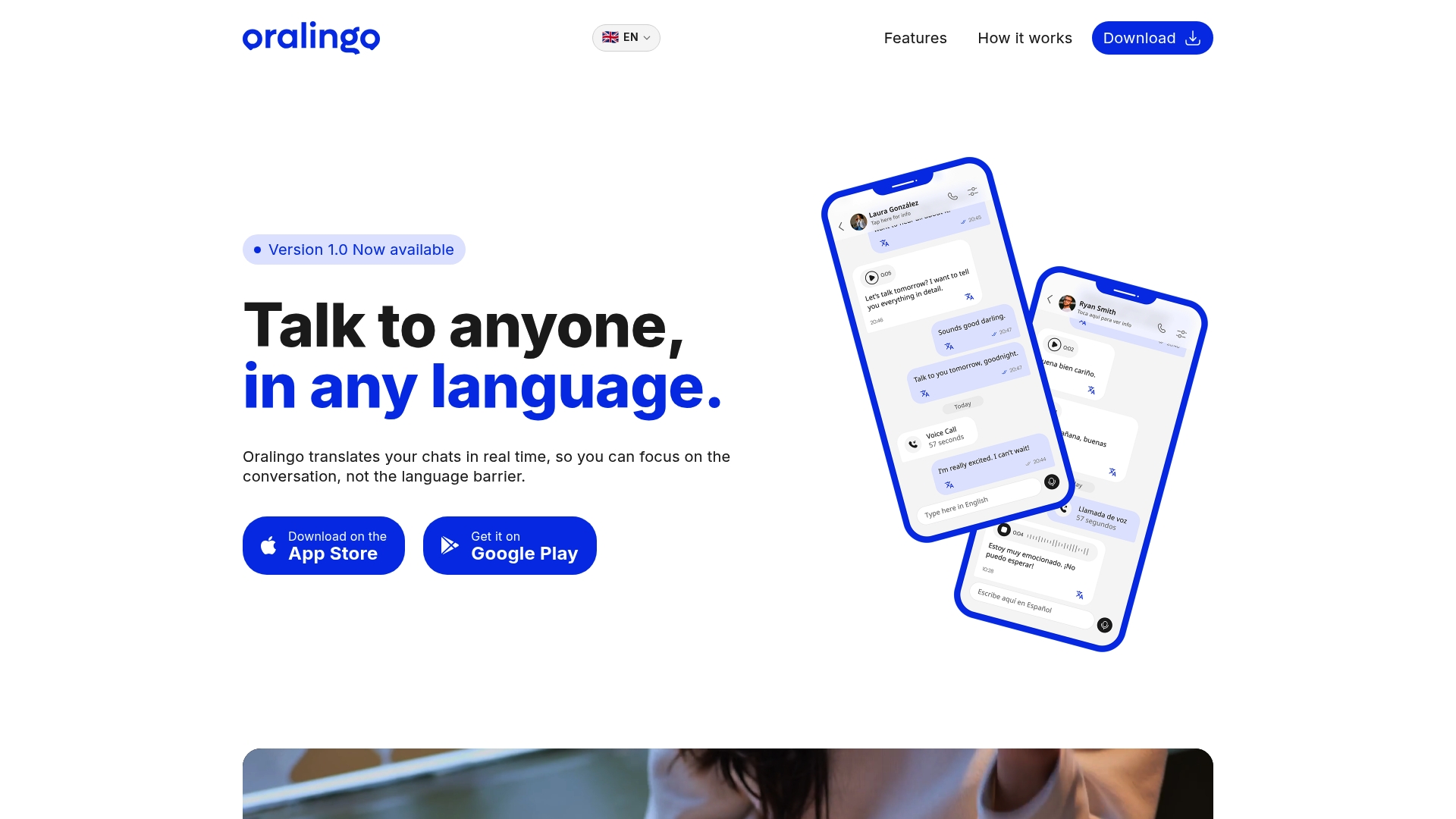
Oralingo supports over 100 languages with a 99% accuracy rate and protects every conversation with end-to-end encryption. The hands-free voice mode means your team can talk without typing, which is a real advantage in fast-moving discussions. You can learn more about how translation apps work in real conversations, or visit Oralingo to see the platform in action. Setup takes minutes, and your team can start communicating across languages the same day.
FAQ
What are the main types of multilingual collaboration platforms?
The four main types are multi-messenger aggregators, localization management platforms (LMPs), translation management systems (TMS), and AI-powered real-time translation tools. Each type addresses a different layer of multilingual communication, from daily chat to enterprise content workflows.
How do I choose between an LMP and a TMS?
Choose an LMP if your internal team manages translations directly and needs fast deployment. Choose a TMS if you coordinate multiple external translation vendors and require audit trails, compliance reporting, and complex workflow controls.
Are multilingual collaboration platforms secure for sensitive business data?
Security varies by platform. Platforms that use client-side or local translation processing keep your data off third-party servers, which is the safest option for sensitive business content. Always check whether a platform processes translation on-device or routes data through external cloud servers.
Can AI translation platforms handle live multilingual meetings?
Yes. AI-powered real-time translation platforms deliver native-language audio to each participant simultaneously during live meetings. This removes the cognitive load of working in a second language and allows every team member to contribute fully.
What is the fastest way to get a remote team communicating across languages?
A multi-messenger aggregator with built-in AI translation is the fastest starting point. These platforms aggregate 36 or more messaging apps and translate across 100 or more languages automatically, with no complex setup required.