
Yes, private, instant one-to-one translated chats and voice calls exist today, and secure business messaging translation is already built around end-to-end encrypted, pre-delivery translation apps. Oralingo is one example: it translates text before it displays, runs hands-free voice mode, and supports many languages. Before you trust one with a sensitive conversation, check the encryption claim, test the latency yourself, and run a small pilot with your actual vocabulary.
TL;DR:
- End-to-end encryption must keep decryption keys solely on your device, not on the app's servers, to ensure true message privacy.
- Translation should occur locally on your device or via peer-to-peer connections to avoid exposing content to central servers and metadata.
- Latency under one second is crucial for natural conversation flow, with streaming partial results providing a more seamless experience.
- Custom glossaries and terminology controls significantly improve translation accuracy for industry-specific or technical vocabulary.
- Testing app permissions, encryption indicators, and latency in real-world scenarios within ten minutes provides a reliable assessment of privacy and performance.
Table of Contents
- What should you check before trusting an app with private translated chats?
- How do you test and secure an app in 10 minutes?
- What are the real limits, and how do you work around them?
- Why a privacy-first, pre-delivery translator makes more sense
- Try it yourself: what to test in the first 10 minutes
- Sources
What should you check before trusting an app with private translated chats?
Not every translation app that says "secure" actually is. You need to check a few things yourself, and it takes less time than you'd think.
Start with encryption. True end-to-end encryption means the app itself can't read your messages, because the decryption keys live only on your device, not on the vendor's servers. This is the same principle behind Signal-style protocols, and it's worth confirming in the app's own documentation rather than taking a marketing badge at face value.
Next, figure out where translation actually happens. Some apps translate on your device; others send your text or audio to a cloud server first. Most multilingual chat apps route messages through centralized servers for translation, which increases exposure of your content and metadata unless the vendor layers on E2EE or processes locally. A newer approach uses peer-to-peer connections instead: a 2026 study on real-time multilingual chat translation demonstrates a system using WebRTC for direct device-to-device links, RSA-OAEP for key exchange, and AES-GCM for message encryption, avoiding central servers entirely while still delivering low-latency translation.
Here's your practical checklist:
- Encryption and keys: Confirm E2EE is real and that keys stay on your device, not the vendor's cloud.
- Where translation runs: Ask whether processing happens client-side or on remote servers.
- Latency model: Find out if the app streams partial results as you type or talk, or waits for a full sentence before translating.
- Accuracy controls: Check for custom glossaries or terminology settings for your industry's specific words.
- Voice handling: Ask if voice samples are stored, and whether voice simulation happens without saving a biometric copy.
- Retention and consent: Look for a clear policy on transcript logs, data residency, and admin visibility.
Pro Tip: Ask a company's support team one direct question: "Do you store my message content on your servers, encrypted or not?" A vendor with true E2EE will answer clearly and quickly. A vague or delayed answer is itself useful information.
How do you test and secure an app in 10 minutes?
You don't need a security audit to get real confidence in an app. A focused ten-minute test tells you almost everything.
- Check permissions on install. Look at what the app asks for on your phone (microphone, contacts, storage) and confirm it matches what the features actually need.
- Find the encryption indicator. Open a conversation and look for an explicit E2EE confirmation in settings, not just a general privacy statement in the app store listing.
- Run a two-person pilot. Have a colleague or family member type or say a few sentences with domain-specific words, names, or numbers. Time the delay between when they speak and when the translation appears.
- Test rough conditions. Try it with two people talking over each other and on a weak Wi-Fi connection to see how the app handles stress, not just a clean demo.
- Set your retention preferences. Check settings for transcript storage and turn off anything you don't need saved.
- Confirm audio handling. If you use voice mode, verify whether audio is stored remotely or discarded after translation.
The latency number matters more than most people realize. Conversational UX research places the point where delay becomes noticeable at around one second, and delay becomes actively disruptive to conversation past roughly two seconds. Apps that stream partial results as words come in, rather than waiting for a full sentence to batch-translate, keep you closer to that one-second window. That's the difference between a chat that feels like a real conversation and one that feels like an awkward radio call with a satellite delay.
If your pilot turns up shaky results, that's your answer for now. When an app fails your basic checks and the conversation genuinely matters, a delayed meeting or a human interpreter still beats guessing.
What are the real limits, and how do you work around them?
No translation app, however well built, handles every situation perfectly. Knowing the failure points ahead of time saves you from an awkward moment mid-conversation.
Jargon and proper names are the most common trip-up. Machine translation models are trained on general language, so a company product name, a regional slang term, or an industry acronym can come out garbled or mistranslated entirely. Apps that let you add custom terms or a small glossary handle this far better than ones that don't, so check for that setting before a call involving technical or legal vocabulary.
Overlapping speech is the second big issue. Voice translation works best when one person finishes a thought before the other starts. Two people talking at once, even briefly, confuses speech recognition and can produce a translation that mixes both voices' words together.
There's also a real trade-off between browser-based and platform-native tools. Browser-native capture tools can provide live translation without joining a call as a visible participant, which some people prefer for privacy. Platform-native features, like Microsoft Teams' Interpreter agent, work well but only inside that one platform, and meeting recordings capture only the original audio, not the translated version.
A few habits reduce friction regardless of which app you use:
- Give the other person a heads-up that you're using a translation app, so pauses don't feel awkward.
- Speak in complete thoughts and pause before your conversation partner responds.
- Save the original transcript when the app allows it, in case a detail needs double-checking later.
Why a privacy-first, pre-delivery translator makes more sense
Most translation tools were built for meetings, not for the one conversation that actually matters to you: the message you're sending your business partner in Seoul at midnight, or the voice note to your mother-in-law who only speaks Portuguese. That gap between enterprise meeting tools and genuine one-to-one privacy is where I think the industry has underestimated what people actually need.
Server-side solutions built for platforms work fine when everyone's already inside that platform. But real relationships, business and personal both, happen across apps, across time zones, and often in moments that are too sensitive for a tool designed around corporate licensing. Some apps use an approach of translating before a message displays, combined with end-to-end encryption and support for many languages, fitting how people actually talk: quickly, privately, and without a meeting bot in the middle of it.
Hands-free voice mode matters here too. Typing a translated reply while someone waits on the other end of a call breaks the rhythm of a real conversation. Voice-to-voice communication done privately can be closer to how people want to talk to each other across a language gap.
— Poul
Try it yourself: what to test in the first 10 minutes
Reading about encryption and latency thresholds only gets you so far. The real test is putting an app in your hands during your next cross-language call.
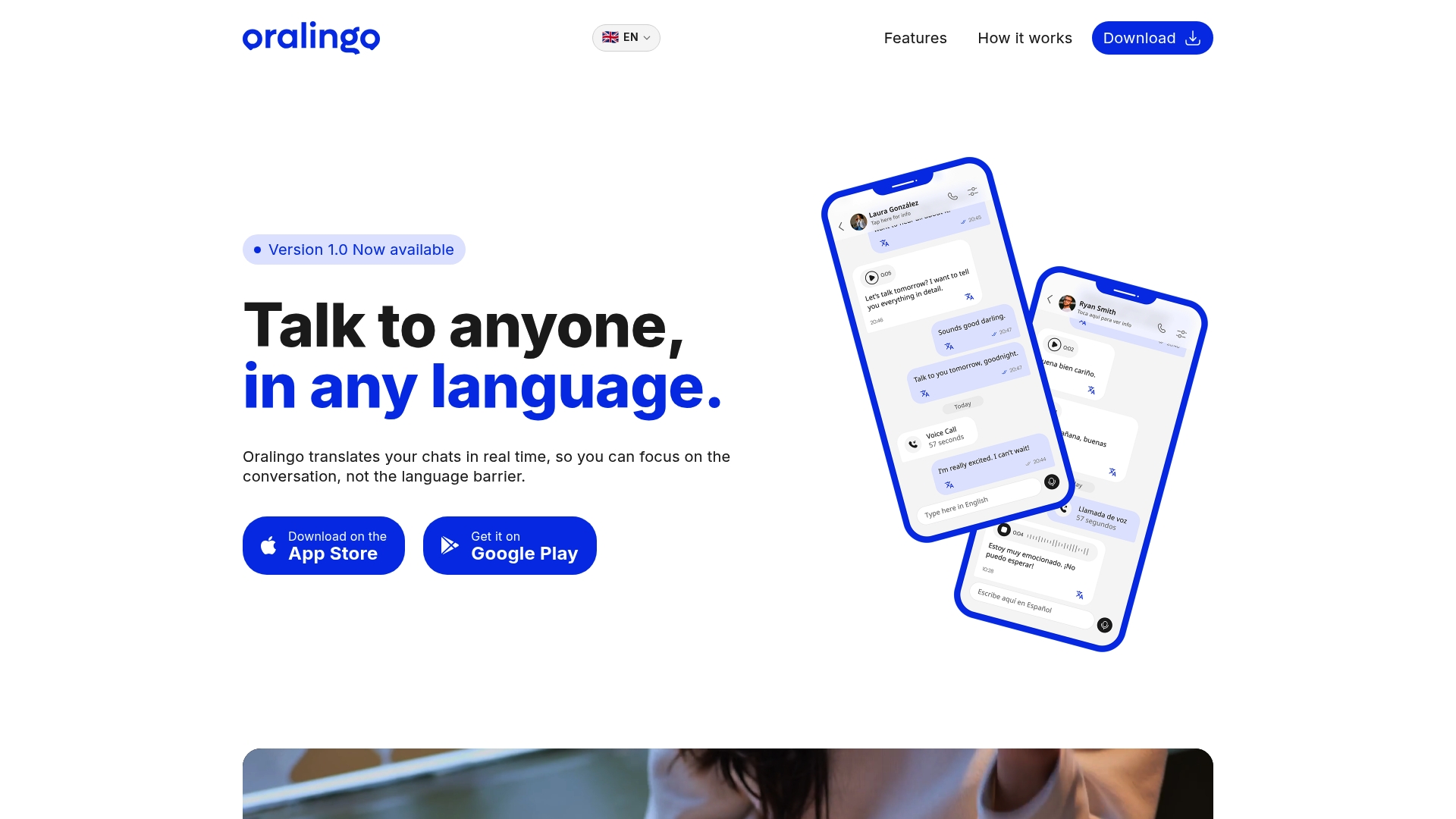
Start with the Oralingo landing page and install it on your phone. Open a conversation, confirm the end-to-end encryption indicator in settings, and set your language pair. Then run the same pilot you'd run on any app: say a few domain-specific words from your work or family vocabulary, switch to hands-free voice mode for a short back-and-forth, and pay attention to how quickly the translation lands. Oralingo's pre-delivery translation means the other person only ever sees the finished, translated message, not a rough draft mid-edit.
Free tiers let you get a feel for the basics; paid subscriptions often unlock higher usage caps and additional features for frequent users. Test the app on your hardest conversation, not your easiest one. That's where you'll actually learn whether it holds up.
Sources
- Interpreter in Microsoft Teams meetings and calls
- Real-Time Multilingual Chat Translator (ICISS 2026)