
Confidential cross-language messaging is the practice of translating or interpreting communication between languages while keeping all plaintext, personal data, and sensitive metadata protected from unauthorized access. If you handle any regulated or sensitive content, the single most important step you can take right now is to stop using free, general-purpose translation tools for that content and verify that any provider you use offers end-to-end encryption (E2EE), audit logs, and a signed Business Associate Agreement (BAA) where HIPAA applies.
The core building blocks of a genuinely confidential solution are:
- E2EE or on-device processing so the provider never sees your plaintext
- Key management (BYOK or HYOK) so you control who can decrypt
- Immutable audit logs for regulatory accountability
- Signed NDAs and BAAs for every human linguist who touches your content
- Minimal metadata logging to prevent relationship inference from timestamps and language pairs
Pro Tip: Before you sign any translation or interpretation contract, ask one question: "At what point in your pipeline does plaintext exist, and who can read it?" The answer tells you almost everything you need to know about the provider's real privacy posture.
Table of Contents
- Why does confidentiality matter in multilingual messaging?
- How do human translators and interpreters protect confidentiality?
- What technical safeguards should a confidential translation system have?
- Why are free translation tools risky for sensitive content?
- How do you choose a secure translation or interpretation provider?
- Which sensitive scenarios need the strongest confidentiality controls?
- How does Oralingo approach privacy-first real-time chat translation?
- Key Takeaways
- The trade-off most organizations get wrong
- Oralingo makes private real-time translation practical
- Useful sources and further reading
Why does confidentiality matter in multilingual messaging?
Failing to protect content during translation is not a theoretical risk. When sensitive information crosses a language barrier through an insecure channel, the consequences are concrete: privacy breaches, regulatory fines, reputational damage, and real clinical or legal harm caused by mistranslated or leaked content.
In the United States, three regulated environments carry the highest stakes. Healthcare settings covered by HIPAA require that any vendor handling protected health information (PHI) sign a BAA and implement technical safeguards. Court proceedings require interpreters who meet strict confidentiality standards, and a breach can compromise due process. Government and law enforcement contexts often involve information that, if disclosed, creates national security or civil liability exposure. Each of these settings demands controls that go well beyond what a standard messaging app provides.
The risks organizations should anticipate include:
- Regulatory audit and breach notification under HIPAA, state privacy laws (California's CPRA, for example), or sector-specific rules
- Contractual liability when a vendor's data-use policy conflicts with a client's confidentiality obligations
- Reputational damage from a disclosed breach involving patient, client, or employee data
- Clinical or legal harm when a mistranslation or unauthorized disclosure affects a diagnosis, a verdict, or an employment decision
Industry guidance consistently warns that free translation tools process text in the cloud without guaranteed E2EE and may retain or use submitted data to train models, directly exposing personally identifiable information (PII).
The gap between "we use a translation tool" and "we use a confidential translation workflow" is where most breaches originate.
How do human translators and interpreters protect confidentiality?

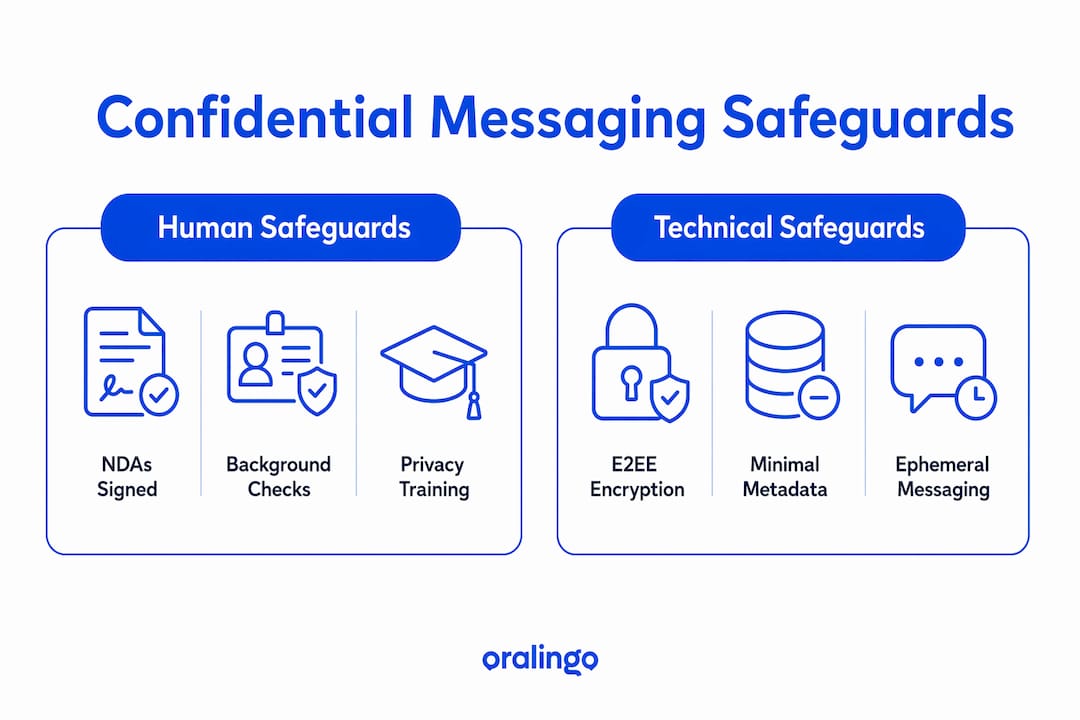
Human safeguards are the foundation. Professional ethics codes, background checks, signed NDAs, BAAs, and explicit data-handling agreements together create the accountability layer that technical controls alone cannot provide.
In the U.S., interpreters in regulated environments — medical, legal, and government — operate under strict confidentiality obligations. HIPAA requires that any interpreter or translation vendor with access to PHI sign a BAA, making them a covered business associate with legal liability for breaches. Court interpreters must meet federal or state certification standards, and many jurisdictions impose confidentiality rules equivalent to attorney-client privilege for what they hear during proceedings. The American Translators Association (ATA) maintains a professional code of ethics that includes confidentiality as a core obligation, and ATA-certified translators carry a credential that signals adherence to those standards.
Operationally, what you should expect from a vendor using human linguists:
- Scoped access: linguists see only the content assigned to them, not full conversation logs
- Vetted and background-checked staff: no anonymous crowd-sourced reviewers for regulated content
- Secure review workflows: content reviewed inside encrypted environments, not emailed as attachments
- Explicit retention and purge policies: written commitments on how long source text is kept and how it is deleted
Red flags are equally clear. Walk away from any vendor that cannot produce a signed NDA or BAA, gives linguists access to raw system logs, uses anonymous crowd-sourced reviewers for sensitive documents, or has ambiguous language in its data-use policy about repurposing submitted content.
Pro Tip: For medical or legal contexts, ask the vendor whether their linguists have completed HIPAA privacy training and whether that training is documented. A "yes" with documentation is a meaningful signal; a vague "they're trained" is not.
What technical safeguards should a confidential translation system have?
The technical core of any confidential cross-language messaging system is minimizing plaintext exposure. That means on-device processing or E2EE combined with confidential compute, robust key management, and minimal metadata logging.
E2EE vs. TLS: a critical distinction
Many organizations mistake TLS (transport layer security) for end-to-end encryption. They are not the same thing. TLS encrypts the connection between your device and a server, but the server itself can decrypt and read your message. In a cloud translation workflow, that means the translation provider has access to your plaintext unless translation happens on-device or inside a Trusted Execution Environment (TEE) with keys the provider cannot access. A multilingual chat application that uses AES-256 encryption with asymmetric key exchange for transport and role-based access controls gets meaningfully closer to genuine E2EE, but the architecture still needs to be reviewed for where plaintext exists during the translation step itself.
On-device vs. cloud vs. hybrid
Each approach involves real trade-offs. Real-time voice translation systems face a genuine engineering tension: on-device processing improves confidentiality but can reduce language coverage and increase latency on lower-powered devices. A hybrid approach, using edge automatic speech recognition (ASR) plus chunked encrypted streaming into confidential compute in the cloud, often hits acceptable latency targets while keeping plaintext out of the provider's reach.

| Approach | Privacy | Latency | Language coverage | Cost |
|---|---|---|---|---|
| On-device only | Highest | Higher on low-power devices | Limited | Low ongoing |
| Hybrid (edge ASR + confidential cloud) | High | Moderate | Broad | Moderate |
| Fully cloud (standard) | Lower | Lowest | Broadest | Lowest |
Key technical components to require
Privacy-preserving translation pipelines combine several controls that you should verify before signing with any vendor:
- Client-side PII detection and redaction before content leaves the device
- On-premises or VPC proxies as the single egress point for any cloud calls
- Envelope encryption with BYOK so your organization holds the master key
- Confidential compute or TEEs for the translation step itself
- Mutual TLS (mTLS) for all service-to-service communication
- Immutable audit logs on WORM storage for regulatory provenance
- Cryptographic deletion (key revocation) as the purge mechanism
Logs and metadata can leak sensitive relationships even when message content is encrypted. Timestamps, language pairs, and communication frequency can reveal who is talking to whom and about what. Immutable audit logs with WORM storage satisfy regulatory requirements, while purge mechanisms and cryptographic deletion address retention limits.
Pro Tip: For high-sensitivity conversations, combine ephemeral messaging (automatic deletion after a set window) with metadata minimization. Products that prevent persistent copies and limit logging of language-pair metadata, similar to patterns used by confidential messaging tools like Confide, reduce the risk that logs become a liability.
Why are free translation tools risky for sensitive content?
Free, general-purpose translation tools are not built for confidential messaging. They are built for convenience, and those two goals conflict directly when your content includes PII, PHI, or legally privileged information.
The core problem is architectural. Free tools typically process text in the cloud without guaranteed E2EE to the provider, and many explicitly reserve the right to use submitted content to improve their models. That means a patient's symptoms, a client's legal strategy, or an employee's HR complaint could become training data. There is no BAA, no audit log you control, no key management, and no contractual accountability.
Specific behaviors that create risk:
- Cloud processing without E2EE: the provider can read your plaintext
- Data retention for model training: submitted content may persist and be reused
- No audit trail: you cannot demonstrate to a regulator that content was handled appropriately
- Unclear or permissive data-use policies: terms of service that allow broad use of submitted text
- Server-side decryption for translation: a common patent-documented architecture that exposes plaintext to the provider
Industry guidance for emergency, medical, and high-stakes contexts recommends offline or government-grade solutions rather than general-purpose public tools.
Practical alternatives when you need machine translation without the exposure:
- Offline or on-device models for languages where coverage is adequate
- Vetted secure providers with documented confidential compute and BYOK
- Redaction or tokenization pipelines that strip PII before any cloud API call
- Private API deployments inside your own VPC with no data leaving your perimeter
How do you choose a secure translation or interpretation provider?
Choose vendors that can prove they keep PII out of untrusted services, provide audit trails you can access, and accept contractual controls including BAAs, NDAs, and evidence of SOC 2 compliance or confidential compute architecture.
Procurement checklist
- Does the product use E2EE? Ask specifically whether the provider can read plaintext during translation, or whether translation happens on-device or inside a TEE.
- Is BYOK or HYOK key management available? You should control the encryption keys, not the vendor.
- Does the vendor accept a BAA? Required for any HIPAA-covered content; refusal is a disqualifier.
- What are the data retention and purge policies? Get specific timelines and the deletion mechanism in writing.
- Are audit logs available to you? You need to be able to pull logs for your own regulatory audits.
- Is confidential compute used for the translation step? Ask for architecture documentation, not just a marketing claim.
- What linguist vetting and NDA processes exist? For human-assisted workflows, ask for evidence of background checks and signed agreements.
Red flags
- No audit logs, or logs you cannot access independently
- Ambiguous data-use language that permits model training on submitted content
- No key management offering; vendor holds all keys
- Refusal to sign a BAA for health-related content
- Crowd-sourced or anonymous reviewers for sensitive documents
Minimum evidence to accept
Request architecture diagrams showing where plaintext exists, sample audit log formats, SOC 2 Type II or ISO 27001 evidence, and willingness to run a small pilot with PII redacted. A vendor confident in their security posture will provide these without hesitation. Best practice pipelines detect and redact PII client-side, use on-premises or VPC proxies as single egress points, and run vendor models inside confidential compute. Use that standard as your benchmark. For a broader view of platform categories, the types of multilingual collaboration platforms guide can help procurement teams frame the right questions.
Which sensitive scenarios need the strongest confidentiality controls?
The right combination of human and technical safeguards depends on the specific use case. Here is a practical mapping.
Medical and telehealth (HIPAA-covered) Minimum controls: BAA with every vendor and linguist, E2EE or confidential compute for the translation step, vetted and HIPAA-trained interpreters, and explicit retention limits. Ideal stack adds BYOK key management and client-side PII redaction before any cloud call. For high-stakes medical conversations, language technology should be treated as an assistive tool with human oversight, not a replacement for a qualified interpreter. Audit logs must be accessible to your compliance team.
Legal and court proceedings Minimum controls: court-certified interpreters who meet federal or state standards, signed NDAs, and no recording or logging beyond what the proceeding requires. For document translation, use ATA-certified translators under NDA with scoped access. Confidential compute for any machine-assisted review. For live negotiation contexts where accuracy and confidentiality both matter, real-time multilingual negotiation practices apply directly.
HR and internal investigations Minimum controls: signed NDAs for all linguists, scoped access (linguist sees only the specific document or conversation), no retention beyond the investigation period, and audit logs. Machine translation is acceptable for initial triage if PII is redacted first; human review is required before any translated content enters a formal record.
Government and classified-adjacent Minimum controls: on-premises or air-gapped processing, government-grade encryption, cleared linguists with appropriate background checks, and zero cloud egress. Hybrid edge-plus-confidential-compute approaches may be acceptable for unclassified but sensitive content; fully cloud approaches are generally not.
Timeline and cost notes: A confidential compute or on-premises pilot typically takes four to eight weeks to stand up. Incremental cost drivers include confidential compute infrastructure, BYOK key management licensing, and vetted linguist rates, which run higher than crowd-sourced alternatives.
Pro Tip: Combine tokenization or redaction with translation to enable safe analytics. Strip names, dates, and identifiers before the text reaches the translation engine, then re-inject them after. This lets you analyze translated content at scale without ever exposing PII to the translation provider.
How does Oralingo approach privacy-first real-time chat translation?
A privacy-first chat translation product must combine E2EE, minimal metadata exposure, and clear contractual controls to be genuinely suitable for sensitive multilingual communication. Oralingo is built around exactly that premise.
Oralingo delivers real-time chat translation across more than 100 languages with a 99% accuracy rate, and its private design applies end-to-end encryption to every conversation. Messages are translated before they are displayed, which means the exchange feels natural and uninterrupted. The hands-free voice mode extends that to verbal communication without requiring users to type, which matters in clinical or field settings where typing is impractical.
For organizations evaluating Oralingo as part of a confidential workflow, the typical deployment pattern looks like this:
- Pilot phase: run a 30–90 day pilot with a defined user group and PII-redacted test content to validate performance and privacy controls
- Contractual setup: confirm BAA applicability for your use case and request architecture documentation
- Integration: connect Oralingo's E2EE layer with your existing key management and audit log infrastructure
- Training and policy: brief users on what the app does and does not log, and set a retention policy aligned with your compliance requirements
How Oralingo maps to the procurement checklist:
- E2EE: built into the product's private design for every conversation
- Real-time translation: messages translated before display, no plaintext stored in transit
- Voice mode: hands-free verbal communication with the same privacy architecture
- Language coverage: 100+ languages, reducing the need to fall back to less secure alternatives
- Accuracy: 99% accuracy rate, reducing the risk of mistranslation in sensitive exchanges
Key Takeaways
Confidential cross-language messaging requires E2EE or on-device processing, signed BAAs and NDAs, immutable audit logs, and BYOK key management — free public tools satisfy none of these requirements.
| Point | Details |
|---|---|
| Avoid free tools for sensitive content | Free translation tools process text in the cloud and may retain data for model training, exposing PII. |
| Require BAAs and NDAs | Any vendor or linguist handling regulated content must sign a BAA (for HIPAA) and an NDA before accessing your data. |
| Verify E2EE, not just TLS | TLS protects the connection; E2EE protects the content from the provider. Ask where plaintext exists during translation. |
| Minimize metadata, not just content | Timestamps, language pairs, and communication frequency can reveal sensitive relationships even when message content is encrypted. |
| Oralingo for privacy-first real-time translation | Oralingo combines E2EE, 100+ language support, and a 99% accuracy rate in a private-by-design chat translation app. |
The trade-off most organizations get wrong
Convenience is valuable. But in regulated contexts, it has to yield to confidentiality. That is not a controversial position, yet most organizations get the balance wrong in the same direction: they adopt a fast, free tool for a low-stakes use case, and then that tool becomes the default for everything, including the sensitive stuff.
The practical heuristic I find most useful is this: if the content would require a signed NDA in a face-to-face meeting, it requires equivalent controls in a digital translation workflow. Medical diagnoses, legal strategy, HR investigations, and government briefings all clear that bar. A casual internal announcement does not.
When to favor human workflows: any situation where a mistranslation could cause direct harm (clinical, legal, safety), where the content is so sensitive that even a vetted machine pipeline feels like too much exposure, or where the regulatory framework explicitly requires a certified human interpreter. When machine workflows are appropriate: high-volume, lower-sensitivity content where speed matters and PII can be redacted before translation. Pilots make sense whenever you are moving a workflow from human-only to hybrid. Run the pilot with redacted content, measure accuracy and latency, and only expand access after your compliance team has reviewed the audit logs.
One organizational reality that gets underestimated: training and consent. Users who do not understand what a translation tool logs, retains, or shares will make poor decisions about what to put into it. A short briefing and a clear acceptable-use policy prevent most of the avoidable incidents.
Oralingo makes private real-time translation practical
Switching to a confidential translation workflow does not have to mean slower conversations or a complicated setup. Oralingo gives you end-to-end encrypted, real-time chat translation across more than 100 languages, with a 99% accuracy rate and a hands-free voice mode that works in clinical, legal, and field settings where typing is not an option.
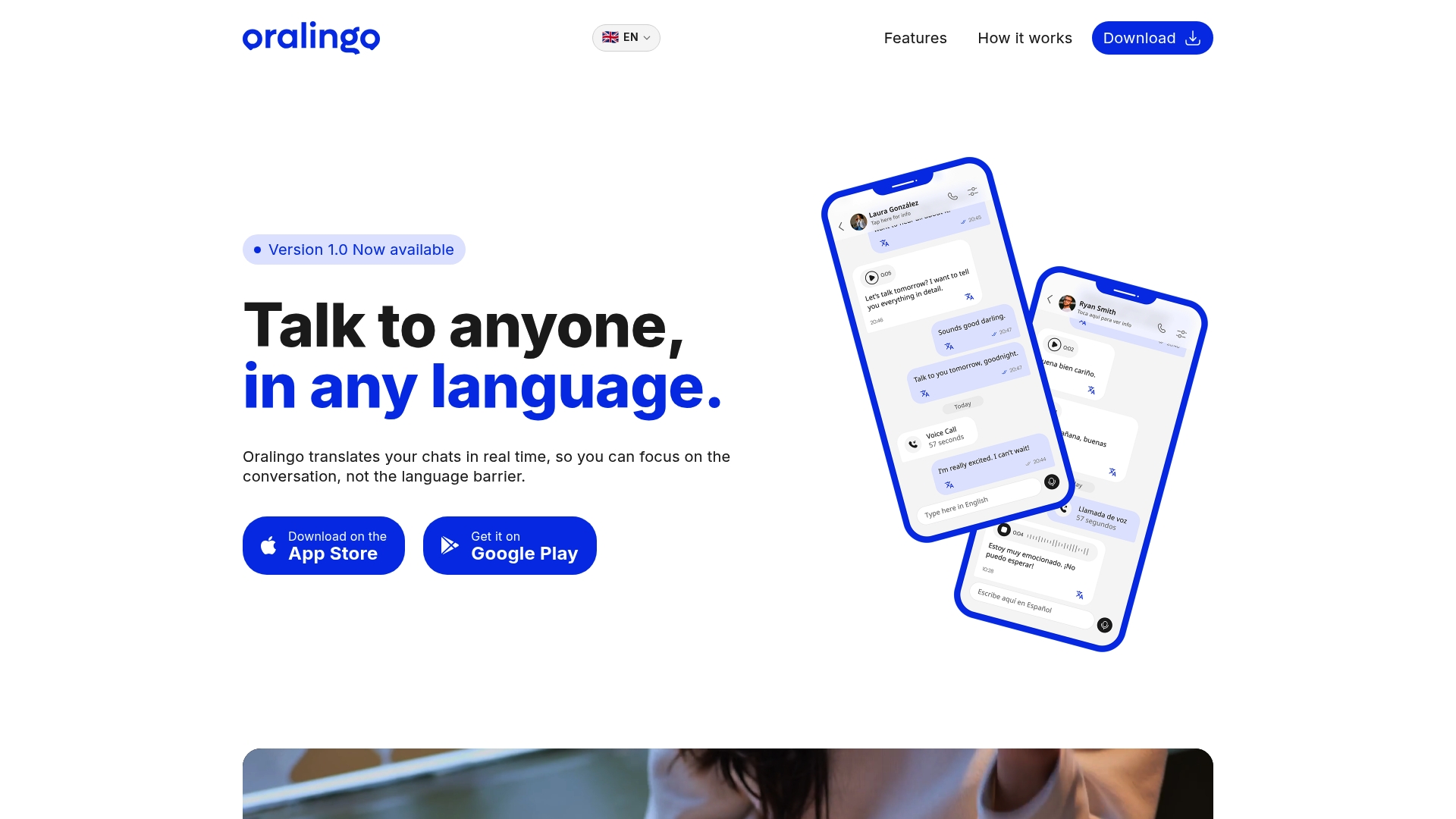
The privacy architecture is built in, not bolted on. Every conversation is E2EE by design, so you can focus on the exchange itself rather than worrying about who else might be reading it. For organizations ready to move from a free, insecure tool to a privacy-first alternative, the next step is straightforward: try Oralingo and request architecture documentation or a BAA discussion for your specific use case. A 30–90 day pilot with your own content is the fastest way to validate that the controls meet your compliance requirements.
Useful sources and further reading
Use these when preparing RFPs, running pilots, or briefing compliance teams. U.S. regulatory references and privacy-preserving architecture resources are prioritized.
- Two-Way Translation Guide (Convey 911): Covers confidentiality obligations for interpreters in U.S. medical, legal, and emergency contexts, including HIPAA and court interpreter standards. Start here for the regulatory framing.
- Privacy-Preserving Translation Pipelines (next-gen.cloud): Technical deep-dive on client-side PII redaction, VPC proxies, envelope encryption, BYOK, and confidential compute. Use this when writing architecture requirements for an RFP.
- Multilingual Chat Application Security (IJSRET V11): Academic treatment of AES-256, asymmetric key exchange, role-based access, and E2EE in a multilingual chat context. Useful for technical teams evaluating cryptographic choices.
- Real-Time AI Voice Translation Architecture (dev.to): Engineering walkthrough of latency vs. privacy trade-offs in voice translation, including edge ASR and confidential compute patterns.
- American Translators Association (atanet.org): The primary U.S. professional body for translators. Use to verify ATA certification and review the professional code of ethics that governs confidentiality obligations.
- Confide Confidential Messenger: Product reference for ephemeral messaging and metadata minimization patterns. Useful when evaluating whether a messaging tool's design limits persistent copies of sensitive content.
- Integrated Instant Messaging with Built-In Translation (patent summary): Documents common server-side decryption architectures in translation-enabled messaging systems. Read this to understand what "translation with encryption" often actually means under the hood.
This article provides general information about confidentiality practices in cross-language messaging and is not legal, medical, or compliance advice. Confirm current regulatory requirements with a qualified attorney, compliance officer, or the relevant primary source for your specific situation.