
The fastest way to identify your English dialect is to take the NYT U.S. Dialect Quiz, which maps your vocabulary choices to the cities whose speakers sound most like you. For British and Irish varieties, the NYT British-Irish Dialect Quiz does the same job. If you want academic depth, the English Dialect Survey by Caleb Ziems classifies you among dozens of cataloged varieties using acceptability-judgment tasks.
Here is what each quiz returns at a glance:
- NYT U.S. Quiz: A heat map of the U.S. showing your most-similar cities, built from Harvard Dialect Survey items.
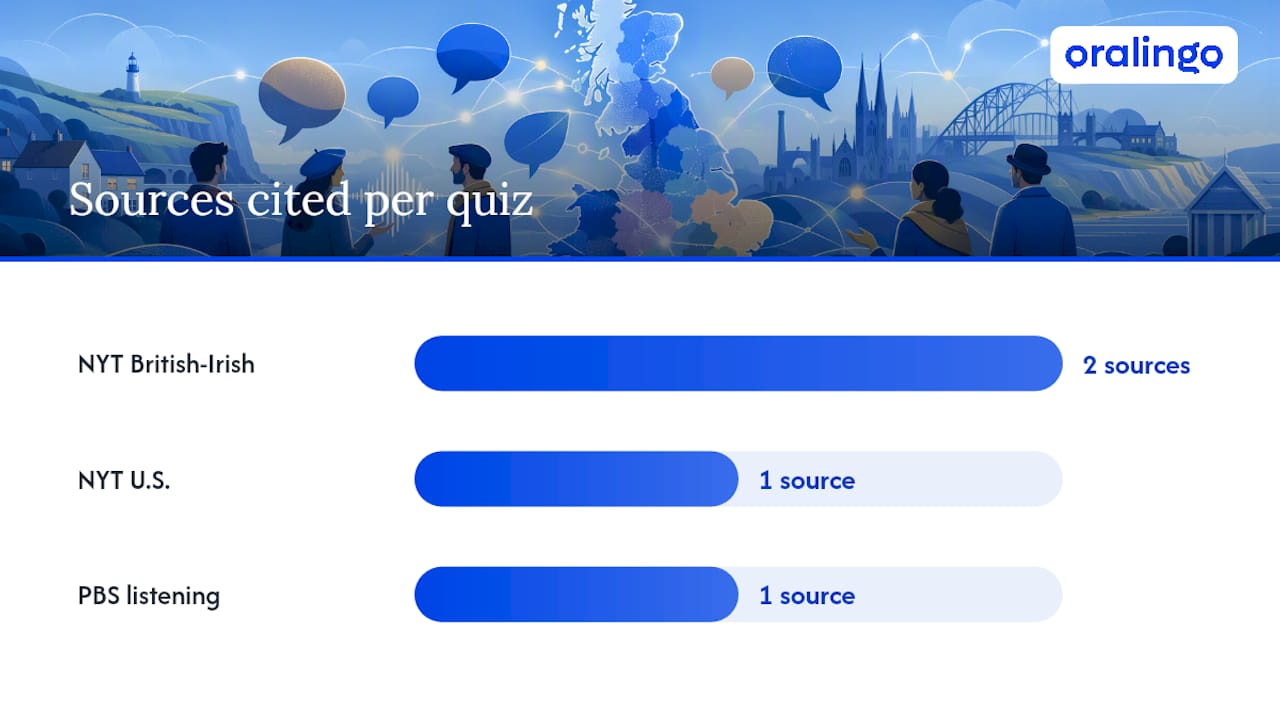
- NYT British-Irish Quiz: A regional match across Britain and Ireland, with sources including the Survey of English Dialects and BBC Voices.
- English Dialect Survey: A classification among 77 cataloged English varieties based on your grammatical acceptability judgments.
Pro Tip: Answer every question based on how you talk with close friends or family, not how you think you should speak. That one shift makes the result far more accurate.
Key Takeaways
Research-backed dialect quizzes map your vocabulary and pronunciation choices to probabilistic regional matches, not fixed labels, so treat results as a starting point for exploration.
| Point | Details |
|---|---|
| Best first quiz | The NYT U.S. Dialect Quiz uses Harvard Dialect Survey items and returns a visual city heat map. |
| Answer for casual speech | Choose the word or form you use with close friends, not the one you think sounds correct. |
| Results are probabilities | Your match shows which regions' speakers made similar choices, not where you are definitively from. |
| Limitations are real | Sample bias, language change, and regional mixing all affect accuracy; try a second quiz to check the pattern. |
| Follow up actively | Listen to regional recordings, explore dialect maps, and use a tool like Oralingo for live cross-dialect practice. |
Table of Contents
- Which English dialects quiz should you take first?
- How do dialect quizzes actually identify a regional variety?
- How to answer so the quiz captures your real speech
- What do your quiz results actually mean?
- What research backs the best dialect quizzes?
- Dialect quizzes are tools, not verdicts
- Where to take the quizzes and read the research
- Sources
Which English dialects quiz should you take first?
Choosing the right quiz depends on what you want to learn. The table below lays out the key differences so you can pick the one that fits your goal.
Quick verdicts:
- Start with the NYT U.S. Quiz if you grew up in America and want a fast, visual result on a map.
- Try the NYT British-Irish Quiz if you have UK or Irish roots, or you just want to test your dialect knowledge across the Atlantic.
- Use the English Dialect Survey when you want a more rigorous, research-style classification. Some quiz platforms note that anonymized results may be shared with academic consultants to support ongoing research.
- Visit the PBS audio exercise if you are curious about how pronunciation alone places a speaker on the map.
How do dialect quizzes actually identify a regional variety?
Quizzes use three main types of markers to pin down where your speech comes from.
Lexical choices are the most common. Do you call a carbonated drink "soda," "pop," or "coke"? Do you say "you guys," "y'all," or "youse"? These vocabulary splits are geographically consistent enough that a single highly distinctive answer can shift your probability map more than a dozen neutral ones. The NYT U.S. Quiz leans heavily on this approach, tying each question to Harvard Dialect Survey items that target historically informative contrasts rather than passing slang.
Pronunciation contrasts add another layer. The vowel in "aunt," the way you merge "pin" and "pen," or whether "cot" and "caught" sound identical to you are all acoustic signals. Quizzes that combine vocabulary checklists with a small set of well-chosen audio samples tend to produce better geographic resolution than vocabulary-only tools. The PBS listening exercise, developed by Drs. Cynthia Clopper and David Pisoni, demonstrates exactly this: 12 audio samples, each matched to a U.S. region, showing how acoustic cues alone can place a speaker.
Acceptability judgments are the most academic approach. Instead of asking what word you use, these tasks present a sentence and ask whether it sounds natural to you. "I might could do that" reads as perfectly normal in parts of the American South; elsewhere it sounds ungrammatical. The English Dialect Survey uses this method to classify respondents among 77 cataloged varieties.
How to answer so the quiz captures your real speech
The single most important instruction is this: answer for the way you talk when you are relaxed, not the way you think you should talk. The NYT British-Irish Quiz makes this explicit, telling respondents to choose the option closest to their casual speech. The English Dialect Survey goes further, advising participants to focus on a single speech setting throughout.
A few practical tips:
- Pick your most frequent form. If you sometimes say "soda" and sometimes "pop," go with whichever one comes out first when you are not thinking about it.
- Think of a specific conversation. Picture chatting with a sibling or a close friend. What word would you use there?
- Do not second-guess regional identity. If you grew up in one place but moved, answer for the dialect you acquired first, unless you feel your speech has genuinely shifted.
- For audio tasks, use headphones in a quiet room. Ambient noise makes it harder to catch the subtle vowel differences that distinguish, say, a Boston accent from a New York one.
Pro Tip: If a question stumps you because you genuinely use multiple forms, pick the one you would use in a text message to a friend. Texting tends to pull out your most natural, unguarded register.
What do your quiz results actually mean?
Your result is a probability, not a passport stamp. The NYT U.S. Quiz, for example, does not declare you a Midwesterner. It shows which cities' speakers made the same choices you did, weighted by how geographically distinctive each answer was. A result pointing to Minneapolis and Chicago means your speech pattern overlaps most with those regions, not that you are from there.
Dialect quizzes are best read as a mirror, not a label. They reflect the speech patterns you have absorbed over a lifetime, which may span multiple regions, social groups, and age cohorts. A result that surprises you is often the most interesting one to explore further.
Common limitations to keep in mind:
- Small sample bias. Online quizzes attract self-selected participants, which can skew geographic distributions.
- Language change. Dialects shift over generations. A quiz built on data from a decade ago may not capture the speech of younger speakers accurately.
- Social factors. Age, class, education, and peer group all shape dialect. A quiz cannot account for all of them.
- Regional mixing. If you grew up in multiple places or in a multilingual household, your results may spread across several regions rather than pinpointing one.
After you get your result, listen to regional recordings on platforms like the BBC's dialect resources to hear what your matched variety actually sounds like. Then try a second quiz to see whether the pattern holds.
What research backs the best dialect quizzes?
Well-designed quizzes do not invent their questions. They draw on established survey instruments and then validate results by mapping respondent patterns to geographic probability distributions.
The three most cited sources in reputable quizzes are:
- Harvard Dialect Survey: A large-scale U.S. survey of regional vocabulary and pronunciation differences, whose items form the backbone of the NYT U.S. Quiz.
- Survey of English Dialects: A mid-20th-century British fieldwork project that documented regional speech across England, cited by the NYT British-Irish Quiz.
- BBC Voices: A more recent BBC project collecting spoken samples and self-reported dialect data across the UK, also consulted for the NYT British-Irish Quiz.
On the computational side, research documented on arXiv shows how machine-learning approaches can classify dialect varieties at scale, supporting the kind of probabilistic mapping that makes modern quizzes more accurate than simple scoring systems.
Transparency matters too. Some quiz platforms note that anonymized demographic data may be shared with academic consultants, as the BBC-inspired quiz disclosed. That practice helps researchers refine geographic models over time.
| Research source | What it contributes | Quizzes that cite it |
|---|---|---|
| Harvard Dialect Survey | U.S. lexical and pronunciation items | NYT U.S. Dialect Quiz |
| Survey of English Dialects | British regional fieldwork data | NYT British-Irish Dialect Quiz |
| BBC Voices | UK spoken samples and self-report data | NYT British-Irish Dialect Quiz |
| Clopper & Pisoni acoustic research | Audio-based regional classification | PBS listening exercise |
Dialect quizzes are tools, not verdicts
Dialect quizzes are one of the most accessible ways to start paying attention to how you actually speak, and that awareness is genuinely useful. But they work best when you treat the result as a starting point rather than a final answer. Your speech is shaped by where you grew up, who you spent time with, and how you have moved through the world. A quiz can surface that history in a few minutes. What you do with that information is the interesting part.
One thing worth keeping in mind: a dialect result is not a social category. Knowing that your speech patterns align with a particular region does not mean you belong there, or that people from that region speak the same way you do. Linguistic diversity within any region is enormous, and quizzes necessarily flatten that complexity. Use the result to get curious, not to draw boundaries.
If you want to take the next step and actually practice talking across dialects and languages, Oralingo lets you chat in real time with speakers of other languages and varieties. It translates before the message displays, so the conversation stays natural. That kind of live practice is where quiz results start to feel real.
Where to take the quizzes and read the research
For live language practice after your quiz, Oralingo supports real-time chat translation across 100+ languages, so you can put your dialect curiosity to work in actual conversations. You can also explore how translation apps handle real conversations to understand what happens when dialects meet across languages.
Sources
- The U.S. Dialect Quiz: How Y’all, Youse and You Guys Talk - The New York Times
- English Dialect Survey
- Do You Speak... American Varieties | PBS
- Do you have a secret British accent? - BBC
- arXiv paper on computational dialect classification