
Spanish varies mainly in three ways: pronunciation (how sounds are produced), everyday vocabulary (which word a region uses for the same object), and a small set of grammatical choices (which pronouns and tenses speakers prefer). These are the core examples of Spanish regional dialect differences you will hear the moment you cross a border or switch on a foreign TV channel.
Here are six paired examples to show the scale right away:
- Bus: autobús (Spain) / colectivo or bondi (Argentina) / micro (Chile) / guagua (Cuba, Puerto Rico)
- Straw: pajita (Spain) / popote (Mexico) / sorbeto (Puerto Rico)
- Popcorn: palomitas (Mexico, Spain) / pochoclo (Argentina) / cabritas (Chile)
- "You all": vosotros (Spain) / ustedes (all of Latin America)
- "Where are you?": ¿Dónde estás? (universal) vs. ¿Dónde estáh? (Caribbean, with aspirated final /s/)
- "I have eaten": He comido (Spain, present perfect preferred) / Comí (most of Latin America, simple preterite preferred)
These differences come from distinct pronunciation systems, pronoun grids, and regional word sets that developed over centuries of geographic separation. Most varieties remain mutually intelligible, though fast local speech and heavy regional slang can slow comprehension until your ear adjusts.
Key Takeaways
Spanish regional dialect differences span pronunciation, vocabulary, and grammar, and recognizing all three layers is what separates a learner who understands one variety from one who can follow any Spanish speaker.
| Point | Details |
|---|---|
| Pronunciation varies most visibly | Distinción vs. seseo, /s/ aspiration, and Rioplatense sh/zh are the features you will hear in every sentence. |
| Vocabulary gaps are region-specific | Words like guagua, colectivo, and popote replace each other across regions; learn 10–15 key terms before engaging with a new variety. |
| Grammar differences are few but high-impact | Voseo, the absence of vosotros in Latin America, and preterite vs. present perfect preferences are the three you need to know first. |
| Mutual intelligibility is real but not effortless | Most varieties are broadly understandable, but Chilean and Caribbean Spanish require extra ear-training due to speed and sound reduction. |
| Oralingo bridges gaps while you learn | Real-time translation keeps conversations flowing in dialect-mixed settings and highlights which regional words to study next. |
Table of Contents
- What are the major Spanish dialect groups and where do you hear them?
- How do Spanish pronunciation differences actually sound?
- Everyday vocabulary that changes across regions
- Grammar and pronoun differences you need to know
- Can speakers from different regions understand each other?
- What linguists and recent studies show about dialect divergence
- How to practice recognizing and adopting a regional variant
- Why noticing dialect differences makes you a better learner
- Real-time translation tools and regional Spanish: when they help
- Sources
What are the major Spanish dialect groups and where do you hear them?
Spanish is spoken across more than 20 countries, and linguists group its varieties into broad regional clusters rather than single monolithic accents. Think of each cluster as a family of related accents sharing key features.
Peninsular (Spain): Characterized by distinción (the /θ/ sound for c before e/i and z), use of vosotros, and a relatively strong pronunciation of final consonants. Castilian Spanish from Madrid is the reference point for many learners, but Andalusian and Canarian Spanish inside Spain diverge significantly.
Andalusian / Canarian: These southern and island varieties use seseo (or ceceo in parts of Andalusia), aspirate or drop syllable-final /s/, and share several features with Caribbean Spanish. The Canary Islands served as a staging point for colonization, which is why Canarian and Caribbean speech sound strikingly similar.
Mexican and Central American: The largest Spanish-speaking population in the world resides in Mexico and Central America. Mexican highland speech (especially Mexico City) is considered relatively conservative, with clear vowels and strong consonants. Central American varieties show more variation, with Honduran Spanish often cited as particularly distinctive.
Caribbean (Cuba, Puerto Rico, Dominican Republic, coastal Venezuela and Colombia): Fast speech, heavy aspiration or deletion of syllable-final /s/, weakening of intervocalic consonants, and a musical rhythm influenced by African language contact. Puerto Rican Spanish also shows notable English influence.
Andean (highland Colombia, Ecuador, Peru, Bolivia): Conservative, clear vowel articulation, strong consonants, and a tendency to preserve older vocabulary. Quechua contact has left lexical traces (guagua meaning "baby" in highland areas, for instance).
Rioplatense (Argentina, Uruguay): Immediately recognizable by its Italian-influenced melody, voseo (using vos instead of tú), and the sh/zh realization of ll and y. Buenos Aires Spanish is the reference for this group.
Chilean / Southern Cone: Often ranked among the most challenging for other Spanish speakers to follow. Rapid speech, heavy reduction of unstressed vowels, unique slang (cachai? for "you know?"), and a distinctive intonation pattern set it apart.
Internal variation inside each cluster is real. A speaker from Medellín sounds different from one in Bogotá, and both differ from a coastal Colombian. These are starting points, not fixed categories.
Where to listen: Argentine Netflix productions (El marginal, Okupas) for Rioplatense; Mexican shows (Club de Cuervos, La Casa de las Flores) for Mexican Spanish; Puerto Rican reggaeton for Caribbean features; Spanish news channels (RTVE, Antena 3) for Peninsular reference.
How do Spanish pronunciation differences actually sound?
Pronunciation is where regional Spanish language diversity hits you first. Six features account for most of what you hear.

Distinción vs. seseo vs. ceceo
In northern and central Spain, c before e/i and z are pronounced /θ/, the same sound as English th in think. So zapato (shoe) sounds like /θaˈpato/ and hacer (to do) sounds like /aˈθer/. This is distinción.
Across Latin America and in southern Spain, those same letters merge with /s/. Zapato becomes /saˈpato/. This is seseo, and it covers the vast majority of Spanish speakers worldwide.
Ceceo, found in parts of Andalusia, goes further: speakers use /θ/ for s as well, so casa sounds like /ˈkaθa/. It is a minority feature even within Andalusia.
Minimal pair to practice: Say caza (hunt) and casa (house). In a distinción dialect, they sound different (/ˈkaθa/ vs. /ˈkasa/). In seseo, they are homophones (/ˈkasa/ both).
Yeísmo and the Rioplatense sh/zh sound
Historically, ll (as in calle, street) and y (as in yo, I) were distinct sounds. Today, most Spanish speakers merge them into a single /ʝ/ sound. This merger is called yeísmo.
Rioplatense Spanish takes it further. In Buenos Aires, ll and y are typically realized as /ʃ/ (like English sh) or /ʒ/ (like the s in English measure), depending on the speaker and context. So yo sounds like sho, and calle sounds roughly like ca-she. The voiceless /ʃ/ variant is more common among younger speakers.
Quick test: Listen to an Argentine say lluvia (rain). You will hear something close to shoo-vya rather than the yoo-vya you might expect.
Aspiration and deletion of syllable-final /s/
Caribbean and Andalusian speakers often aspirate or drop /s/ at the end of a syllable. Estás (you are) becomes ehtáh or even etá. Los amigos becomes loh amigo or lo amigo. This aspiration and weakening of final consonants speeds up speech considerably and is one of the main reasons learners find Caribbean Spanish harder to follow at first.
Listening drill: Find a short clip of Dominican or Puerto Rican news. Count how many times you hear a word-final /s/ fully pronounced versus aspirated or dropped. The ratio will surprise you.
The /x/ sound (the letter j)
The letter j (and g before e/i) represents /x/, a back-of-throat fricative. In Spain and Mexico, this sound is strong and clearly audible. In the Caribbean and parts of Central America, it weakens to /h/, almost like a soft English h. So mujer (woman) ranges from a strong /muˈxer/ in Spain to a breathy /muˈher/ in Cuba.
R-variants and final -n
Tapped /ɾ/ and trilled /r/ are standard across dialects, but some Caribbean varieties assimilate or weaken the tapped r in certain positions. Puerto Rican Spanish is also known for a uvular /R/ in some speakers, similar to French r. Final -n in many Caribbean varieties shifts toward a velar /ŋ/ (like English ng in sing), so pan (bread) sounds like pang.
Listen for the /h/-like breath where /s/ should be. Once you can hear it at slow speed, bump back to normal. Three sessions of this drill usually makes the feature click.*
Everyday vocabulary that changes across regions
Vocabulary is where regional Spanish language examples become most immediately practical. The same object can have four or five names depending on where you are.
| English | Spain | Mexico | Argentina | Chile | Cuba / Puerto Rico |
|---|---|---|---|---|---|
| Bus | autobús | camión | colectivo, bondi | micro | guagua |
| Straw (drinking) | pajita | popote | sorbete | pitillo | sorbeto |
| Popcorn | palomitas | palomitas | pochoclo | cabritas | rositas de maíz |
| Car | coche | carro | auto | auto | carro |
| Sandals / flip-flops | chanclas | chanclas | ojotas | chancletas | chancletas |
| Apartment | piso | departamento | departamento | departamento | apartamento |
| Cell phone | móvil | celular | celular | celular | celular |
| Computer | ordenador | computadora | computadora | computador | computadora |
| Juice | zumo | jugo | jugo | jugo | jugo |
| To drive | conducir | manejar | manejar | manejar | manejar |
| Grocery store | supermercado | tienda, super | almacén, kiosco | almacén | bodega |
| Baby | bebé | bebé | bebé, nene | guagua | nene |
A few usage notes worth keeping in mind:
- Bondi (Argentina for bus) is colloquial and informal. Use colectivo in writing or formal contexts.
- Guagua means "bus" in Cuba and Puerto Rico but "baby" in the Andean highlands (Ecuador, Bolivia, Peru). Context prevents confusion, but it is worth knowing.
- Piso in Spain means "apartment" or "floor." In Latin America, piso almost always means "floor" only. Saying tengo un piso in Mexico sounds like you own a floor, not a home.
- Ordenador for computer is specific to Spain. Everywhere else, computadora or computador is standard. Using ordenador in Mexico marks you immediately as a Spain-trained learner.
- The Royal Spanish Academy (RAE) and the Diccionario de americanismos document these regional preferences and their register levels, making them the go-to references when you need to know whether a word is standard, colloquial, or potentially offensive in a given country.
Grammar and pronoun differences you need to know
Three grammatical features account for most of the morphosyntactic variation learners encounter. Master these and you will handle the vast majority of regional grammar differences in Spanish.
1. Voseo vs. tú
In Argentina, Uruguay, and parts of Central America (especially Costa Rica, Guatemala, and El Salvador), speakers use vos instead of tú for the informal singular "you." This is voseo, and it comes with its own verb conjugations.
Parallel examples:
- Tú hablas (you speak) → Vos hablás
- Tú tienes (you have) → Vos tenés
- Tú eres (you are) → Vos sos
- Tú quieres (you want) → Vos querés
The pattern for regular voseo present tense: drop the r from the infinitive and add a stressed -ás (for -ar verbs), -és (for -er verbs), or -ís (for -ir verbs). Voseo is not a single uniform system across all regions, though. Conjugation patterns and social registers vary, so learning the local form for your target country matters more than memorizing one universal rule.
2. Vosotros vs. ustedes
Spain uses vosotros for informal plural "you all" and ustedes for formal plural. Latin America dropped vosotros entirely: ustedes covers both formal and informal plural in every Latin American country. This means the vosotros conjugations (habláis, tenéis, sois) are essentially invisible to Latin American learners unless they study Peninsular Spanish specifically.
Parallel examples:
- Spain: ¿Vosotros queréis café? (Do you all want coffee? informal)
- Latin America: ¿Ustedes quieren café? (same meaning, same register)
3. Present perfect vs. simple preterite
Spain strongly prefers the present perfect (he comido, I have eaten) for recent past events connected to the present. Most of Latin America uses the simple preterite (comí, I ate) for the same situations.
- Spain: Esta mañana he desayunado tarde. (This morning I have had breakfast late.)
- Mexico / Argentina: Esta mañana desayuné tarde. (This morning I had breakfast late.)
Both are grammatically correct. The preference is regional, not a matter of right or wrong.
4. Other morphosyntactic notes
Clitic doubling (using both a pronoun and a noun object in the same clause, as in Le dije a María or Lo vi al chico) is more common in Rioplatense and some Andean coastal varieties than in Peninsular or Mexican Spanish. It is grammatically accepted but sounds redundant to speakers from other regions.
Can speakers from different regions understand each other?
Yes, generally. Spanish dialects are mutually intelligible overall, and a speaker from Madrid can hold a conversation with one from Buenos Aires or Mexico City without a translator. That said, comprehension is not automatic or effortless, especially at normal conversational speed.
The main friction points are:
- Speed and reduction: Caribbean and Chilean speakers tend to speak fast and reduce syllables heavily. A Cuban dropping every final /s/ while speaking at full speed can genuinely challenge a learner trained on Mexican or Peninsular Spanish.
- Local slang and idioms: Every region has expressions that do not travel. Argentine che (hey, buddy), Chilean cachai (you know?), and Mexican güey (dude) are all widely known, but deeper regional slang can stop comprehension cold.
- Extreme localisms: Rural vocabulary, indigenous loanwords, and hyper-local food or object names are the hardest to decode. A Bolivian ch'uño (freeze-dried potato) or a Chilean once (afternoon tea) will not appear in any standard textbook.
- Intonation mismatch: Even when words are clear, unfamiliar intonation patterns can make a sentence sound like a question when it is a statement, or vice versa.
Quick strategies when comprehension breaks down:
- Ask the speaker to slow down: ¿Puedes hablar más despacio?
- Request a rephrasing: ¿Puedes decirlo de otra manera?
- Use context and cognates aggressively. Spanish shares a large vocabulary with English through Latin and French, and context fills gaps faster than you expect.
- Learn 10–15 high-frequency regional words before visiting or consuming media from a specific country. Knowing that guagua means bus in Cuba before you land saves real confusion.
- When you produce speech, a slightly slower pace and clear consonants will make you understood almost anywhere.
What linguists and recent studies show about dialect divergence
Dialectology research consistently finds that Spanish dialects sit on a spectrum from conservative to innovative, and that geography, urbanization, and historical contact all shape where a variety lands on that spectrum.
Key finding from recent dialectology research: Conservative varieties, including central Mexican highland speech and Andean highland Spanish, preserve older phonological and lexical features, while innovative varieties in Andalusia, the Canary Islands, and the Caribbean coasts show faster rates of change and greater divergence from a Peninsular norm. Urbanization and mass media drive a centripetal leveling force, pulling urban speech toward shared pan-regional forms, while rural areas preserve local variants longer.
Research published in Dialectologia documents these conservative versus innovative regional patterns and shows that media and city speech accelerate homogenization, while rural communities act as preservers of local lexical and phonological features.
Chilean and Honduran Spanish are frequently cited by linguists as among the most divergent varieties. Chilean Spanish combines rapid vowel reduction, unique intonation, and a dense layer of local slang that even experienced Spanish speakers from other countries find challenging. Honduran Spanish shows distinctive phonological features and lexical choices that set it apart from neighboring Central American varieties.
The media and dubbing industry reflects this reality. Professional localization rarely uses a single "universal" Spanish. Large productions typically create at least two versions: one for Spain and one for a neutral Latin American audience. High-budget projects sometimes add a specific Rioplatense version for Argentina and Uruguay, recognizing that voseo and the sh/zh realization of ll/y are too distinctive to paper over with a generic dub. This industry practice, documented in Wikipedia's overview of Spanish dialects and varieties, is one of the clearest signals that the dialect splits are real and commercially significant.
The concept of español neutro (neutral Spanish) emerged from this need. Learners and media professionals use it to reach broad Latin American audiences, but it trades local authenticity for broad intelligibility. If you want to connect naturally with people from a specific country, neutral Spanish is a starting point, not a destination.
How to practice recognizing and adopting a regional variant
The most efficient path follows three steps: listen, shadow, produce. Here is how to build that into a real practice routine.
-
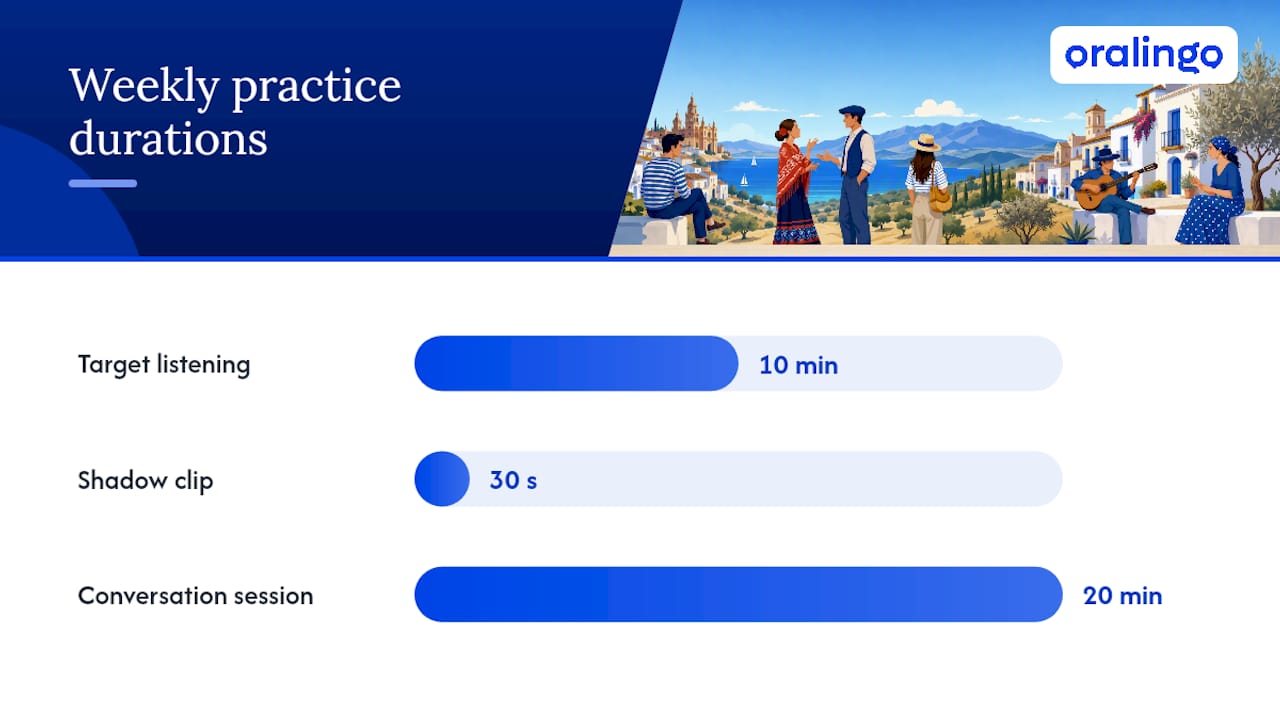
Listen with a target. Pick one dialect feature to focus on per week. Start with seseo vs. distinción because it is the most audible contrast and appears in every sentence. Find 10 minutes of audio from your target region (a podcast, a YouTube vlog, a TV clip) and listen specifically for that feature. Do not try to catch everything at once.
-
Shadow the audio. Play a 30-second clip and repeat it aloud simultaneously, matching the speaker's rhythm and pronunciation as closely as you can. For Rioplatense sh/zh, shadow sentences with ll and y words: Yo me llamo, llueve hoy, ella ya llegó. For Caribbean /s/ aspiration, shadow: Estás bien, los amigos, más o menos. Slowing audio to 75–80% speed for the first few passes makes the feature audible before you try to reproduce it.
-
Produce in conversation. Use a language exchange partner from your target region (iTalki, Tandem, or HelloTalk all connect you with native speakers) and consciously apply the feature you practiced. Ask for feedback. One targeted 20-minute conversation session per week produces faster progress than hours of passive listening.
Concrete drills by feature:
- Distinción/seseo minimal pairs: practice caza/casa, cocer/coser, cien/sien until you can hear and produce both variants on demand.
- Rioplatense y/ll: record yourself saying yo, lluvia, calle, ella, voy with a /ʃ/ sound and compare to a native clip.
- Caribbean /s/ aspiration: use slowed-down audio from a Dominican or Puerto Rican podcast. Listen for the /h/ breath where /s/ should be, then try to reproduce it in isolated words before full sentences.
Measurement milestones: You are making real progress when you can (a) identify the feature in media without consciously listening for it, and (b) produce it in a conversation without pausing to think. Most learners reach milestone (a) in two to three weeks of targeted listening and milestone (b) in four to six weeks of active shadowing and conversation practice.
Pro Tip: Use a cross-language conversation guide to structure your practice sessions. Having a clear framework for what to listen for, what to produce, and how to measure progress keeps you from drifting into passive consumption that feels productive but builds fewer skills.
For learners who want to track comprehension in real conversations, tools that handle real-time translation can serve as a safety net while you build dialect recognition skills, letting you focus on the conversation rather than panicking over a word you missed.
Why noticing dialect differences makes you a better learner
Most learners spend years studying Spanish without ever consciously noticing that the s in estás disappears in Puerto Rico, or that vos in Argentina carries a completely different conjugation set than tú. That gap costs them. When they finally encounter native speech from a region they have not studied, comprehension drops sharply and confidence follows.
Paying deliberate attention to regional variation from early in your learning does something specific: it trains your ear to tolerate acoustic variation. A learner who has heard both distinción and seseo is not thrown when a Spanish speaker from Seville sounds different from their Mexican teacher. A learner who knows voseo exists does not freeze when an Argentine says ¿Vos querés? instead of ¿Tú quieres?
The practical suggestion is simple. Before you travel, start a job, or build a relationship that involves Spanish speakers from a specific region, spend two weeks consuming media from that region. Not studying it formally. Just watching, listening, and letting the sounds and words land. Your brain will start pattern-matching faster than you expect. Then layer in the targeted drills from the practice section above, and you will arrive at that conversation with a real head start.
The features covered here, from seseo to voseo to /s/ aspiration, are not exotic edge cases. They are the everyday reality of Spanish as it is actually spoken by hundreds of millions of people. Noticing them is not a distraction from "real" Spanish learning. It is what real Spanish learning looks like.
Real-time translation tools and regional Spanish: when they help
Learning a regional dialect takes time, and sometimes you need to communicate right now. That is where a real-time translation tool earns its place alongside your study routine.

Oralingo translates messages instantly before they are displayed, so you can follow a conversation even when regional vocabulary or fast local speech outpaces your current level. If a Chilean colleague drops cachai or a Cuban contact uses guagua in a context you have not seen before, Oralingo keeps the conversation moving without an awkward pause. Its hands-free voice mode means you can stay focused on the exchange rather than typing frantically, and end-to-end encryption keeps every message private.
Two concrete benefits for dialect-mixed settings: first, instant clarity when regional words or heavy aspiration make a message ambiguous; second, a real-time reference point that helps you notice which words or phrases you keep needing help with, pointing you toward exactly what to study next. That feedback loop is genuinely useful for building dialect recognition over time.
Learning regional features still matters for cultural nuance and long-term fluency. Oralingo is not a replacement for that. It is the tool that keeps you in the conversation while you build those skills. Download Oralingo and see how much easier it is to stay connected across dialects.
Sources
- How Many Spanish Dialects Are There?
- Latin American Spanish vs. Castilian Spanish | Spanish Authority
- Spanish Word Comparisons | Mezzo Guild
- Spanish dialects and varieties - Wikipedia