
Real-time translation technology is defined as software that converts spoken or written language into another language instantly, with no human interpreter required. Language lessons, by contrast, are structured programs designed to build independent fluency, grammar, and cultural understanding over time. Understanding why real-time translation differs from language lessons matters because each tool serves a completely different purpose. One gives you immediate access to communication. The other gives you the ability to communicate on your own. Knowing which to use, and when, changes how effectively you connect with people across languages.
Why real-time translation differs from language lessons: the core technology
Real-time translation runs on neural machine translation (NMT), a form of AI that processes entire sentences for meaning rather than translating word by word. Modern systems use streaming translation pipelines that translate partial utterances as you speak, updating continuously so there is no lag in conversation. This is fundamentally different from how a language student processes speech, which involves recognizing grammar, retrieving vocabulary, and constructing meaning from memory.
The speed advantage is real. Real-time translation now achieves sub-second latency and supports 50+ languages, with 94% of multilingual event professionals either using or actively considering it. That adoption rate reflects how quickly the technology has become a practical standard in professional settings.
The practical benefits extend well beyond speed:
- Cost reduction: AI-powered translation reduces interpretation costs by 60–70% and support staffing expenses by up to 90%.
- Faster resolution: Support teams using native-language AI translation resolve issues 126% faster and report 70% higher customer satisfaction.
- Accessibility: Real-time captions and AR wearables now deliver live translation in large multilingual events, making participation possible for audiences who would otherwise be excluded.
- Speed to market: Businesses can enter new language markets in weeks instead of months.
Language lessons produce none of these immediate outputs. A beginner Spanish class does not help you close a deal in Madrid next Tuesday. That is the core practical gap between the two approaches.
Pro Tip: If you need to communicate across languages right now, real-time translation is the right tool. If you want to communicate independently in six months, start language lessons today. The two goals require different solutions.

What real-time translation gets wrong about communication
Real-time translation excels at literal meaning transfer. It consistently struggles with everything else. Translation technology often misses emotional tone, sarcasm, humor, and the cultural context that makes communication feel natural rather than mechanical.
Consider a simple example. In Japanese business culture, a polite refusal rarely sounds like "no." A translation tool renders the words accurately but misses the social signal entirely. A fluent speaker reads the situation and adjusts. A person relying on translation gets the literal output and walks away confused or, worse, makes a bad decision based on incomplete information.
"Users relying on instant translators may lose the ability to discern subtle emotional meanings. Translation dependency creates gaps in cultural nuance, improvisation, and direct communication confidence that fluent speakers manage intuitively." Source: Human fluency vs instant translation
The cognitive cost of translation dependency is also significant. Over-reliance on translation in early language learning impairs the ability to think in the target language and limits linguistic autonomy. This means the more you lean on a translation tool, the harder it becomes to develop independent language skills. The tool that helps you communicate today can quietly undermine your ability to communicate without it tomorrow.
Relying solely on translation tools also introduces real risks in high-stakes situations. Connectivity failures, privacy concerns, and missed social cues can all derail a conversation at the worst possible moment. Human fluency provides an independence that no app can replicate.
How language lessons build skills that translation cannot
Language learning is not about memorizing words. It is about reconstructing how meaning works inside a different cultural system. Fluency means natural formulation without conscious translation steps. Fluent speakers react and feel language rather than assembling sentences piece by piece.
This distinction has measurable cognitive consequences. Research consistently links independent language processing to stronger memory, more flexible thinking, and improved executive function. These are not side effects of language study. They are direct results of the productive struggle involved in learning to express yourself in a new system.
Here is how language lessons develop skills that translation tools cannot provide:
- Grammar internalization: Lessons teach you to recognize and produce correct sentence structures automatically, without looking anything up.
- Cultural literacy: A good language course teaches you why people say what they say, not just what the words mean. You learn the social rules behind the language.
- Emotional range: You learn to express frustration, warmth, humor, and hesitation in ways that feel natural to native speakers.
- Improvisation: You develop the ability to handle unexpected vocabulary gaps, slang, and fast speech without freezing up.
- Confidence: Speaking without a device between you and the other person builds a different kind of confidence. You own the conversation.
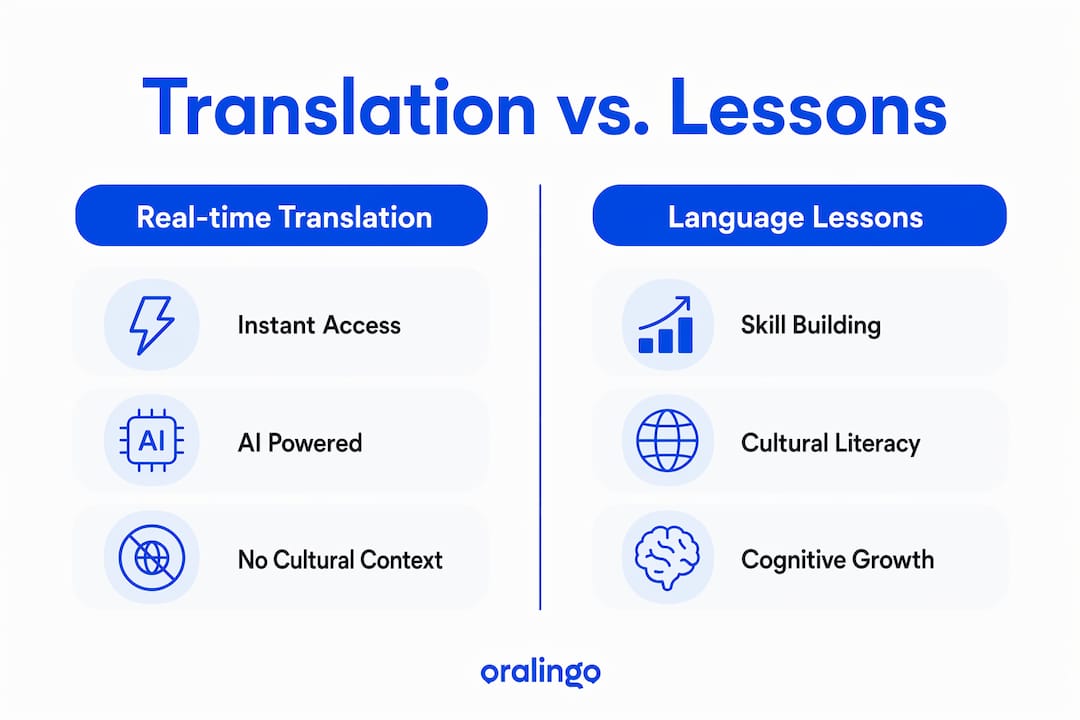
Translation tools support access while language learning builds independence and cultural literacy through active engagement. That is the clearest summary of the difference. Access is not the same as ability.
The cognitive resilience that comes from processing language independently cannot be outsourced to a machine. Every time you struggle to find the right word in a lesson, your brain is doing work that makes you a stronger communicator. Translation skips that work entirely.
How to use both together without losing ground
The most effective approach combines real-time translation and language lessons at the right stages. Translation is useful for reducing anxiety and comprehension gaps early in learning, but learners must wean off it to build true fluency over time. Teachers who understand this use translation as a temporary scaffold, not a permanent crutch.
Here is how the two tools complement each other across learning stages:
- Beginner stage: Use real-time translation to handle live conversations while you build foundational vocabulary in lessons. This keeps communication open without overwhelming you.
- Intermediate stage: Start limiting translation use during practice sessions. Use it only when you hit a genuine wall, not as a first response.
- Advanced stage: Reserve translation for high-stakes or unfamiliar technical contexts. Your lessons should now carry most of the load.
Hybrid methods that work well include reverse translation exercises, parallel text reading, and grammar-translation drills. These techniques use translation as a learning tool rather than a communication shortcut. They force you to engage with the language actively, which is exactly what builds fluency.
Technology plays a support role here, not a replacement role. An app that supports early-stage multilingual communication can reduce the anxiety that stops beginners from practicing at all. That is a genuine benefit. The key is treating the tool as a bridge you eventually cross, not a place you live permanently.
Pro Tip: Track how often you reach for a translation tool during conversations. If the number is not decreasing over time, your lessons need more speaking practice, not more vocabulary lists.
Understanding how translation apps work in real conversations also helps you use them more deliberately. When you know what the technology is doing, you can identify where it is helping and where it is hiding a gap in your own skills.
Key Takeaways
Real-time translation provides instant language access, while language lessons build the independent fluency, cultural literacy, and cognitive resilience that no translation tool can replace.
| Point | Details |
|---|---|
| Different purposes | Translation gives immediate access; lessons build long-term independent communication ability. |
| Technology strengths | NMT achieves sub-second latency and supports 50+ languages, cutting interpretation costs by 60–70%. |
| Translation limitations | Tools miss emotional tone, sarcasm, and cultural context that fluent speakers handle intuitively. |
| Lessons build the brain | Independent language processing strengthens memory, flexible thinking, and speaking confidence. |
| Best combined approach | Use translation as a temporary scaffold early on, then reduce reliance as lessons build real fluency. |
The cognitive edge you give up when you skip lessons
I have watched people choose translation tools over language lessons and call it a practical decision. In the short term, it is. In the long term, it is a trade-off most of them did not fully understand when they made it.
The thing translation cannot give you is the feeling of thinking in another language. That shift, where you stop translating in your head and start reacting directly, changes how you relate to people. You pick up on tone. You catch the joke before it is explained. You notice when someone is being polite but actually saying no. None of that comes from an app.
I also think the dependency risk is underestimated. When you rely on a device to mediate every conversation, you are one dead battery or lost connection away from being unable to communicate. That is a fragile position, especially in travel, business, or any situation where relationships matter.
The future I find most interesting is not translation replacing lessons. It is AI-supported learning that uses translation data to personalize instruction, showing you exactly where your gaps are and building lessons around them. That is where the real value lies. Translation and learning stop competing and start working together in a way that actually accelerates fluency.
Use translation to stay in the conversation. Use lessons to own it.
— Poul
Talk across languages while you build real skills
Real-time translation and language learning do not have to pull in opposite directions. Oralingo gives you both in one place.
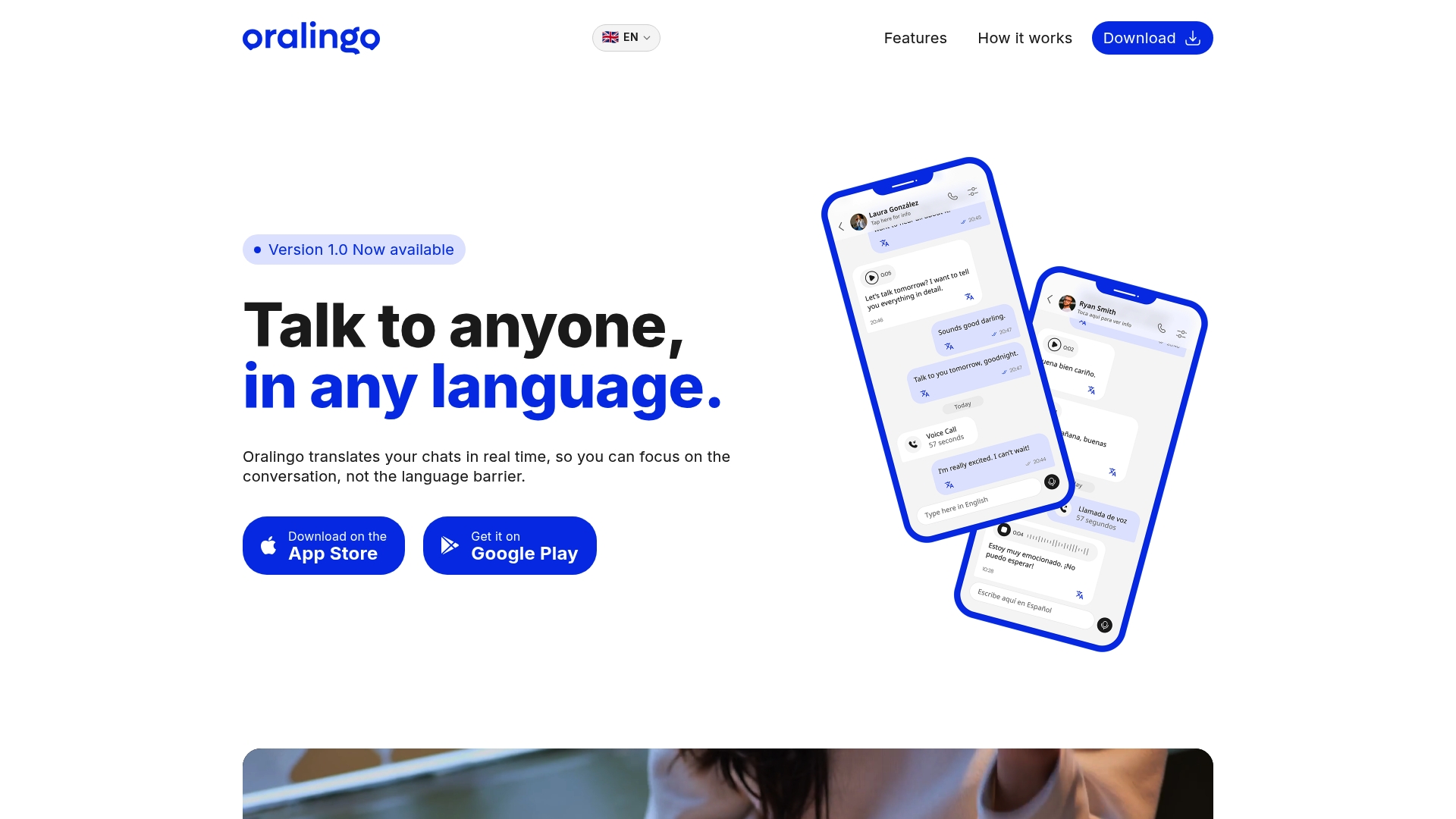
Oralingo translates messages instantly before they appear on screen, so your conversations flow without interruption. With support for over 100 languages and a 99% accuracy rate, you can talk to anyone right now, regardless of what language they speak. The hands-free voice mode means you do not even need to type. Every conversation is end-to-end encrypted, so your exchanges stay private. Whether you are building language skills or just need to communicate clearly today, Oralingo keeps the conversation going while you grow.
FAQ
What is the main difference between real-time translation and language lessons?
Real-time translation converts language instantly using AI, giving you immediate access to communication. Language lessons build independent fluency, cultural understanding, and the ability to speak without any tool.
Can real-time translation replace language learning?
Translation tools cannot replace language lessons because they miss cultural nuance, emotional tone, and the cognitive development that comes from active language practice. They serve different goals.
Does using translation tools slow down language learning?
Over-reliance on translation impairs the ability to think in the target language and limits linguistic autonomy. Using translation as a temporary scaffold, rather than a default, keeps learning on track.
When should I use real-time translation instead of relying on my lessons?
Use real-time translation in high-stakes or unfamiliar situations where communication cannot wait. Use your lessons to build the skills that eventually make the translation tool unnecessary.
How accurate is real-time translation technology in 2026?
Modern real-time translation achieves sub-second latency across 50+ languages. Accuracy is high for literal meaning but lower for emotional tone, sarcasm, and culturally specific expressions.