
Speak once early in class using a short, prepared sentence frame. That single early contribution lowers the psychological barrier for everything that follows. Techniques like think–pair–share and dialogic teaching are backed by classroom research, and tools like Oralingo let you rehearse those frames before you ever walk in.
Quick wins to use right now:
- Prepare two or three talking points before class, not a full script
- Use a bridging phrase to enter without starting cold.
- Aim to speak early, even just one sentence, to break the silence barrier.
- Practice your opener aloud the night before using Oralingo's hands-free voice mode
- Prioritize clarity over perfect grammar every time
Pro Tip: Write your two best talking points on a sticky note and keep it on your desk. Glancing at it mid-class is not cheating. It's preparation.
Table of Contents
- What quick tactics help you join class discussions right now?
- How to prepare before class so you always have something ready to say
- Practice routines and tools to build speaking fluency outside class
- How do teachers grade participation, and how do you meet those criteria?
- Sentence starters and short scripts you can reuse in any class
- A one-week checklist to track your speaking practice
- Key Takeaways
- The part most students skip
- Rehearse your class contributions with Oralingo
- Useful sources and further reading
What quick tactics help you join class discussions right now?
You do not need a perfect sentence. You need a low-risk entry point. Three tactics work in almost any classroom setting.
Early win: Speak in the first ten minutes with something short and factual. "I noticed that the reading focused on X" costs almost no grammar and signals engagement immediately. Preparing two to three points in advance and aiming to contribute early are two of the most consistent pieces of advice from language instructors.
Bridging: Use a peer's comment as your launchpad. "I agree with what [name] said, and I'd add..." lets you skip the cold start entirely. This works in seminars, small groups, and even large lectures when the instructor opens the floor.
Short agreement + add-on: A one-sentence agreement followed by one new idea is a complete, graded contribution. "That's a good point. I think it also connects to..." counts.
| Tactic | Pressure level | Best setting | Example phrase |
|---|---|---|---|
| Early win statement | Low | Any | "The reading mentioned X, which surprised me." |
| Bridging phrase | Low | Seminar, small group | "Building on what [name] said..." |
| Think–pair–share | Very low | Structured class activity | "My partner and I thought..." |
| Short agree + add | Low | Any open discussion | "I agree, and I'd also add..." |
| Chat-to-oral | Low | Online/hybrid | Post in chat, then expand verbally |
Pro Tip: In a lecture with 20+ students, raise your hand before you have a full sentence ready. The few seconds while the instructor calls on you are enough to finish the thought.
How to prepare before class so you always have something ready to say
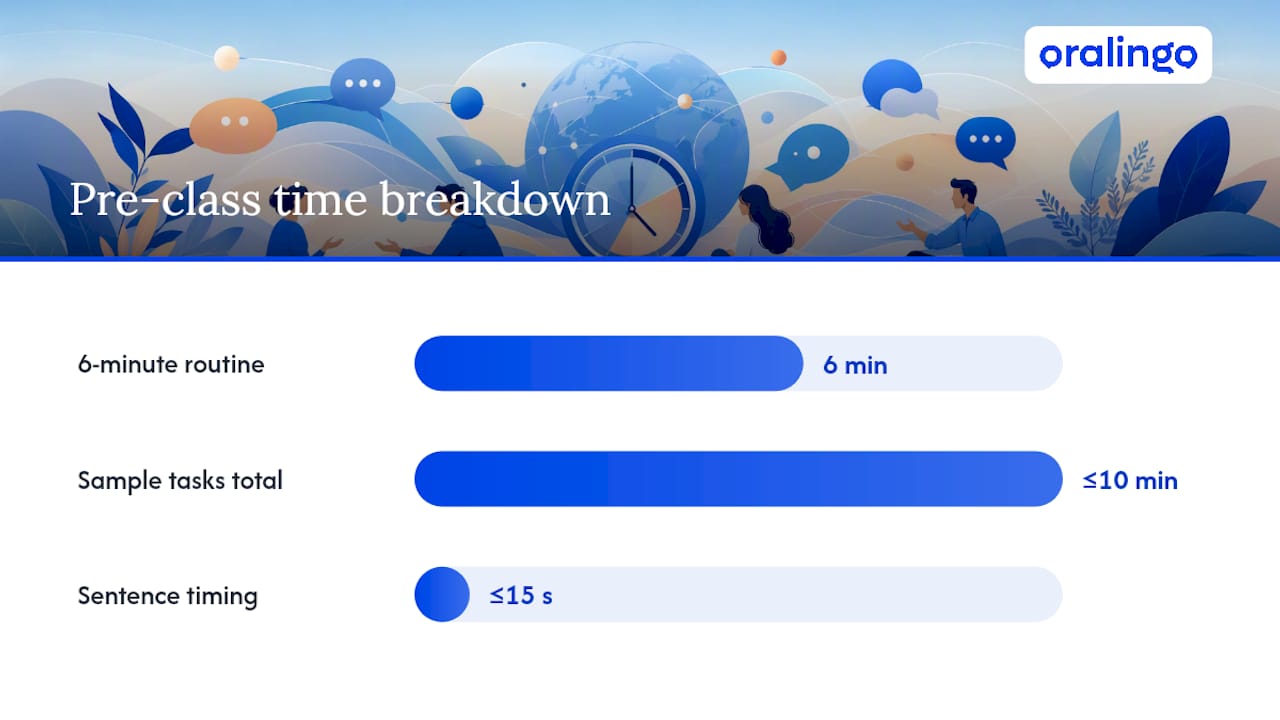
A six-minute routine before each session is enough. Skim the assigned reading for two or three key ideas, write one sentence about each, and note one vocabulary word you want to use out loud. That is your whole prep.
Providing discussion questions in advance and using a shared Google Doc to jot initial ideas gives you a written springboard when speaking feels hard. Short bullet-point prompts, not memorized scripts, act as a visual safety net if you lose your train of thought mid-sentence.
Three sample pre-class tasks:
- Write two questions about the reading you genuinely want answered.
- Draft one sentence that agrees or disagrees with the main argument.
- Say that sentence aloud twice, timing yourself. Aim for under fifteen seconds.
These tasks take under ten minutes. Done consistently, they mean you never sit in class with nothing to say. Check out multilingual collaboration platforms if your class uses shared docs or group workspaces.
Practice routines and tools to build speaking fluency outside class
Two plans work well depending on how much time you have.
- Weekly (one hour): Run a mock seminar with a study partner. Each person takes a position on the week's topic and responds to the other for three turns. Use study group communication strategies to keep the exchange structured.
Oralingo fits naturally into both plans. Its hands-free voice mode lets you speak your practice lines aloud without typing, and its pre-delivery translation means you can check whether your phrasing lands correctly before committing to it in class. With support for over 100 languages, it works whether your target language is Spanish, Mandarin, or Arabic. The British Council's LearnEnglish community discussions are another low-pressure space to practice written and recorded contributions before taking them into a live classroom.
Pro Tip: Use Oralingo to rehearse a three-turn exchange: you speak, it translates, you respond to your own translation. It sounds odd but it trains you to think in the target language fast.
How do teachers grade participation, and how do you meet those criteria?
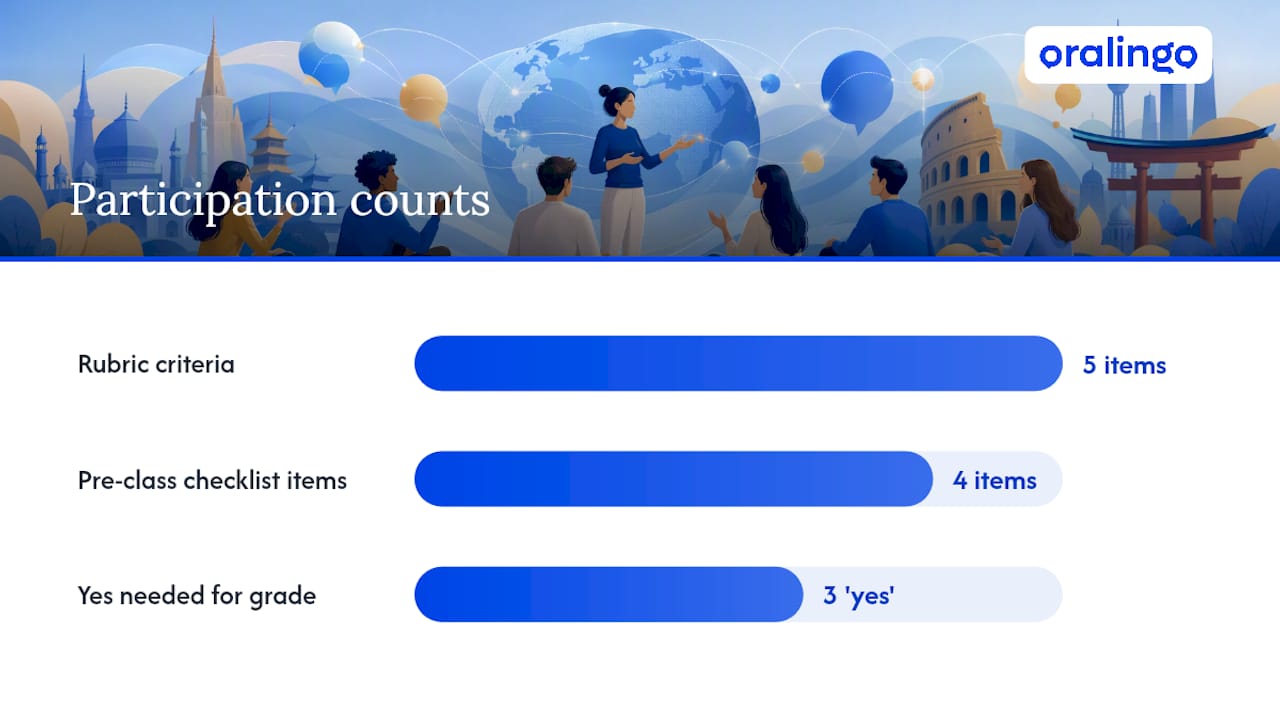
Most participation rubrics score five things: frequency, relevance, evidence of preparation, interaction with peers, and language accuracy. You do not need to score perfectly on all five every session.
Short contributions that reference the reading, build on a peer's point, or ask a clarifying question tend to score well on relevance and interaction even when language accuracy is imperfect. Active listening techniques, like asking a follow-up question, let you participate meaningfully without waiting for full grammatical fluency.
Before each class, check:
- Did I read enough to mention one specific idea?
- Do I have one bridging phrase ready?
- Can I name one classmate's point I want to respond to?
- Have I used at least one target-language vocabulary word this session?
Three "yes" answers from that list usually translate to a solid participation grade.
Sentence starters and short scripts you can reuse in any class
Group these by what you need to do.
Agree and add:
- "I think [name] is right, and I'd also point out..."
- "That connects to what the reading said about..."
Polite disagreement:
- "I see it a little differently. The text suggests..."
- "That's one way to read it. Another interpretation might be..."
Ask for clarification:
- "Could you say more about what you mean by...?"
- "I'm not sure I followed that. Did you mean...?"
Bridge into discussion:
- "Building on that idea..."
- "To add to what was just said..."
For a quick role-play, try this two-turn exchange with a partner: Person A states a position in one sentence. Person B uses a bridging phrase and adds one new idea. Switch. Do three rounds. It takes under five minutes and covers the most common classroom moves. For more conversation flow tips, see this guide to multilingual conversation practice.
A one-week checklist to track your speaking practice
Use this to measure real progress, not just effort.
- Spoke at least once in class (yes/no)
- Used a bridging phrase (yes/no)
- Rehearsed with Oralingo or a study partner (yes/no)
- Noted one new vocabulary word and used it aloud (yes/no)
- Rated comfort level after speaking (1 = very anxious, 5 = confident)
Review these five items every Friday. If your comfort score stays at 1 or 2 for two weeks in a row, go back to pair-only contributions and rebuild from there. If it hits 4 or 5 consistently, push yourself to contribute twice per session.
Key Takeaways
Speaking early, preparing short prompts, and rehearsing aloud outside class are the three habits that most reliably build confidence when you want to participate in class discussions in a foreign language.
| Point | Details |
|---|---|
| Speak early | One sentence in the first 20 minutes lowers the barrier for every contribution after it. |
| Prepare short prompts | Two to three bullet-point talking points before class give you a safety net mid-discussion. |
| Use graded exposure | Move from pair work to small group to whole class over four weeks to reduce anxiety steadily. |
| Track weekly | Regularly rate your comfort level and adjust your participation goal accordingly. |
| Rehearse with Oralingo | Use Oralingo's hands-free voice mode to practice scripts and check phrasing before class. |
The part most students skip
The students who improve fastest in foreign language classes are not the ones with the best grammar. They are the ones willing to say something imperfect early and often. Every stumbled sentence is data. Every bridging phrase you use in class is a rep. The first few weeks feel uncomfortable, and that discomfort is exactly what progress feels like.
Small wins compound. One contribution per class becomes two. Two becomes a habit. The habit becomes fluency. Start with the sticky note, the early sentence, the three-turn Oralingo drill. The confidence follows the action, not the other way around.
Rehearse your class contributions with Oralingo
Oralingo gives you a private, pressure-free space to practice before class. Its hands-free voice mode means you can speak your prepared lines aloud, and its pre-delivery translation checks your phrasing in over 100 languages before you commit to it. Every conversation is end-to-end encrypted, so your practice stays yours.
Try this five-minute drill: open Oralingo, speak your opening statement, read the translation, then respond to it as if a classmate had just said it. Do three turns. That single exercise covers the most common moves in any class discussion. For more on how voice translation works in real conversations, the Oralingo blog breaks it down clearly.
Ready to practice? Download Oralingo and run your first mock discussion today.
Useful sources and further reading
- 8 strategies to foster active participation in language classes
- Supporting foreign-language students in online class discussions
- Integrating dialogic teaching and online discussion forums in foreign language classrooms
- Oral participation & dealing with shy students (FLTeach resource)
- Community discussions | LearnEnglish
- How to Participate in Class Discussions in English (Even if You’re the Only Non-Native Speaker)
- Oralingo — Talk to anyone, in any language.