
Effective multilingual staff training is defined as a structured, role-specific program that builds language proficiency tied directly to business communication goals. With 52% of the global workforce expected to work remotely by the end of 2026, the ability to train remote staff in different languages is no longer a nice-to-have. It is a core operational requirement. Industry standards like the Common European Framework of Reference (CEFR) give teams a shared language for measuring proficiency, while role-based training ensures every hour spent learning connects to real work tasks. The teams that get this right communicate faster, make fewer errors, and onboard new hires more confidently across borders.
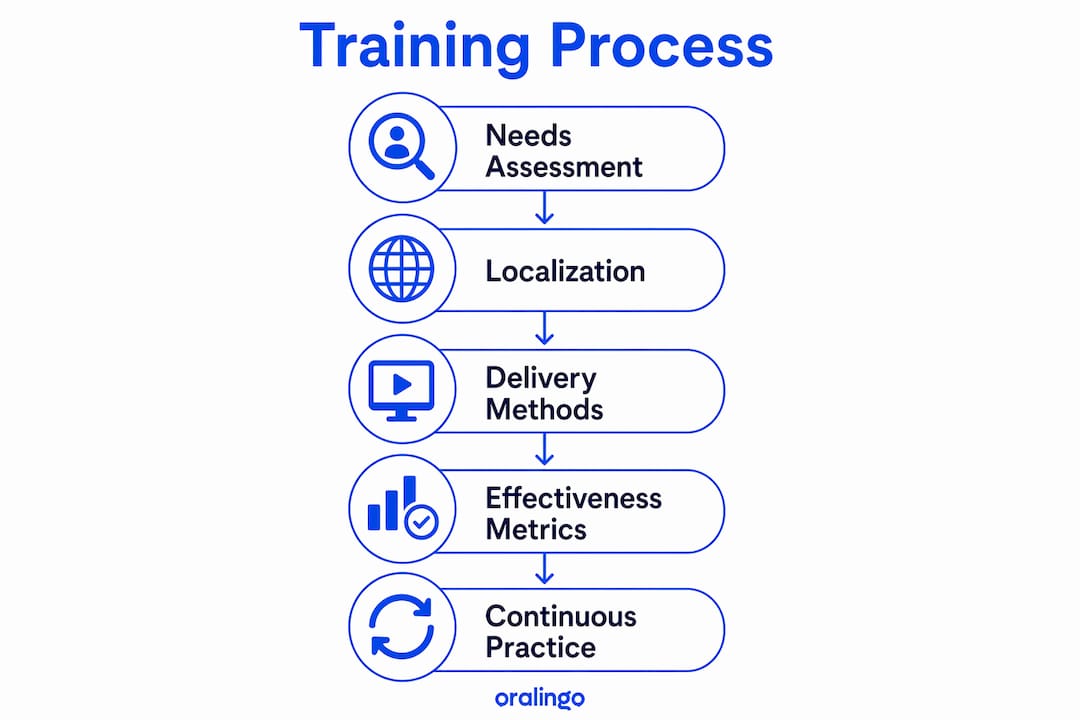
How to train remote staff in different languages: start with a needs assessment
Guessing which languages your team needs is the fastest way to waste your training budget. A proper needs assessment maps every role to its actual communication tasks before a single lesson begins.
- List every role and its communication touchpoints. A customer support agent in Manila needs different language skills than a project manager coordinating with engineers in Berlin. Write out who each role talks to, in what format (written chat, video calls, email), and how often.
- Test actual proficiency, not assumptions. Use standardized diagnostics aligned with CEFR levels (A1 through C2) to measure where each team member stands today. Role-specific proficiency testing based on real communication tasks, rather than abstract grammar quizzes, produces far more useful data.
- Rank languages by business impact. Not every language gap carries equal risk. Prioritize the combinations that affect client relationships, cross-team handoffs, or compliance reporting. A gap in English for a team lead running weekly standups costs more than a gap in a language used only for optional social channels.
- Segment learners by starting point and goal. Group staff by current CEFR level and target proficiency. Someone at A2 heading to B2 needs a different program than a B1 speaker polishing professional writing.
Pro Tip: Ask managers to submit one real communication failure from the past quarter. Those examples reveal the exact language gaps your assessment should target, and they make the business case for training far easier to approve.
Personalized training tied to job role, current proficiency, and real-world scenarios produces measurably better results than generic courses. That specificity is what separates a program that changes behavior from one that fills a compliance checkbox.
How do you localize multilingual training content effectively?
Translation and localization are not the same thing. Translation converts words from one language to another. Localization adapts the meaning, tone, and context so the content feels native to the reader's culture and work environment.
Here is why that distinction matters in practice:
- Direct translation often fails in business contexts. A phrase like "let's circle back" translates literally into many languages but carries no professional meaning outside English-speaking business culture. Localized content replaces it with an equivalent that fits the target culture.
- Localized content improves retention by up to 50% compared to simple translation. Learners engage more deeply when examples, case studies, and scenarios reflect their own business context.
- Style guides prevent inconsistency at scale. When multiple translators or regional teams contribute to a training library, a centralized style guide keeps terminology, tone, and formatting consistent across every language version.
- Regional communication norms shape how feedback lands. A module teaching "how to give constructive feedback" needs different framing for a team in Japan than for a team in the Netherlands. Both cultures value honesty, but the directness and hierarchy involved differ significantly.
Localization of training should incorporate regional communication styles, time zone challenges, and local business context. Without that layer, even a perfectly translated module can feel irrelevant or tone-deaf to the learner.
Use professional localization services for high-stakes content like compliance training, onboarding, and client communication scripts. For lower-stakes internal content, a bilingual subject-matter expert reviewing machine-translated drafts can work well and keeps costs manageable.
What delivery methods work best for multilingual remote training?
The delivery format determines whether learning actually sticks. For distributed teams spanning multiple time zones and language backgrounds, no single format covers every need.

| Delivery method | Best for | Key limitation |
|---|---|---|
| Asynchronous microlearning modules | Self-paced vocabulary, grammar, and scenario practice | No real-time feedback or conversation practice |
| Live instructor-led sessions | Speaking practice, nuanced feedback, cultural coaching | Scheduling across time zones is difficult |
| AI-powered live translation | Real-time multilingual meetings and training sessions | Complex discussions still benefit from human support |
| Peer language exchange | Low-pressure daily practice between colleagues | Requires structured pairing and accountability |
The most effective programs use a hybrid model combining self-paced modules with live instructor-led practice. Learners complete vocabulary and scenario work asynchronously, then apply it in live sessions where a trainer can correct pronunciation, adjust tone, and answer cultural questions in real time.
AI-powered live translation now supports over 125 languages for real-time captions and speech-to-speech conversion. That capability lets you run a single training session for a globally distributed team without scheduling separate language-specific sessions. For multilingual collaboration platforms that combine these formats, the 2026 guide to multilingual platforms covers the current options in detail.
Time zone management is a real constraint. Record every live session and make it available within two hours of the call ending. Teams in Asia-Pacific should not wait 16 hours for access to content their European colleagues received live.
Pro Tip: Pair each asynchronous module with a 15-minute live "office hours" slot where learners can ask questions in the target language. That short live touchpoint dramatically increases how much of the module content transfers to actual conversations.
How do you measure language training effectiveness over time?
Setting a benchmark before training starts is the only way to prove progress later. Without a baseline, you cannot tell whether your program is working or whether staff would have improved anyway through daily exposure.
| Metric | What to measure | Review frequency |
|---|---|---|
| CEFR level progression | Movement from starting level to target level | Every 90 days |
| Task completion accuracy | Error rate in real work outputs (emails, reports, calls) | Monthly |
| Learner engagement rate | Module completion, session attendance, practice frequency | Weekly |
| Manager-reported communication quality | Qualitative ratings from direct supervisors | Quarterly |
| Time to proficiency | Weeks from program start to reaching target CEFR level | Per cohort |
LMS platforms built for multilingual teams must support multilingual interfaces, language-switching, and accurate assessment reporting. A platform that only tracks completion rates misses the most important data: whether proficiency is actually improving.
Corporate language training tied to specific business goals and CEFR benchmarks consistently drives better outcomes than optional, unstructured classes. Build quarterly reviews into the program calendar so managers and learners both see progress data and can adjust goals before a full year passes.
Refresher sessions matter more than most teams expect. Language skills decay without regular use. Schedule short practice sessions every four to six weeks for staff who have completed their core program, especially for languages they use less frequently in daily work.
What are the biggest challenges in multilingual remote training?
Even well-funded programs run into predictable problems. Knowing them in advance lets you build solutions into the program design rather than scrambling to fix them mid-rollout.
- Over-reliance on automated translation for complex discussions. AI translation handles everyday conversation well, but human interpreters remain necessary for nuanced training discussions, legal content, and sensitive HR conversations. Use a tiered approach: AI for routine sessions, human support for high-stakes content.
- Cultural mismatches in training scenarios. A case study built around American corporate culture will confuse or disengage learners in Southeast Asia or Latin America. Review every scenario for cultural fit before publishing.
- Low learner motivation when training feels disconnected from daily work. Integrating language skill development into daily workflows, rather than treating it as a separate activity, keeps motivation high. Assign language tasks that are also real work tasks.
- Tech access gaps across regions. Not every team member has the same bandwidth, device quality, or comfort with digital tools. Design modules that work on mobile and load quickly on slower connections.
- Inconsistent manager support. Training programs stall when managers do not reinforce language use in daily work. Brief managers on how to create low-pressure opportunities for staff to practice in real conversations. For practical approaches to live cross-language interaction, structured session formats help managers facilitate without needing to be language experts themselves.
Employees trained in their native or preferred languages feel more valued, engage more deeply, and make fewer errors. That outcome is worth protecting by solving these challenges before they erode the program.
Key Takeaways
Effective multilingual remote training requires structured, role-specific programs that combine CEFR-aligned benchmarks, localized content, hybrid delivery, and consistent measurement to produce real communication gains.
| Point | Details |
|---|---|
| Start with a needs assessment | Map roles to real communication tasks and test proficiency with CEFR-aligned diagnostics before designing any content. |
| Localize, don't just translate | Culturally adapted content improves learner retention by up to 50% compared to direct translation alone. |
| Use a hybrid delivery model | Combine self-paced microlearning with live instructor-led sessions for the best balance of flexibility and real practice. |
| Measure with specific metrics | Track CEFR progression, task accuracy, and engagement weekly and quarterly, not just course completion rates. |
| Solve for motivation early | Integrate language practice into daily work tasks so training feels relevant, not like an extra obligation. |
Language diversity is a skill, not just a logistics problem
I have worked with teams that spent real money on language training and saw almost no change in how people actually communicated. The programs were not bad. The content was accurate, the instructors were qualified, and the LMS worked fine. The problem was that training lived in a separate box from daily work. Staff completed modules, got their certificates, and then went back to defaulting to English in every meeting because that was the path of least resistance.
What actually changed things was making language use a normal part of the workday. A team lead in Singapore started running her Monday standups in Mandarin for the first 10 minutes, then switching to English. A manager in Brazil began sending his weekly update emails in Portuguese and English side by side. Neither of those things required a training budget. They required a decision to treat language diversity as a team asset rather than a problem to fix.
The technology side matters too, and I am not dismissing it. Real-time translation tools have genuinely changed what is possible for distributed teams. But technology works best when it removes friction from conversations that people already want to have. It does not replace the cultural empathy that makes those conversations worth having. The teams I have seen succeed at this treat language training as a long-term investment in trust, not a one-time compliance exercise.
— Poul
Oralingo makes multilingual team communication easier
Real-time translation changes what your team can accomplish across languages. Oralingo supports over 100 languages with a 99% accuracy rate, translating messages instantly before they appear in the conversation so the exchange feels natural and uninterrupted.
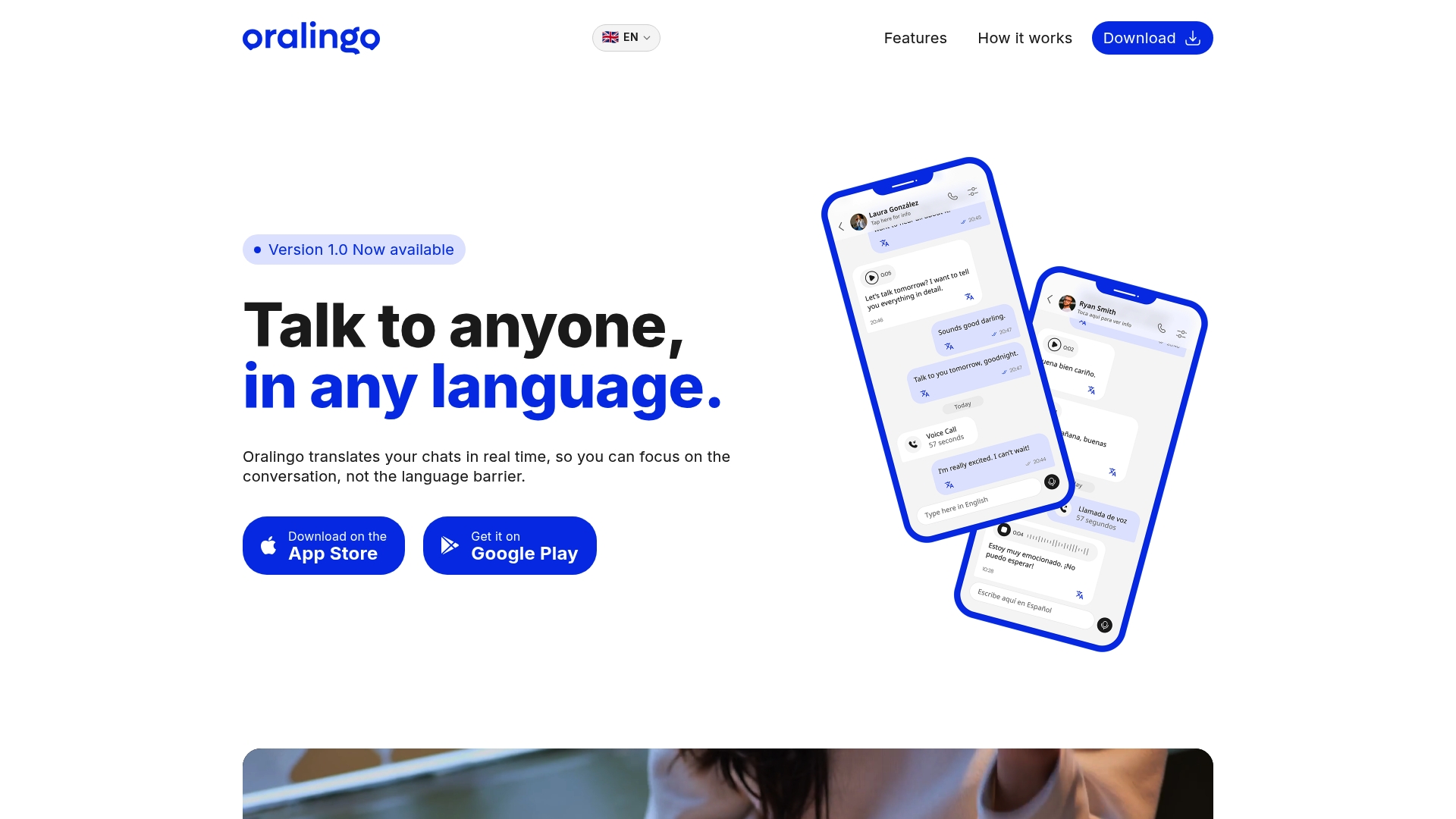
For remote teams managing training sessions, onboarding, and daily collaboration across language barriers, Oralingo's hands-free voice mode means staff can speak and listen without stopping to type. Every conversation is end-to-end encrypted, so sensitive training discussions stay private. If you want your team to talk across languages without the friction of scheduling separate language sessions or waiting for translations, Oralingo is built for exactly that.
FAQ
What does CEFR mean for remote language training?
CEFR stands for Common European Framework of Reference for Languages. It provides a standardized scale (A1 through C2) that lets teams set clear, measurable proficiency targets for each role.
How long does it take to see results from multilingual training?
Consistent practice over several months is required before measurable proficiency gains appear. Programs that combine self-paced modules with live sessions tend to reach benchmarks faster than either format alone.
Can AI translation replace language training for remote teams?
AI translation handles routine communication well but cannot replace structured training. Human interpreters and trained staff are still necessary for nuanced, high-stakes, or culturally complex discussions.
How do you keep remote staff motivated to complete language training?
Integrate language tasks into real daily work rather than treating training as a separate activity. When staff practice in the context of actual job tasks, motivation and retention both improve significantly.
What is the best LMS setup for multilingual remote training?
An LMS built for multilingual teams must support multilingual interfaces, language-switching, and detailed assessment reporting. Platforms that only track completion rates miss the proficiency data that actually shows whether training is working.