
Translation is the single most direct tool you have for making every team member feel like they actually belong. When employees can read a policy in their own language, follow a training in words they understand, and speak up in meetings without fear of being misunderstood, inclusion stops being a goal and starts being a daily reality. Organizations that prioritize communication clarity, inclusivity, and cultural awareness are nearly twice as likely to achieve better business and human outcomes, according to Deloitte's 2024 Global Human Capital Trends Report. That gap is too wide to ignore.
How translation supports global team inclusion comes down to three things: making information accessible, giving every voice equal weight, and respecting the cultural context behind the words. Here is what that looks like in practice:
- Accessible information: Translated handbooks, safety procedures, and training materials mean no one is left guessing.
- Equal participation: Real-time translation in meetings lets non-native speakers contribute fully, not just listen.
- Cultural respect: Localized language signals that the organization values who people are, not just what they produce.
- Technology backbone: Tools with real-time voice translation, AI-powered captions, and glossary support make all of the above scalable across distributed teams.
What are the real benefits of translation for diverse global teams?
The clearest benefit is reduced misunderstanding. When a team member in São Paulo and a colleague in Seoul read the same project brief in their own languages, they start from the same page. Fewer assumptions, fewer errors, faster decisions. Real-time AI translation that preserves tone and emotion across 100+ languages with sub-second latency takes this further, letting distributed teams talk naturally rather than carefully.
Beyond clarity, translation builds psychological safety. Employees who can communicate in their strongest language feel more confident raising concerns, asking questions, and sharing ideas. That confidence translates directly into engagement. A team member who stays quiet in every meeting because they are struggling with English is not disengaged by choice.
Translation also creates equity in access to information. When only English speakers receive the full context of a decision, non-English speakers are structurally excluded from participating in that decision, even if they are nominally on the team. Translated communications close that gap.
- Reduced misunderstandings across time zones and languages, leading to faster collaboration
- Higher psychological safety for multilingual employees who can express themselves clearly
- Equitable access to decisions, updates, and institutional knowledge
- Stronger cross-cultural trust when colleagues see their language treated as legitimate
- Better compliance with local labor laws and safety regulations through accurate localized documentation
- Broader talent access by removing language proficiency as a barrier to participation
- Faster onboarding for international hires who receive materials in their native language from day one
For a deeper look at how multilingual team chat technology supports these outcomes, the practical setup matters as much as the principle.
How do you translate employee materials and training effectively?
Not everything needs to be translated. That is actually the first rule. Translating every document equally spreads resources thin and can overwhelm employees with content that does not apply to them. The smarter approach is to prioritize high-impact materials: safety procedures, HR policies, compliance training, and onboarding documents. These are the texts where a misread sentence has real consequences.
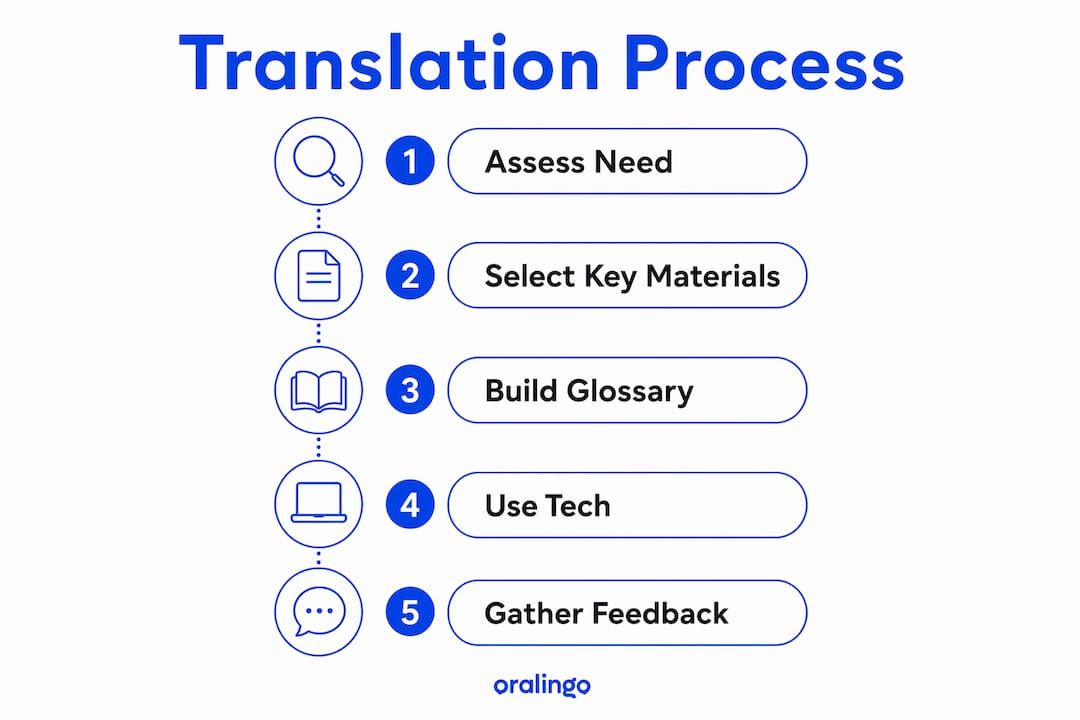
Localizing training programs goes beyond word-for-word translation. A safety training built around American workplace norms may not resonate with a team in Vietnam or Germany without cultural adaptation. Examples, scenarios, and even humor need to fit the local context. AI translation tools improve team productivity by reducing misunderstandings and clarifying decisions, but they work best when the source content is already clear and culturally neutral.
Terminology consistency is another practical concern. When your product has a specific name or your company uses particular acronyms, inconsistent translation creates confusion fast. A shared glossary, maintained centrally and updated regularly, keeps every translated document aligned. For live sessions, integrating real-time translation into meetings lets non-native speakers follow along and respond in the moment rather than catching up afterward.
- Prioritize critical documents like safety procedures, compliance policies, and onboarding guides for translation first
- Localize, not just translate, training programs so examples and scenarios fit the local cultural context
- Maintain a shared terminology glossary to keep product names, acronyms, and key terms consistent across all languages
- Use real-time translation in live training so non-native speakers can participate, not just observe
- Avoid over-translating broad content that dilutes focus and can introduce nuance loss
Pro Tip: Before any live training or all-hands meeting, build a session-specific glossary that includes your product names, internal acronyms, and any technical terms. Load it into your AI translation or captioning tool in advance. This single step measurably reduces mistranslations and keeps the conversation on track.
The role of voice translation in meetings has expanded significantly, and knowing how to set it up correctly makes a real difference for live sessions.

How does translation help build a genuinely inclusive company culture?
Translation becomes cultural when it is embedded in how your organization communicates by default, not just deployed as a fix when something goes wrong. That means rotating languages in team updates, providing captions or voice translation as standard in all-hands meetings, and treating multilingual communication as a norm rather than an accommodation.

One of the most effective structural moves is deploying multilingual leaders as boundary spanners. Research from Cambridge Core shows that multilingual managers who actively moderate language faultlines improve team camaraderie and inclusion in multicultural settings. These leaders do not just translate words. They translate context, intent, and tone, which is where most cross-cultural misunderstanding actually lives.
Cultural awareness training alongside language support matters too. Knowing a word in another language is useful. Understanding why a colleague from a high-context culture communicates indirectly, or why a colleague from a low-context culture sounds blunt, prevents the kind of friction that translation alone cannot fix. Language support and cultural education work together.
- Embed multilingual communication as a stated organizational value, not a reactive measure
- Rotate languages in team updates so no single language always dominates the conversation
- Provide captions and voice translation as standard features in all meetings, not optional add-ons
- Deploy multilingual leaders who understand language faultlines and actively work to reduce subgroup divisions
- Pair language support with cultural training so employees understand context, not just vocabulary
- Support non-dominant languages in decision-making processes to prevent power imbalances from forming
A shift toward what researchers call a "multilingual turn" means actively embracing multiple languages rather than defaulting to a single corporate language and translating everything else as an afterthought. That shift signals respect at an organizational level.
What challenges and ethical issues should you plan for?
Language diversity creates what researchers call faultlines: invisible dividing lines where subgroups form along linguistic boundaries. Kalra's 2023 research at Cambridge Core found that these faultlines affect trust and relationships in ways that translation alone cannot resolve. Even when everyone technically understands each other, the social dynamics of who speaks which language, and when, shape who feels included and who does not.
Over-reliance on translation technology carries its own risk. When employees know a tool will handle all cross-language communication, the motivation to learn even basic phrases in a colleague's language can drop. That matters because language learning builds empathy and relationship depth that no app fully replicates. The practical fix is pairing translation tools with structured language learning opportunities, so technology supports human connection rather than replacing it.
Privacy is a real concern with any translation tool that processes internal communications. Before deploying any platform, HR teams need to verify that conversations are encrypted and that data is not stored or used to train external models. End-to-end encryption, like what Oralingo provides, is the baseline standard for professional use.
- Language faultlines can create subgroup divisions that require active leader intervention, not just better tools
- Over-reliance on AI translation may reduce motivation to develop personal language skills over time
- Privacy and data security must be verified before any translation tool handles sensitive internal communications
- Cost and quality trade-offs between human translators and machine translation require deliberate decisions by document type
- Cultural nuance and bias in machine translation outputs can distort meaning, particularly for idiomatic or emotionally sensitive content
- Power imbalances persist when dominant-language speakers set the pace and non-dominant speakers rely entirely on translation to keep up
Setting clear communication norms for multilingual teams before rolling out translation tools prevents many of these issues from surfacing mid-project.
What does recent research tell us about translation and team inclusion?
The evidence is clear and consistent. Deloitte's 2024 findings show organizations focused on communication clarity and inclusivity are nearly twice as likely to see improved outcomes across both business performance and employee wellbeing. That is not a marginal difference.
Research highlight: Culturally adapting machine translation tools significantly enhance global leadership self-efficacy and willingness to join multinational organizations, compared to non-adapting tools. Perceived effectiveness, not just accuracy, drives this effect.
Research by Glikson et al. published in 2026 found that access to culturally adapting machine translation, compared to standard translation tools, meaningfully raised participants' confidence in leading across cultures and their intention to work in global organizations. The mechanism is not just comprehension. It is the feeling that the tool understands cultural context, which makes the user feel capable of navigating that context too.
The NSF-supported study by Ge Gao and colleagues at the University of Maryland adds another layer. Machine translation of subgroup conversation logs shared before team meetings improved meeting quality, task performance, and discussion depth compared to meetings without that pre-exchange. The insight is practical: translation works best when it provides context ahead of time, not just real-time word conversion.
Key findings worth acting on:
- Cultural adaptation in translation tools raises global leadership confidence more than standard translation accuracy alone
- Pre-meeting translation of subgroup discussions improves the quality of full-team meetings by giving everyone shared context
- Active leader mediation of language faultlines is as important as the translation technology itself
- A multilingual turn approach produces more equitable participation than a translation-only strategy
- Balanced AI use keeps motivation to learn languages intact; over-reliance on highly autonomous tools can reduce that motivation
- Targeted translation of critical documents and live sessions outperforms broad universal translation in both clarity and cost-effectiveness
The effective communication strategies that work in multilingual workplaces consistently combine technology, cultural training, and deliberate leadership, not any single element alone.
Key Takeaways
Translation drives global team inclusion when it combines accessible communication, cultural respect, and active leadership with the right technology.
| Point | Details |
|---|---|
| Translation enables equal participation | Employees who receive information in their own language can contribute fully to decisions and discussions. |
| Cultural adaptation outperforms word-for-word translation | Tools that adapt to cultural context raise global leadership confidence more than standard translation accuracy. |
| Language faultlines require leader action | Translation technology alone cannot resolve subgroup divisions; multilingual managers must actively mediate. |
| Targeted translation beats universal translation | Prioritizing high-impact documents and live meetings delivers better clarity without information overload. |
| Privacy and ethics matter from day one | Any translation tool handling internal communications must use end-to-end encryption and clear data policies. |
Ready to remove language barriers from your team's daily conversations?
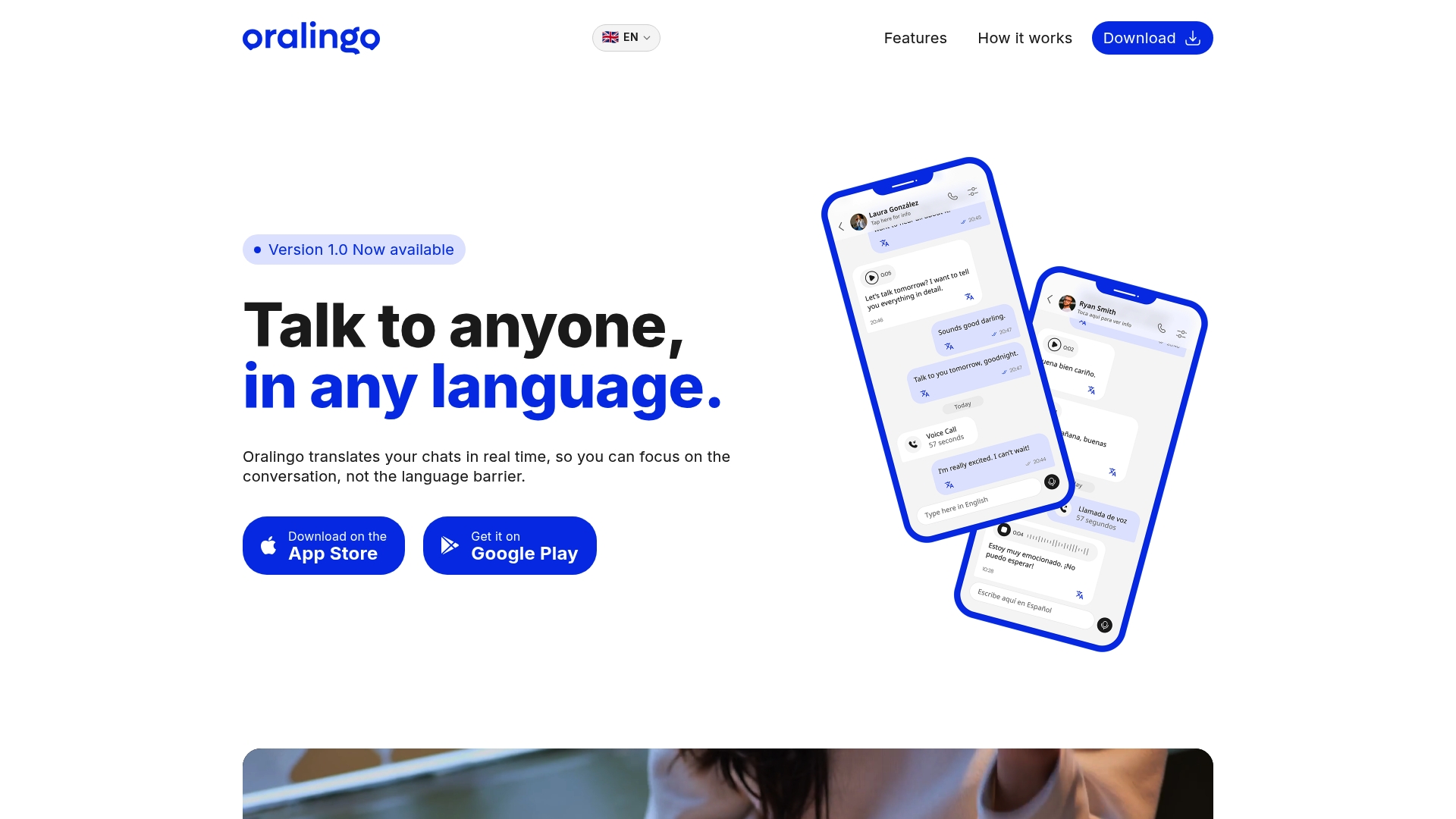
Oralingo translates messages instantly, before they appear on screen, so your team can focus on the conversation rather than the language gap. With support for over 100 languages, end-to-end encryption on every chat, and high translation accuracy, it is built for the way global teams actually work. Voice mode means no one has to stop and type. Privacy mode means sensitive discussions stay private.
Try Oralingo today and give every team member a voice, in any language.