
For most real-time chat, a hybrid approach beats going all in on either side. Use AI-only for casual, low-stakes conversations where speed matters most. Bring in human review for legal, medical, or high-value business chats where one bad word choice creates real risk. AI is fast and now hits junior-translator quality in many language pairs, but studies still show humans catch nuance and cultural context AI misses.
TL;DR:
- AI translation performs well for major language pairs but remains less reliable for resource-poor languages and specialized domains like legal or medical texts.
- Human review consistently surpasses AI in capturing idiomatic expressions, tone, and cultural context, especially in high-stakes conversations.
- Hybrid workflows, with AI handling high-volume, low-stakes chats and humans reviewing critical messages, optimize both speed and accuracy.
- For business and legal chats, end-to-end encryption and strict data handling policies are essential to ensure privacy and compliance.
- Translation latency under three seconds is crucial for maintaining natural chat flow, with pre-delivery translation and context management enhancing user experience.
Table of Contents
- Human vs AI Translation for Chat: The Real Trade-Offs
- When Should You Use AI, Human, or Hybrid Translation for Chat?
- Getting Chat Translation to Work in Real Time
- Keeping Chat Translation Private and Compliant
- What the Research Actually Shows
- Where Teams Get Chat Translation Wrong
- How Oralingo Handles Real-Time Chat Translation
- Sources
- FAQ
Human vs AI Translation for Chat: The Real Trade-Offs
Speed and accuracy pull in opposite directions, and chat forces you to pick a spot on that line every single time someone hits send.
AI translation now performs close to entry-level human quality for common language pairs. A comprehensive evaluation comparing GPT-4 against professional translators found that GPT-4 matches the error levels typical of junior translators, though it still trails medium and senior-level linguists. That gap widens fast once you move from resource-rich pairs like English to Spanish toward resource-poor pairs with less training data behind them. If your chat traffic runs mostly through major world languages, AI is closer to human quality than most people assume. If it runs through less common pairs, treat AI output with more suspicion.
Quality isn't just about grammar. It's about whether the joke lands, the idiom makes sense, and the tone matches the relationship between the two people talking. Experts studying this gap point out that AI systems still struggle with cultural nuance and dialect sensitivity in ways trained human translators handle almost automatically. A literal translation of a sarcastic comment can read as a genuine insult. A formal greeting rendered too casually can undercut a business relationship before it starts.
Here's how the two approaches actually compare across the dimensions that matter for chat:
- Quality: Human translators win on idiom, tone, and cultural fit. AI wins on consistency for straightforward, literal content.
- Speed: AI delivers near-instant results, often in seconds. Human translation, even fast freelance turnaround, takes minutes to hours.
- Cost: AI-only chat translation typically runs as a flat subscription or per-message micro-cost. Human translation is billed hourly or per word, which adds up fast in an ongoing conversation.
- Risk: AI's failure mode is a confident, plausible-sounding mistranslation. A human's failure mode is availability, which is a slower failure but a more visible one.
- Best fit: AI suits high-volume, everyday conversation. Humans suit low-volume, high-stakes exchanges.
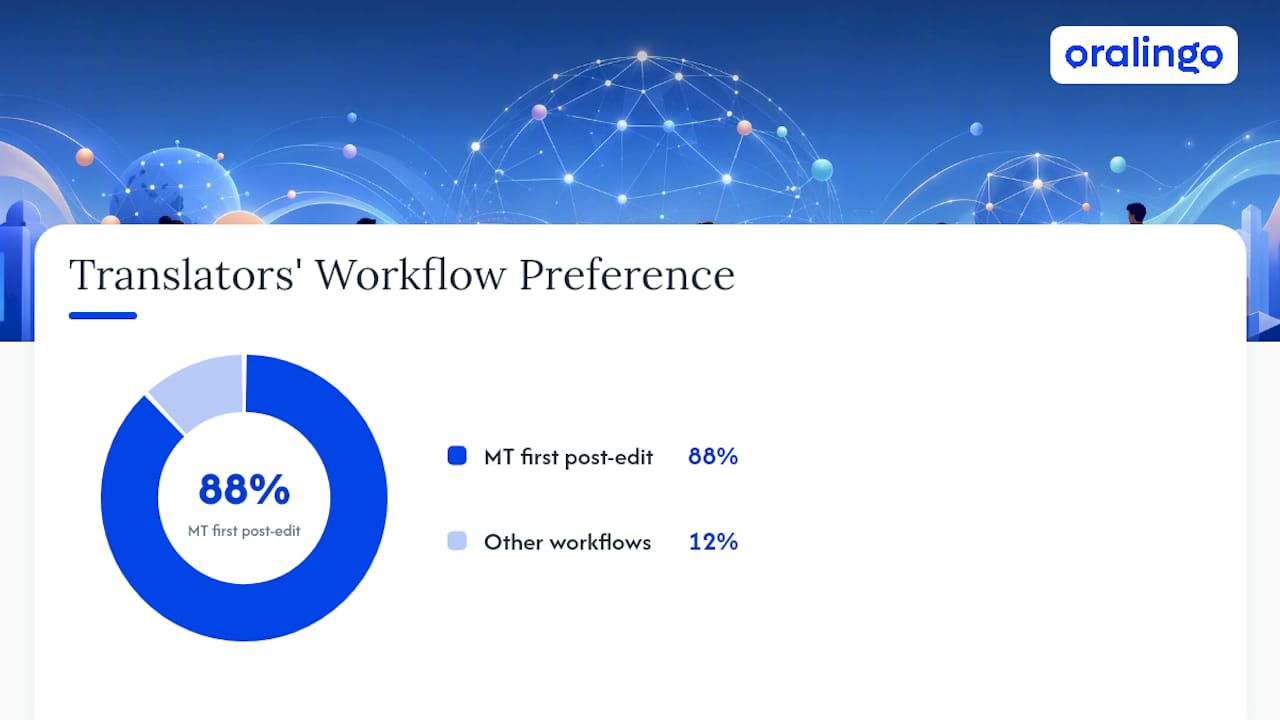
Quick stat: A survey of 49 professional translators found that 88% favored using machine translation for a first draft, followed by human post-editing, rather than choosing one method exclusively.
That number matters more than it looks. Nearly nine out of ten professionals who translate for a living, people you'd expect to defend their craft, still reach for AI first. They just don't stop there. That's the entire argument for hybrid workflows in one data point.
Cost shapes tell a similar story. Subscription-based AI translation tools charge a flat monthly rate regardless of message volume, which makes them predictable for teams handling constant cross-language chat. Human translation, by contrast, scales linearly with volume. A remote team messaging clients daily in six languages would spend far more on human translators per month than on an AI subscription, but a single contract negotiation might justify paying for expert human eyes on every line.
Failure modes deserve extra attention because they're asymmetric. When AI translation fails, it usually fails silently. The sentence still reads fine. It's just wrong, or subtly off in tone, and neither party may notice until real damage is done. When human translation fails, it's usually a delay or an unavailable translator, which is annoying but rarely dangerous. For businesses, that asymmetry should weigh more heavily than raw accuracy scores.
When Should You Use AI, Human, or Hybrid Translation for Chat?
Ask one question before you choose: what happens if this translation is wrong? The answer tells you almost everything you need to know about which approach fits.
If a wrong translation means a friend misunderstands your weekend plans, the cost of error is close to zero. Use AI-only. If a wrong translation means a client misreads a contract term or a patient misunderstands a dosage instruction, the cost of error is severe. Use human-only or a tightly monitored hybrid setup.
Here's a practical breakdown by scenario:
- Internal team chat and casual coordination. Low stakes, high volume, frequent typos and slang. AI-only translation works well here because speed matters more than perfection, and colleagues can usually catch obvious mistakes themselves.
- Customer support conversations. Medium stakes. A support agent handling a billing question in a foreign language needs fast, accurate translation, but a mistranslated refund policy could create a real dispute. This is the classic hybrid zone: AI handles the live exchange, with spot-checks on anything involving money, contracts, or policy language.
- Sales and negotiation chats. Medium to high stakes, especially in cultures where tone and formality signal respect. A literal AI translation can flatten the warmth or directness a skilled negotiator uses deliberately. Human review, or at least a human-trained glossary layered on top of AI, protects the relationship.
- Legal, medical, or compliance-related chats. High stakes, low tolerance for error. A contrastive study on legal text translation found that human translation scored higher on average accuracy than AI translation across every sample tested. Anything touching legal terms, medical instructions, or regulatory language should route to certified human review, full stop.
Operationally, this means different resourcing depending on the tier. Internal chat needs no special monitoring beyond normal IT oversight. Customer support needs defined escalation paths, so agents know when to flag a translated message for human review rather than trusting the AI output blindly. Legal and medical chat needs a standing relationship with certified translators, not an ad hoc lookup when something urgent comes up.
Pro Tip: Run a two-week pilot before committing to any single approach. Pull 50 to 100 real chat transcripts from your actual use case, translate them through your candidate tool, and have a bilingual reviewer score adequacy and flag harmful edits. If the harmful edit rate is near zero and adequacy holds up, you likely have a candidate for AI-only or light-touch hybrid. If harmful edits show up in more than a handful of transcripts, build in mandatory human review before launch.
The pilot doesn't need to be elaborate. What it needs is representative data. Testing a translation tool on polite customer service scripts tells you nothing about how it handles an angry customer typing in fragments and slang. Test the worst version of your actual chat traffic, not the cleanest example you can find.
One more rule worth internalizing: the right approach for a single conversation can change mid-conversation. A casual chat with an international client can suddenly turn into a pricing negotiation. Good chat translation systems, and good internal policies, need a way to escalate from AI-only to human-reviewed without restarting the entire conversation.
Getting Chat Translation to Work in Real Time
Latency is the constraint that decides everything else in chat translation. A translation engine that takes eight seconds per message might be fine for email. In a live chat, it kills the conversation's rhythm and makes both sides feel like they're talking through a bad phone connection.
The strongest chat translation systems translate messages before they're displayed to the recipient, often in the two to three second range, rather than showing the original text first and swapping in a translation afterward. That pre-delivery approach avoids the jarring experience of watching a message change language on screen, and it keeps the conversation feeling closer to a normal exchange between two people who happen to speak different languages.
Pre-delivery translation carries a trade-off worth naming honestly: it removes the sender's chance to catch an obvious error before the recipient sees it. A typo that garbles meaning in the original language can garble the translation just as badly, faster than either party can react. Systems that combine pre-delivery speed with lightweight context checks, like recognizing when a sentence fragment doesn't parse cleanly, catch more of these issues before they reach the other side.
Context is the second hard problem. Chat messages are short, often just a few words, and short messages are exactly where machine translation struggles most because there's little surrounding text to disambiguate meaning. A message that says simply "not bad" can mean genuine praise or mild disappointment depending on what came before it. Good chat translation tools maintain a rolling context window across recent messages rather than translating each line in total isolation.
A few implementation details separate a translation tool that feels natural from one that feels clunky:
- Tone and register controls let teams specify formal versus casual defaults, which matters enormously in languages like Japanese or German where formality is grammatically marked.
- Glossaries and terminology management keep brand names, product terms, and industry jargon from getting mangled by generic translation models.
- Context windows carry recent message history forward so pronouns and short replies resolve correctly.
- Fallback paths flag low-confidence translations for human review instead of silently displaying a guess.
- Voice mode support matters for teams who talk more than they type, since verbal exchanges carry tone cues text alone can't capture.
Integration also matters more than most product teams expect going in. Some chat translation tools work as an SDK embedded directly into an existing messaging app. Others work as a mediated proxy that sits between two chat platforms. Practitioners who build multilingual products regularly combine multiple translation models depending on language pair and content type, since one model may handle major European languages well while a different model performs better on Southeast Asian or African language pairs. Teams that plan for this from the start, rather than assuming one model covers every language equally, avoid an unpleasant surprise six months into deployment.
For teams building or evaluating real-time chat translation architectures, the monitoring layer is what separates a stable rollout from a slow-motion trust problem. Log translated output, sample it regularly for human spot-checks, and build a simple feedback mechanism so users can flag a bad translation the moment they notice one. Feedback loops catch systemic errors, like a glossary term that's consistently mistranslated, far faster than waiting for a customer complaint to surface the same issue.
Keeping Chat Translation Private and Compliant
Chat translation touches sensitive conversations by default, since people say things in private chats they'd never put in a formal document. That makes data handling a practical question, not a footnote.
Compare how providers treat your message content before choosing one. AI translation vendors vary widely in whether they store message content, train future models on it, or delete it immediately after translation. Human translation vendors typically work under signed non-disclosure agreements and named-translator accountability, which gives you a clear person to hold responsible if something leaks. AI vendors give you a policy document instead of a person, and policy documents vary enormously in how carefully they're written.
End-to-end encryption combined with pre-delivery translation gives you the strongest practical mitigation available for casual and business chat. When translation happens before a message is displayed and the entire exchange is encrypted end to end, there's no unencrypted copy sitting on a server for an outside party to intercept. That's a meaningfully different privacy posture than tools that route messages through a third-party server for translation and storage.
For legal and medical chat specifically, encryption alone isn't enough. Certain conversations legally require a certified translator, someone who can testify to translation accuracy in court or who's bound by a professional licensing body. No AI tool, however accurate, currently satisfies that requirement on its own. If your chat traffic touches contracts, medical instructions, or immigration paperwork, route it to certified human review regardless of how good your AI translation performs elsewhere.
Before selecting any chat translation vendor, run through this list:
- Confirm whether the provider stores message content after translation and for how long.
- Confirm whether your data is used to train future models, and whether you can opt out.
- Verify end-to-end encryption covers the translation step itself, not just message transport.
- Ask human translation vendors for their standard NDA terms before sharing sensitive material.
- Identify which chat categories in your organization legally require certified human translation.
Quick stat: Industry research on legal text translation found human output scoring higher on mean accuracy than AI output in a contrastive study on legal texts, reinforcing why certified human review still matters for anything with legal weight.
What the Research Actually Shows
The comparative evidence on AI translation vs human translation has grown fast, and it points toward one consistent conclusion: hybrid workflows outperform either extreme for most real-world chat use.
The most direct head-to-head comes from a comprehensive study using MQM error annotation to compare GPT-4 against professional translators across multiple languages and domains. It found GPT-4 performs comparably to junior translators in total errors made, but consistently lagged behind medium and senior-level translators, especially as language pairs moved from resource-rich to resource-poor. Translated for chat purposes, that means AI-only translation is a reasonable bet for everyday conversation in major languages, and a riskier bet the moment you're working in a less common language pair or a specialized domain like law or medicine.
Workflow order matters just as much as raw model quality. A controlled study comparing human-first workflows against AI-first workflows found that human-first translation workflows showed better adequacy and overall quality than AI-first workflows, while AI-first workflows were faster but produced more harmful edits. That's a specific and useful finding: it's not that AI is simply worse than humans, it's that the order of operations changes outcomes. Having a human draft and AI polish beats having AI draft and a human (or nobody) check it after the fact.
Language-pair sensitivity shows up again and again across this research. Translation quality isn't a single number; it shifts depending on how much training data exists for a given pair and how specialized the content is. A chat translation tool that performs beautifully for English to French may perform noticeably worse for English to Amharic, simply because far less training data exists for the second pair. Decision-makers evaluating chat translation tools should test their specific language pairs directly rather than trusting a general accuracy claim.
Industry adoption data backs the hybrid conclusion from a different angle. That survey of 49 professional translators, the ones whose income depends on getting this right, found 88% preferred using machine translation for first drafts followed by human post-editing. Broader industry analysis echoes the same pattern: most organizations using machine translation professionally still employ human editors on the output, making post-editing the dominant commercial pattern rather than a niche practice.
- GPT-4 reaches junior-translator parity in resource-rich language pairs but degrades in resource-poor ones.
- Human-first workflows beat AI-first workflows on adequacy and reduce harmful edits, even though AI-first is faster.
- A large majority of surveyed professional translators favor AI-assisted first drafts with human post-editing over either extreme.
- Human translation scored higher than AI on legal text accuracy in direct comparison testing.
Oralingo's own research into chat translation accuracy fits squarely into this picture. It documents how context-aware, pre-delivery translation performs on real one-to-one conversations, giving teams a concrete reference point when they're deciding whether AI-only chat translation fits their specific use case or whether it needs a human layer on top.
Where Teams Get Chat Translation Wrong
The conventional wisdom says pick a lane: either trust the AI completely or hire enough translators to cover everything. Both extremes fail in the same way. They treat translation quality as a fixed property of the tool instead of a moving target that depends on stakes, language pair, and conversation type.
The default I'd recommend for most teams starting out is hybrid, weighted toward AI for volume and human review for anything touching money, legal terms, or health. That's not a hedge.
The biggest deployment mistake I see is treating chat translation as a single decision made once at launch. Teams pick a tool, plug it in, and never revisit the choice as their chat volume shifts into new languages or new conversation types. The second mistake is skipping the pilot entirely and trusting vendor accuracy claims at face value; a tool that scores well on formal document translation can still stumble badly on fragmented, slang-heavy chat text. The third is ignoring the asymmetry of failure. Teams obsess over AI speed and cost savings while underweighting how a single mistranslated legal term or medical instruction can cost far more than months of subscription fees ever saved.
For a pilot, track two numbers above everything else: adequacy (does the translation preserve meaning and tone) and harmful edit rate (how often the translation actively introduces a wrong or damaging meaning). If harmful edits stay near zero across a representative transcript sample, greenlight AI-only or light hybrid for that use case. If they show up more than occasionally, don't launch without human review built into the workflow.
— Poul
How Oralingo Handles Real-Time Chat Translation
Some chat translation tools are built for everyday chat between people who don't share a language, where speed and natural conversation flow matter as much as accuracy. These tools translate messages before they're displayed, so both sides read naturally without watching text swap languages mid-conversation, and may support more than 100 languages across one-to-one text and voice chat.
If your team is weighing a pilot for international coworkers, family members, or clients across languages, some chat translation apps offer hands-free voice mode to cover verbal conversation without requiring typing, which matters for sales and support scenarios. Some also provide end-to-end encryption, addressing privacy concerns relevant for business and personal chat alike. For teams specifically testing business use cases, Oralingo's practical guide to business chat translation walks through setup considerations worth reviewing before a pilot. Start by downloading Oralingo and running a short trial conversation with a colleague or contact in another language to see the pre-delivery translation in action.
Sources
For deeper verification, the GPT-4 vs. human translators evaluation breaks down error rates by language pair and domain. The human-first vs AI-first workflow study covers adequacy and harmful edit findings in full. The professional translator survey details post-editing adoption patterns. For hands-on testing, Oralingo's chat translation accuracy research and its guide to real-time chat translation architecture offer practical starting points. Teams comparing conversational AI context handling more broadly may also find AmmarAI's work on contextual chat agents useful.
- GPT-4 vs. Human Translators: A Comprehensive Evaluation of Translation Quality Across Languages, Domains, and Expertise Levels
- Not just language conversion but cultural transmission: comparing human-first and AI-first workflows for translation quality, efficiency, and speed
- Human Translation vs Machine Translation: Evaluating the Role of AI in Modern Translation Practice | Journal of the College of Languages (JCL)
- Artificial intelligence and human translation: A contrastive study based on legal texts
FAQ
Which AI Tool Is Best for Translating Conversations?
No single AI tool dominates every language pair equally, since accuracy varies by language and domain. For real-time chat specifically, look for tools built around pre-delivery translation and context windows, like Oralingo, rather than general-purpose translation apps designed for documents.
Can ChatGPT Translate Accurately?
ChatGPT and similar large language models translate reasonably well for common language pairs, performing comparably to junior human translators in total errors. Accuracy drops for less common language pairs and specialized domains like legal or medical text, where senior human translators still outperform it.
What Are the Key Differences Between Human Translation and AI Translation?
Human translation handles cultural nuance, idiom, and tone more reliably, while AI translation delivers near-instant speed at a fraction of the cost. Studies on legal text found human translation scoring higher on accuracy, while a human-first workflow also produced fewer harmful edits than AI-first approaches.
Is AI-Only Translation Safe for Business Chat?
It depends on the stakes involved. AI-only translation works well for everyday coordination and casual customer conversation, but anything touching contracts, pricing commitments, or compliance language should include human review given the documented gap in domain-specific accuracy.
How Fast Does Chat Translation Need to Be to Feel Natural?
Translation that happens in roughly two to three seconds, before the message displays, tends to preserve a natural conversational rhythm. Delays much beyond that start to feel like a lag in the conversation itself rather than a translation happening in the background.