
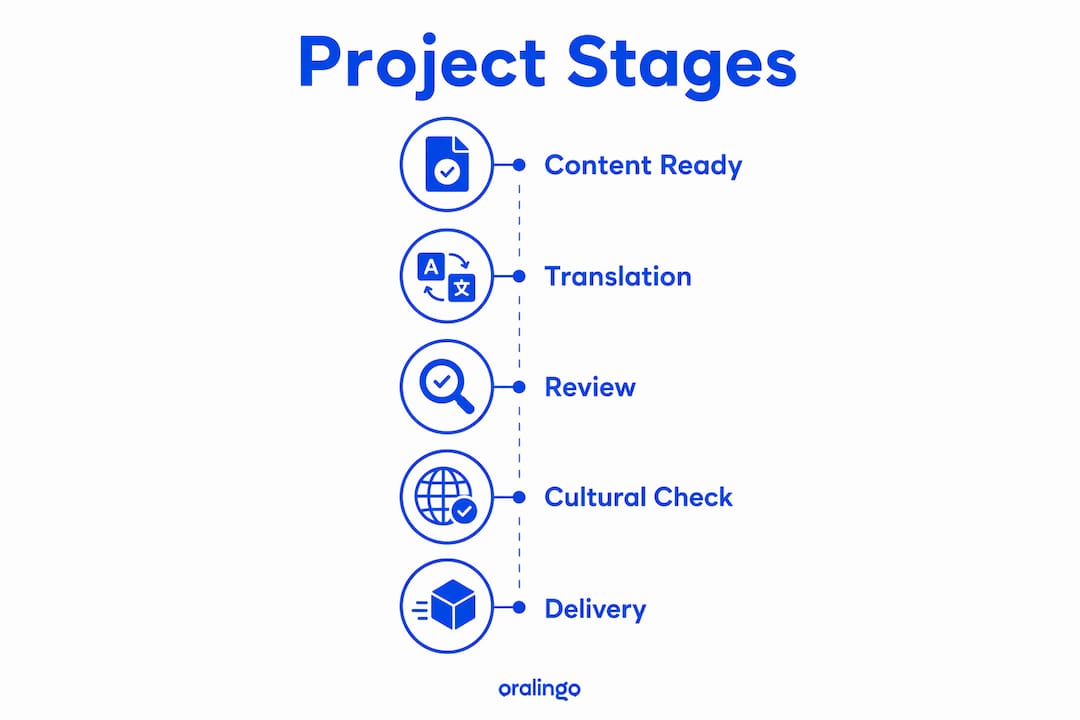
Real-time multilingual project management is the coordinated practice of managing multilingual content production using integrated platforms that deliver live updates on translation status, costs, and quality across multiple languages at once. The industry term for this discipline is continuous localization, and it blends classic project management with localization engineering. Three core components drive it: translation management systems (TMS), AI-powered automation, and agile methodologies like Kanban. Centralized platforms automate up to 80–90% of routine tasks such as file routing and QA checks. That level of automation frees project managers to focus on decisions that actually require human judgment.
What is real-time multilingual project management in practice?
Continuous localization treats translation as a live operation, not a final step. Content moves through a TMS the moment it is ready, triggering automated task assignments, pre-translation, and quality checks without waiting for a project manager to intervene manually. Workflow automation uses templates and rules for task assignment, QA routing, and review handoffs, producing consistent results regardless of team size or language count.
The agile method most teams use is a Kanban board with defined columns: source content ready, in translation, in review, approved, and published. Each column has a work-in-progress (WIP) limit. Setting WIP limits on a Kanban board, such as capping proofreading at five items, prevents bottlenecks and stops quality steps from being skipped under deadline pressure. That constraint forces the team to resolve slowdowns immediately rather than letting backlogs pile up.
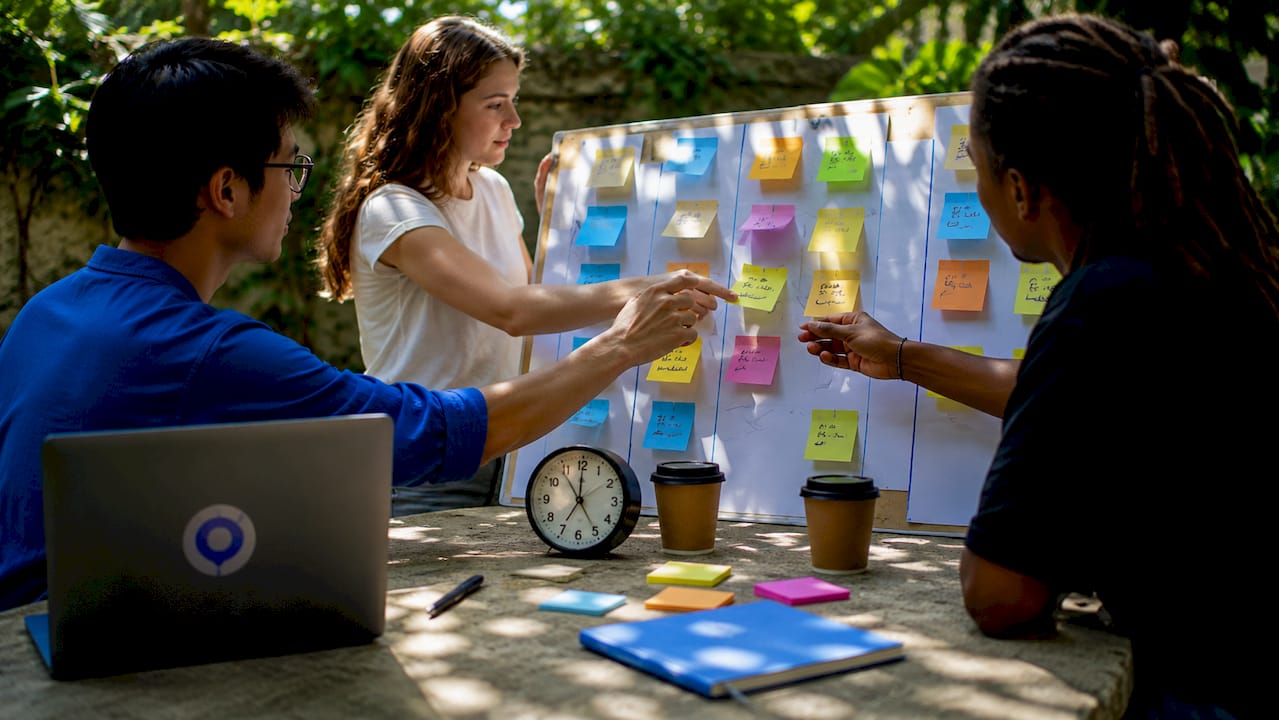
Real-time dashboards sit at the center of this workflow. They surface KPIs like cost per word, turnaround time by language pair, and quality scores by vendor. Project managers can see exactly where a project stands without sending a single status email.
Key workflow elements to build from day one:
- Automated file routing: The TMS pulls source files from a CMS or CI/CD pipeline and assigns them to the right translator or machine translation engine automatically.
- Pre-translation: Translation memory and machine translation fill known segments before a human translator opens the file, cutting time and cost.
- Automated QA checks: Rules flag missing variables, broken tags, and terminology violations before files reach human review.
- Real-time dashboards: Live progress tracking replaces manual status updates and email chains.
- Integration with CI/CD pipelines: Localization runs in parallel with development, not after it.
Pro Tip: Set up a content freeze trigger in your TMS so that translation only starts after a source file passes a defined approval state. This single rule prevents the most common cause of rework.
How do you keep multilingual teams aligned and communicating?
Centralized communication is the single biggest lever for multilingual project collaboration. Disparate spreadsheets and emails create version control issues and confusion that slow every team down. A single TMS acting as the source of truth eliminates that problem at the root.
Shared linguistic assets are equally critical. A localization kit containing a style guide, a glossary, domain-specific terminology, and visual references gives every vendor the same starting point. Localization kits that include these assets reduce literal translations and cut correction cycles significantly. Without them, translators guess at brand voice and terminology, and project managers spend hours fixing the results.
Real-time chat translation and voice translation close the gap for teams that work across languages daily. When a German engineer and a Spanish product manager need to align on a feature spec, waiting for a human interpreter is not practical. Tools that translate messages instantly before they appear in the chat thread let both people stay in their own language while the conversation moves at full speed. Oralingo does exactly this, supporting over 100 languages with a 99% accuracy rate and end-to-end encryption so sensitive project discussions stay private.
Practical communication practices for multilingual teams:
- Centralize all project communication in one platform rather than splitting it across email, chat, and spreadsheets.
- Maintain a shared glossary that all translators and reviewers reference for product terms, brand names, and technical vocabulary.
- Use real-time chat translation tools so cross-language conversations happen without delay.
- Track blockers visibly on the Kanban board so every team member can see what is stalled and why.
- Issue version-stamped updates at each milestone so no one works from outdated source content.
How does AI automation improve multilingual project delivery?
AI is the engine that makes continuous localization possible at scale. AI-native platforms learn from human edits in real time, improving translation accuracy and consistency while reducing repetitive errors across future projects. Static machine translation models do not do this. The difference shows up in quality scores and in the volume of post-editing work a team carries.
Automation handles the tasks that used to consume a project manager's day. File routing, pre-translation, QA flag generation, and review assignments all run on rules set once and applied consistently. Rule-based routing and automated quality checks produce consistent results regardless of how many languages or vendors are in play. That consistency is what makes scaling from five languages to twenty languages a process change rather than a staffing crisis.
Analytics dashboards give project managers a clear picture of where money and time go. Cost per word, vendor performance, on-time delivery rates, and quality scores by language pair are all visible in one place. That data makes vendor negotiations, budget forecasts, and process improvements concrete rather than anecdotal.
The practical benefits of AI automation in multilingual projects include:
- Reduced manual coordination: Automated handoffs mean project managers manage systems, not individual tasks.
- Faster turnaround: Pre-translation and automated QA compress the time between source content approval and translated content delivery.
- Lower cost per word: Translation memory reuse and machine translation reduce the volume of work sent to human translators.
- Consistent quality: Automated terminology checks catch errors before human review, reducing correction cycles.
- Scalability: Adding a new language pair requires a configuration change, not a new hire.
What are the common challenges in multilingual project management?
Version chaos is the most common and most costly problem in multilingual projects. Translating content that is still being edited creates version conflicts that inflate costs and delay launches. The fix is a strict content freeze date. No translation starts until the source content passes a defined approval gate in the TMS.
Bottlenecks at the proofreading and cultural review stages are the second major challenge. Automated translation is fast. Human review is not. Without WIP limits, the review queue grows faster than reviewers can clear it, and deadlines slip. WIP limits force teams to resolve slowdowns immediately, preventing backlogs that erode both deadlines and quality.
Integrating localization planning into the product development lifecycle from day one avoids costly retrospective fixes. Emergency fixes during final QA can increase project costs by 20–30%. Starting localization planning at the same time as product planning eliminates that risk entirely.
| Challenge | Mitigation technique |
|---|---|
| Version conflicts from editing during translation | Set a content freeze date; gate translation start on source approval |
| Proofreading bottlenecks | Apply WIP limits at review stages on the Kanban board |
| Inconsistent brand voice across languages | Build and distribute a localization kit with glossary and style guide |
| Version chaos from email and spreadsheets | Centralize all assets and communication in a single TMS |
| Late localization integration | Include localization planning in the product development kickoff |
Pro Tip: Treat your localization kit as a living document. Update the glossary every time a new product term is approved, and push the updated version to all active vendors the same day.
Key Takeaways
Real-time multilingual project management succeeds when automation, agile workflows, and centralized communication work together from the start of a project, not as an afterthought.
| Point | Details |
|---|---|
| Automate routine tasks | Use a TMS to handle file routing, pre-translation, and QA checks automatically. |
| Apply WIP limits | Cap items at each Kanban stage to prevent review bottlenecks and missed deadlines. |
| Enforce content freeze dates | Never start translation until source content is fully approved to avoid version conflicts. |
| Centralize communication | A single TMS as the source of truth eliminates version chaos and outdated translations. |
| Build localization kits | Provide vendors with glossaries, style guides, and visual context to protect brand voice. |
Why I think most teams treat localization as an afterthought
Project managers who are new to multilingual work tend to treat translation as a packaging step at the end of a project. You finish the product, hand the content to a translation vendor, and wait. That model breaks down fast when you are managing six languages, three vendors, and a hard launch date.
What I have seen work consistently is treating localization as a parallel workstream, not a downstream one. The moment your product team starts writing copy, your localization team should be setting up the TMS, building the glossary, and confirming vendor availability. That parallel approach is what multilingual collaboration platforms are designed to support.
The other thing most articles miss is the human communication layer. Automated workflows handle file movement beautifully. They do not handle the moment a translator in Tokyo needs to ask a product manager in Berlin whether a UI label is a noun or a verb. That question needs a fast answer in a shared language. Real-time translation tools fill that gap in a way that async email chains simply cannot. Voice translation in meetings is especially underused. Project managers who add voice translation to their meetings report that cross-language alignment happens faster and with fewer misunderstandings than text-only workflows.
The future of this discipline is continuous localization fully integrated into CI/CD pipelines, where translated content ships at the same time as the source. That is already standard practice at large software companies. For everyone else, the gap between where they are and where they need to be is mostly a process and tooling problem, not a budget problem.
— Poul
How Oralingo fits into your multilingual project workflow
Managing a multilingual project means your team is constantly talking across languages, whether that is a quick status check, a vendor question, or a cross-border stakeholder call.
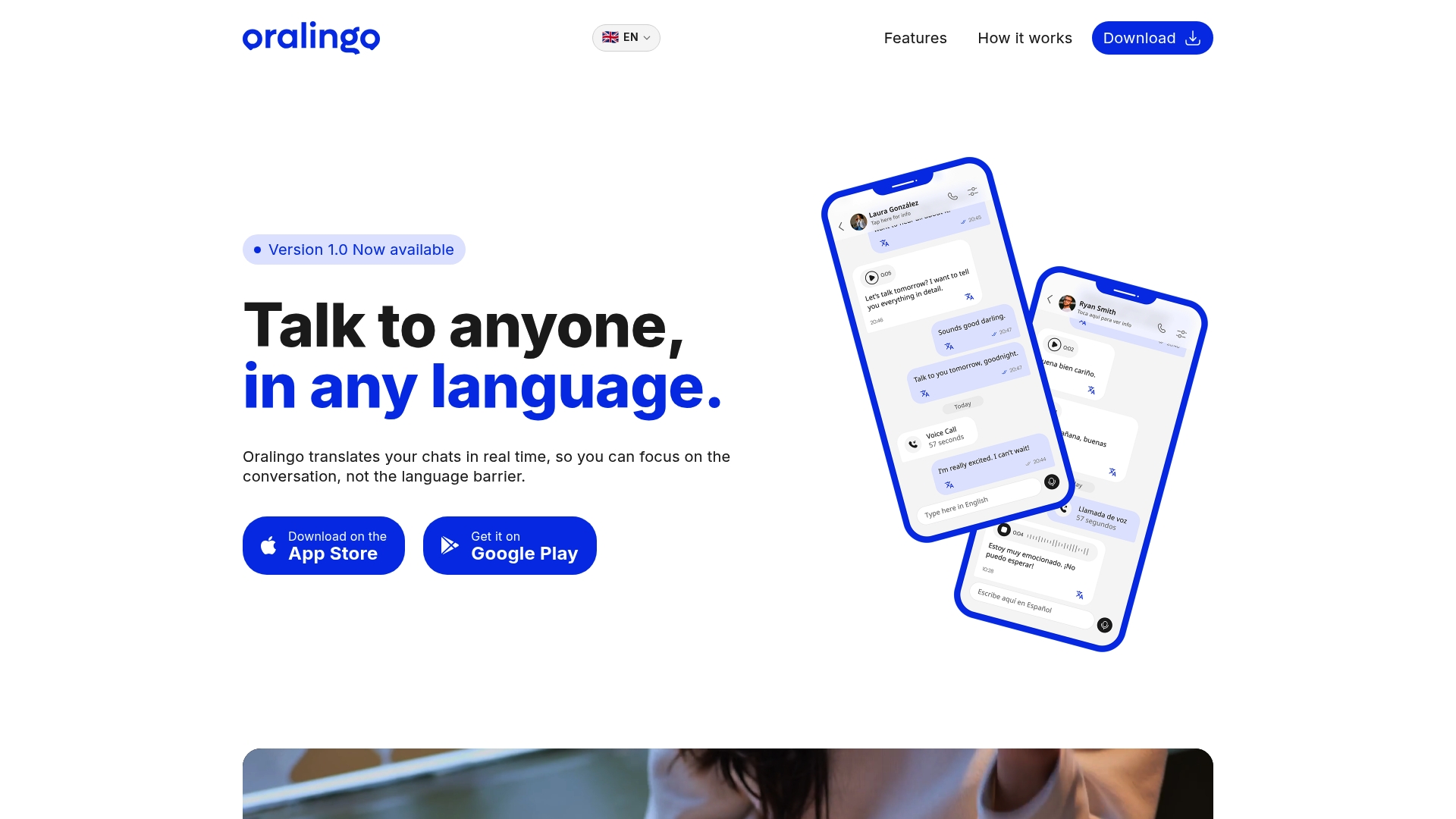
Oralingo translates messages instantly before they appear in the chat thread, so your team can communicate in their own language without slowing the conversation down. With support for over 100 languages, a 99% accuracy rate, and end-to-end encryption, it handles the live communication layer that TMS platforms do not cover. The hands-free voice mode makes verbal check-ins just as easy as text. Talk to anyone, in any language and keep your multilingual projects moving without language getting in the way.
FAQ
What is real-time multilingual project management?
Real-time multilingual project management is the practice of coordinating multilingual content production using integrated platforms that provide live visibility into translation progress, costs, and quality. It combines agile workflows, TMS automation, and AI to manage multiple languages simultaneously.
What is a TMS and why does it matter?
A TMS, or translation management system, is a platform that centralizes all translation assets, automates task routing, and tracks project status across languages. It replaces email and spreadsheets as the single source of truth for multilingual projects.
How do WIP limits help multilingual teams?
WIP limits cap the number of items allowed at each stage of a Kanban board, such as limiting proofreading to five items at a time. This forces teams to resolve bottlenecks immediately rather than letting review queues grow unchecked.
Why does a content freeze date matter for translation?
Starting translation before source content is finalized creates version conflicts that require costly reworks. A content freeze date ensures translators only work on approved, stable content, protecting both quality and budget.
How does real-time chat translation support project teams?
Real-time chat translation lets team members communicate in their own language while the tool translates messages instantly for the other person. Oralingo supports this across 100+ languages, removing language barriers from daily project coordination without interrupting the conversation flow.