
A remote team language barrier happens when different fluency levels, accents, jargon, or writing styles cause teammates to misread each other's meaning, even when everyone's on the same call. Managers can't fix this by waiting for it to resolve itself. Do three things today:
- Document the ask. Turn spoken instructions into a written summary within the hour.
- Follow up in writing. Confirm decisions in a channel everyone can reread, not just hear once.
- Set a clarification ritual. Give every meeting a five-minute "did we all hear the same thing?" checkpoint.
The rest of this guide covers why these gaps form, real scenarios you'll recognize, and a step-by-step fix.
Key Takeaways
Remote team language barriers form when fluency gaps, jargon, and thin documentation collide with async pressure, and they shrink fastest when managers pair plain-language habits with the right translation tool for each situation.
| Point | Details |
|---|---|
| Definition matters | A language barrier is any fluency, accent, jargon, or documentation gap that causes misread meaning on a remote team. |
| Native speakers share the burden | Clarity responsibility belongs to fluent speakers too, not only to non-native teammates. |
| Match tool to moment | Use machine translation for async writing, per-participant translation for meetings, and human interpreters for high-stakes talks. |
| Track rework rate | Count reopened tickets or specs over three cycles to measure real improvement. |
| Pilot before scaling | Test a tool like Oralingo with one cross-language pair for two weeks before rolling it out team-wide. |
Table of Contents
- Why remote team language barriers hurt more than you'd think
- What actually causes these breakdowns on your team
- Five scenarios that reveal a language barrier in action
- What actually works to close the gap
- Your rollout plan: week one to the full quarter
- What the research says should change your priorities
- A manager's take on what actually changes behavior
- Where real-time chat translation fits your playbook
- Sources
Why remote team language barriers hurt more than you'd think
Language gaps don't just slow things down. They erode trust. A teammate who can't follow a fast-talking colleague in a meeting often stays quiet rather than ask for a repeat, and that silence gets mistaken for disengagement.
The costs show up in specific places:
- Slower onboarding, since new hires spend extra hours decoding jargon instead of learning the job.
- Higher error rates on handoffs, when written specs get misread.
- Lower participation from non-native speakers in live discussions.
- Decision drift, where two people walk away from the same meeting with different takeaways.
Language gaps reduce participation and slow problem-solving. Teams that standardize channels and log decisions in writing see fewer inclusion gaps and less confusion than teams relying on verbal-only agreements.
Remote work amplifies all of this. There's no body language to fill in gaps, async messages strip out tone, and most tools default to a single working language that quietly favors native speakers.
What actually causes these breakdowns on your team
Most language barriers trace back to one of six root causes. Knowing which one you're dealing with tells you which fix to reach for.
- Varying fluency levels. A teammate might read English fluently but struggle to produce it quickly in a live call, so they nod along instead of pushing back on a bad idea.
- Accents and pronunciation gaps. Fast speech or unfamiliar accents cause listeners to miss key words, especially over spotty video audio.
- Idioms and internal jargon. Phrases like "let's circle back" or "boil the ocean" translate literally into confusion for non-native speakers.
- Thin documentation. When specs live only in someone's head, or in a Slack thread with no structure, the room for misreading grows fast.
- Async writing constraints. Typing in a second language takes longer and often gets rushed, producing terse messages that read as blunt or incomplete.
- Meeting dynamics. Fast-talking, overlapping speakers make it nearly impossible for someone tracking a second language to get a word in.
To diagnose which causes are live on your team, ask: Who stays silent in meetings but writes clearly in Slack? Whose written specs get the most clarifying questions? Who apologizes for their English before speaking? Each answer points to a different fix.
Five scenarios that reveal a language barrier in action
- The quiet meeting. One engineer never speaks up on calls but sends sharp feedback in the chat afterward. Listen for: silence that doesn't match written contribution quality.
- The mismatched spec. A product manager writes a ticket, and the remote developer builds something close but not right. Listen for: repeated "just to confirm" questions after delivery.
- The uneven standup. Some teammates give two-sentence updates while others ramble past the point. Listen for: updates that shrink when the speaker is non-native.
- The customer success mixup. A support agent translates a customer's complaint literally and misses the real request. Listen for: tickets that get reopened after being marked resolved.
- The stalled brainstorm. A remote workshop produces ideas only from the two most fluent voices. Listen for: a brainstorm doc with contributions from fewer than half the invitees.
What actually works to close the gap
Start with plain language, because it's free and it works immediately. Before: "Let's touch base to align on the go-forward plan before we boil the ocean on this." After: "Let's meet Thursday to agree on next steps. Please don't try to solve every problem at once." Short sentences, no idioms, acronyms spelled out on first use.
Native and fluent speakers carry most of the responsibility here. Nielsen Norman Group's research on plain language makes the point directly: barriers usually form because the dominant-language speaker didn't adjust pace or vocabulary, not because the other person lacks skill.
Meeting rules make a bigger difference than most managers expect. Send pre-reads 24 hours ahead so no one processes new information and a second language at the same time. Rotate who recaps the meeting in writing. Set a norm where the fastest talker deliberately pauses every few minutes for questions.
Training matters too. Build a short communication charter that spells out response-time norms and preferred channels, pair new hires with a language buddy during onboarding, and give role-specific vocabulary lists to teams with heavy jargon, like engineering or legal.
On the technology side, match the tool to the moment:
- Live captions help in meetings but don't translate, so they're best for same-language teams with accent challenges.
- Machine translation handles written async work well, and AI-generated meeting recaps let non-native speakers catch up on fast discussions after the fact.
- Per-participant live translation outperforms room-level translation in mixed-language meetings, since each person gets output in their own language instead of one shared feed.
- Human interpreters are worth the cost for high-stakes conversations: performance reviews, legal discussions, or anything where a misread nuance carries real consequences.
Pro Tip: Give every recurring meeting a designated "recap owner" who posts a three-bullet summary within 30 minutes. It costs nothing and catches most misunderstandings before they turn into rework.
Your rollout plan: week one to the full quarter
Spread the fixes across a real timeline instead of trying everything at once.
- Week 1: Introduce the clarification ritual in meetings and start requiring written recaps. Owner: manager. Cost/effort: low.
- 30 days: Draft a communication charter covering channels, response times, and plain-language norms. Owner: manager with people ops. Cost/effort: medium.
- 60 days: Pilot a translation tool for async written work and one recurring cross-language meeting. Owner: engineering or team lead. Cost/effort: medium.
- 90 days (quarter): Formalize language buddying in onboarding and set a recurring survey to track participation balance. Owner: HR and people ops. Cost/effort: high.
Quick reference for planning:
- Clarification ritual: low cost, low effort, immediate impact.
- Communication charter: medium effort, pays off within a month.
- Translation tooling: medium cost, fastest fix for async pain.
- Formal buddying program: highest effort, best long-term inclusion payoff.
What the research says should change your priorities
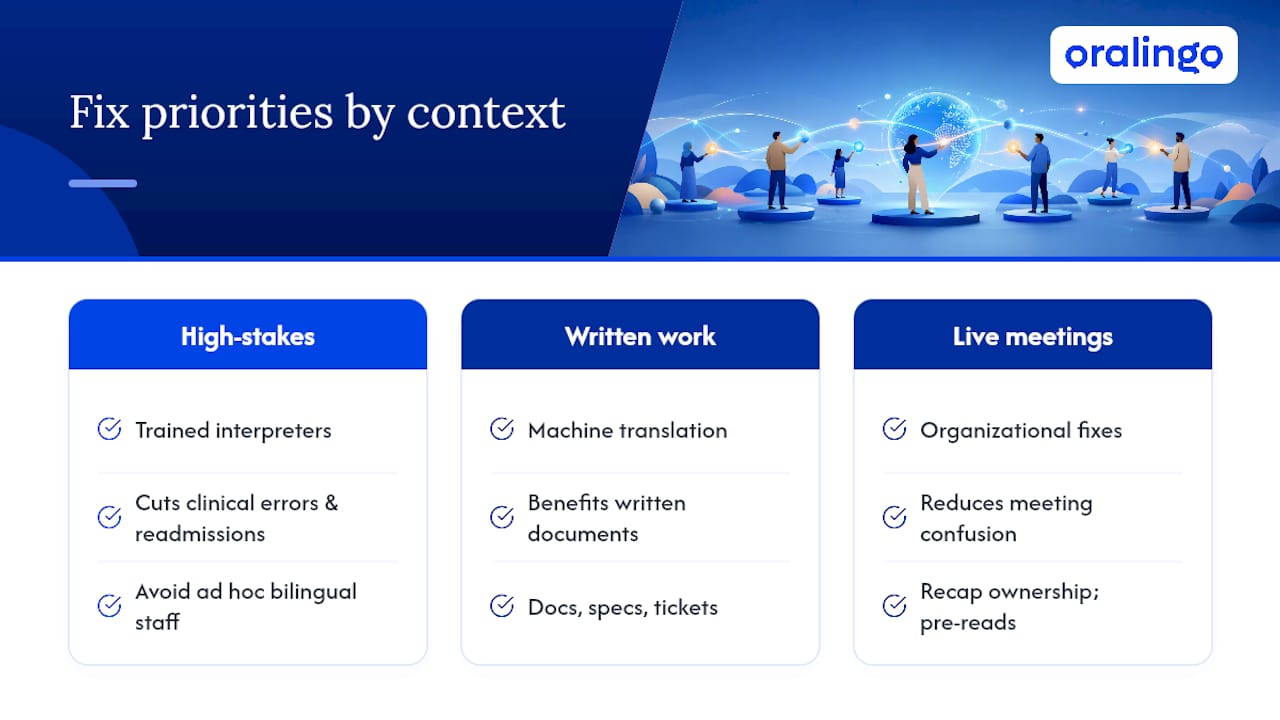
Interpreters used at admission, during teaching, and at discharge cut clinical errors and readmissions, and trained interpreters consistently outperform ad hoc staff filling in.
That finding comes from healthcare settings, but the lesson generalizes: high-stakes conversations deserve trained help, not a quick favor from a bilingual coworker. For everyday team communication, the priority is different. Written work benefits most from machine translation, while live meetings need organizational fixes like recap ownership and pre-reads.
Track one metric: the rework rate on handoffs between roles. Count how many tickets, specs, or deliverables get reopened for clarification within a week. A drop of even a few percentage points over a quarter signals your fixes are working. Don't over-read a single good week. Look for a trend across at least three review cycles before declaring progress.
A manager's take on what actually changes behavior
Early in managing a distributed team, I assumed the fix was hiring people with stronger English scores. It wasn't. The real shift came from requiring written recaps after every meeting. Suddenly the quietest people on calls were correcting details in Slack that everyone else had missed.

The lesson: fluency was never the problem. The format was. Give people a channel that matches how they communicate best, and participation follows.
Where real-time chat translation fits your playbook
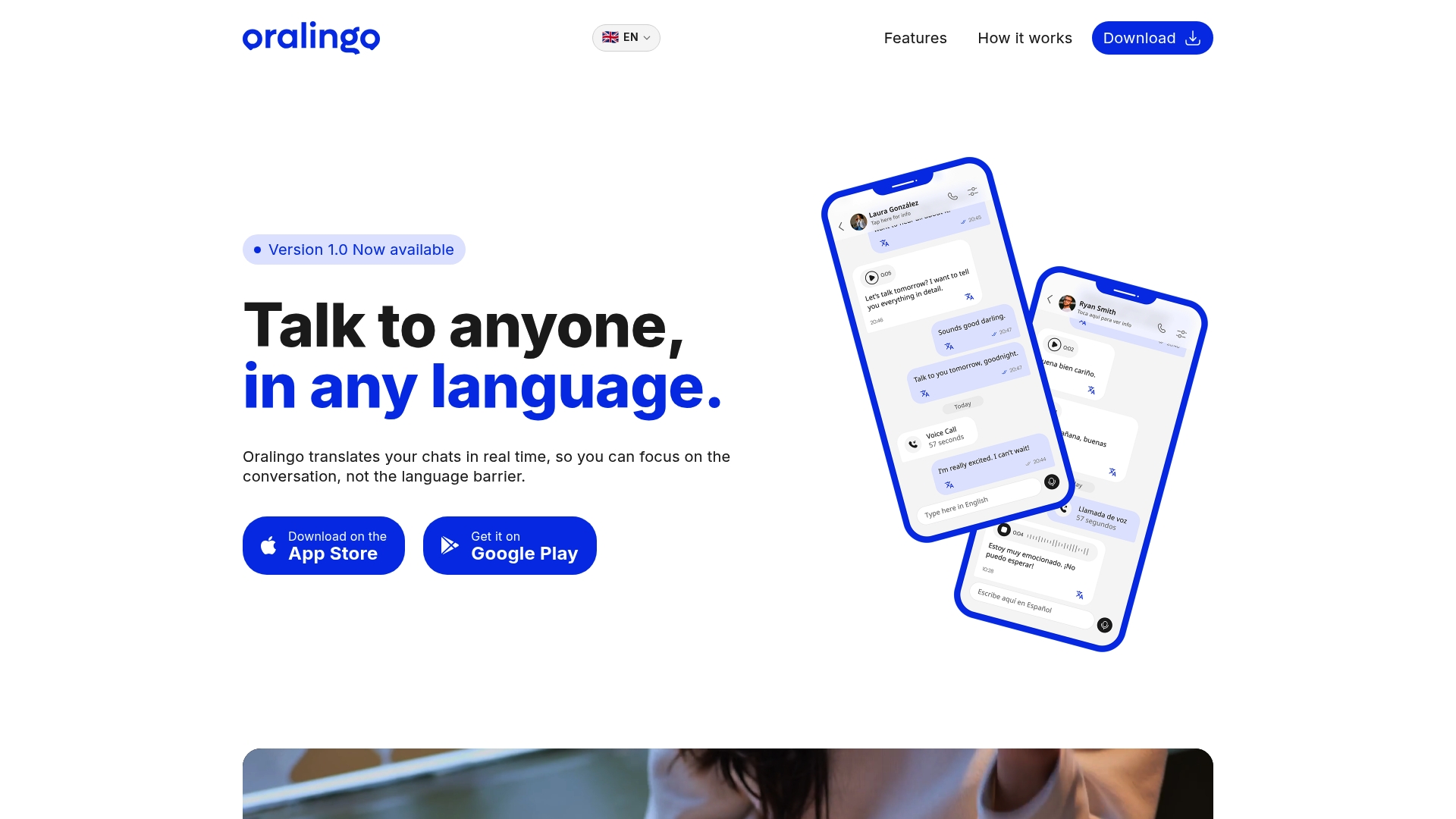
Real-time chat translation apps solve a specific slice of the problem: one-to-one and small-group conversations where someone needs an answer now, not after a translator gets looped in. They're built for the daily back-and-forth between a manager and a direct report, or a quick sync between teammates in different countries, not for formal contract negotiations.
The honest trade-off: speed and accessibility come at the cost of some nuance. Idioms and highly technical jargon can still trip up any translation tool, which is exactly why the plain-language habits covered earlier matter even when you're using one. For legal or HR conversations, stick with a trained human interpreter.
For the everyday friction, though, this is where a tool like Oralingo earns its place. It translates messages before they're displayed, supports over 100 languages, and includes a hands-free voice mode for teammates who'd rather talk than type. Run a two-week pilot with one cross-language pair on your team, and track whether their rework rate on shared tasks drops. If it does, expand it to the rest of the group.
Sources
- NN/g: Plain-language guidance for professional communication
- PMC article: Language barriers and interpretation in healthcare practice
- RemoteFast: Playbook for remote team communication