
Real-time, pre-delivery AI chat-and-voice translation lets a manager and a new hire understand each other instantly during a remote onboarding conversation, without waiting on written transcripts or a third-party interpreter. That's the role it plays: it removes the lag between "I said something" and "you understood it," in the exact moment role expectations, KPIs, or a technical process get explained.
The immediate payoffs show up fast in a first week:
- Fewer follow-up messages. When the hire understands the manager the first time, you skip the "wait, can you clarify?" email thread the next day.
- Less role ambiguity. Job expectations land clearly the moment they're spoken, not after a delayed, garbled translation.
- Faster alignment. HR guidance on live translation points to quicker comprehension in onboarding conversations when translation happens in the conversation itself, not after it.
Key Takeaways
Real-time, pre-delivery AI translation works because it removes the comprehension lag inside the conversation itself, not after it.
| Point | Details |
|---|---|
| Translation happens live | Pre-delivery chat and voice translation lets both people understand each other in the moment, not after a delayed transcript. |
| Trust gaps drive onboarding failure | Role ambiguity and cultural misalignment, not missing paperwork, cause most remote onboarding breakdowns. |
| Use confirm-first loops | Restate KPIs, deadlines, and action items out loud before moving on to catch translation errors early. |
| Escalate sensitive conversations | Disciplinary, legal, or contract discussions should default to a human interpreter, not AI translation alone. |
| Oralingo covers the core workflow | Pre-delivery chat, hands-free voice, 100+ languages, and end-to-end encryption map directly to a translated onboarding session. |
Table of Contents
- What Is the Role of AI Translation in Remote Onboarding, Exactly?
- Where Does One-on-One AI Translation Actually Help During Onboarding?
- How Do You Set Up a Translated One-on-One Onboarding Session?
- When Should You Trust the AI and When Should You Call a Human?
- How Oralingo Fits Into a Translated Onboarding Workflow
- What Managers Get Wrong About Translation in Onboarding
- Try Oralingo for Your Next Onboarding Call
- Frequently Asked Questions
- Sources
What Is the Role of AI Translation in Remote Onboarding, Exactly?
Language barriers do more damage to onboarding than most managers assume. A 2026 review of Global Virtual Teams synthesizing more than a hundred academic sources found that role ambiguity, cultural misalignment, and trust gaps sit at the center of onboarding failure, and that inclusive onboarding practices and role-based trust building are what actually fix it. Translation is one of the fastest ways to build that trust, because it removes the guesswork a new hire feels when they're nodding along to something they only half understood.
Real-time translation matters because it keeps the conversation moving. Post-hoc translation, where someone sends a transcript later, forces the new hire to reconstruct context they've already lost. Live translation preserves the back-and-forth rhythm of a real conversation, which is exactly the format one-to-one onboarding depends on.
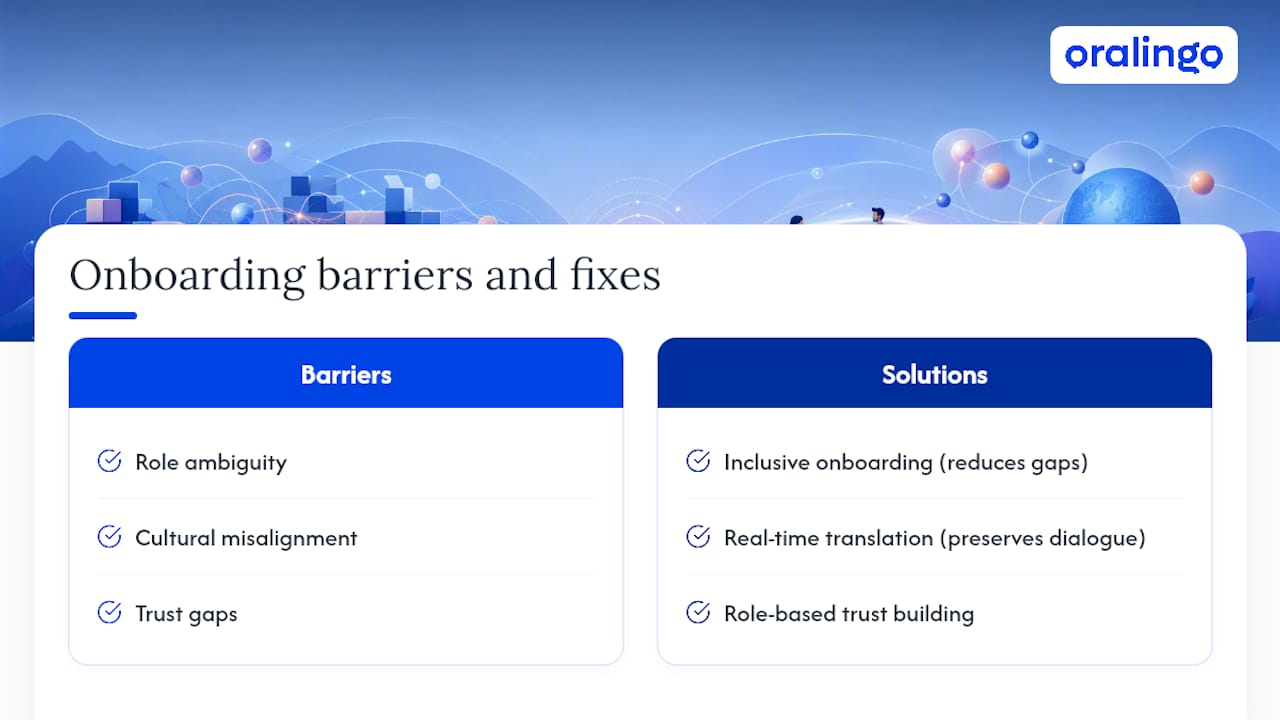
The organizational upside is straightforward: fewer clarification emails, a shorter runway to full productivity, and a manager who spends less time repeating themselves in simpler English.
Where Does One-on-One AI Translation Actually Help During Onboarding?
Most onboarding advice talks in generalities. Here's where translated conversation actually changes the outcome of a specific meeting.
- Manager expectation-setting. When a manager walks a new hire through KPIs, deadlines, and reporting lines, real-time translation means the hire hears the actual nuance, not a simplified paraphrase from a bilingual colleague standing in as an informal interpreter.
- Buddy or mentor introductions. Peer mentors explain unwritten team norms, like when it's fine to skip a meeting or how blunt feedback really is. Translated materials and buddy systems have been shown to reduce the sense of unspoken team dynamics that leave new hires guessing at culture.
- Technical walkthroughs. A screen-share explaining a deployment process or a client account setup needs verbal back-and-forth. Translated voice, not just captions, is what lets a new hire ask "wait, which button?" in real time.
- First feedback conversations. Tone matters more in a feedback session than almost anywhere else in onboarding. Translation that preserves phrasing and intent keeps a mild suggestion from reading as harsh criticism, or the reverse.
- Translated recaps. A short written summary sent right after the call, in the hire's own language, gives them something to reread instead of relying on memory of a conversation held partly in a second language.
Pro Tip: Before a KPI-setting conversation, ask the new hire which language they think in for numbers and deadlines. Some bilingual employees do math fluently in one language and freeze up in another.
How Do You Set Up a Translated One-on-One Onboarding Session?
Treat translated onboarding like any other recurring process. It needs a routine, not improvisation.
Before the session:
- Confirm the hire's preferred language for chat versus voice. These aren't always the same.
- Decide whether the conversation runs better with simultaneous translation (both people talk naturally) or a consecutive back-and-forth.
- Test audio quality and translation latency a few minutes early. A half-second delay is manageable; a three-second delay breaks conversational rhythm.
- Get consent noted if the session touches anything confidential, and confirm what gets logged.
During the session:
- Choose pre-delivery chat translation for detailed instructions, or hands-free voice mode when the conversation needs to feel natural and uninterrupted.
- Use a confirm-first loop on anything critical: restate a KPI or deadline back before moving on.
- Flag action items out loud as they come up, so both people leave with the same list.
After the session:
- Generate a translated recap of what was decided and assign next steps in the hire's preferred language.
- Ask one direct question about clarity: "Was anything confusing?" Translated feedback here catches problems before they become missed deadlines.
Run one pilot session before rolling this out across a team. Measure latency, accuracy, and how it fits your existing video or chat stack before making it standard practice. Guides on managing cross-cultural onboarding consistently recommend pairing this kind of tech setup with a genuine cultural briefing, not swapping one for the other.
When Should You Trust the AI and When Should You Call a Human?
AI translation is strong at conversational speed, but it has real limits. Accuracy drops in noisy environments, with heavy accents, or when someone leans on idioms and slang. A technical guide to live translation notes latency can run as low as half a second under good conditions, but that number climbs fast once the connection or the audio quality gets worse.
Some conversations shouldn't run through AI translation alone at all:
- Disciplinary conversations, legal notices, or termination discussions often carry legal requirements around interpretation that a translation app can't satisfy.
- Anything involving formal consent or contract terms deserves a qualified human interpreter, not a best-effort AI pass.
- High-stakes negotiations, like compensation discussions, benefit from a human who can read hesitation or tone shifts the software might miss.
Pro Tip: Set a simple rule with your team: AI translation handles day-to-day alignment and information sharing. Anything with legal or compliance weight goes to a human interpreter, no exceptions.
Privacy matters just as much as accuracy here. Choose a tool with end-to-end encryption, get clear consent before sessions, and know the retention policy for anything logged. Practical HR guidance on AI translation recommends pairing every live session with a translated written summary, both for clarity and as a record either party can revisit.
How Oralingo Fits Into a Translated Onboarding Workflow
Oralingo was built for exactly this kind of conversation: one person, another person, and a language gap that shouldn't slow either of them down.
- Pre-delivery chat translation means the manager types normally and the message arrives already translated, so the conversation reads naturally instead of like a machine output.
- Hands-free voice mode covers technical walkthroughs and KPI conversations where typing would break the flow.
- Support for over 100 languages covers nearly any onboarding pairing a distributed team is likely to have.
- A 99% accuracy claim gives managers confidence in fast-moving conversations where a mistranslated deadline or number carries real cost.
- End-to-end encryption keeps confidential onboarding details private between the two people in the conversation.
Onboarding conversations only work when both people trust that what they heard is what was actually said. That trust is the entire product.
For more on setting up multilingual training routines, see how to train remote staff in different languages.
Author: Poul
What Managers Get Wrong About Translation in Onboarding
Most advice on remote onboarding treats language as a documentation problem: translate the handbook, translate the training deck, done. That misses where the real damage happens, which is in live conversation, not paperwork. A new hire who nods through a garbled explanation of their own job description isn't confused because the employee handbook wasn't translated. They're confused because the ten-minute conversation where their manager actually explained the role happened partly in a language they don't fully speak.
The research on Global Virtual Teams backs this up: trust gaps and role ambiguity come from ongoing interaction, not one-time documents. That means the fix has to live in the conversation itself, not in a PDF sent on day one.
What should a manager prioritize first? Not a full multilingual onboarding overhaul. Start with the single highest-stakes conversation in someone's first week, usually the KPI-setting or expectations conversation, and get real-time translation right there before worrying about the rest. Get that one conversation clear, and everything downstream gets easier.
Try Oralingo for Your Next Onboarding Call
Oralingo gives you private, one-to-one translated chat and voice in the same conversation window, so your next onboarding call doesn't need a separate interpreter, a translated transcript sent later, or a colleague pulled in to help explain something twice.
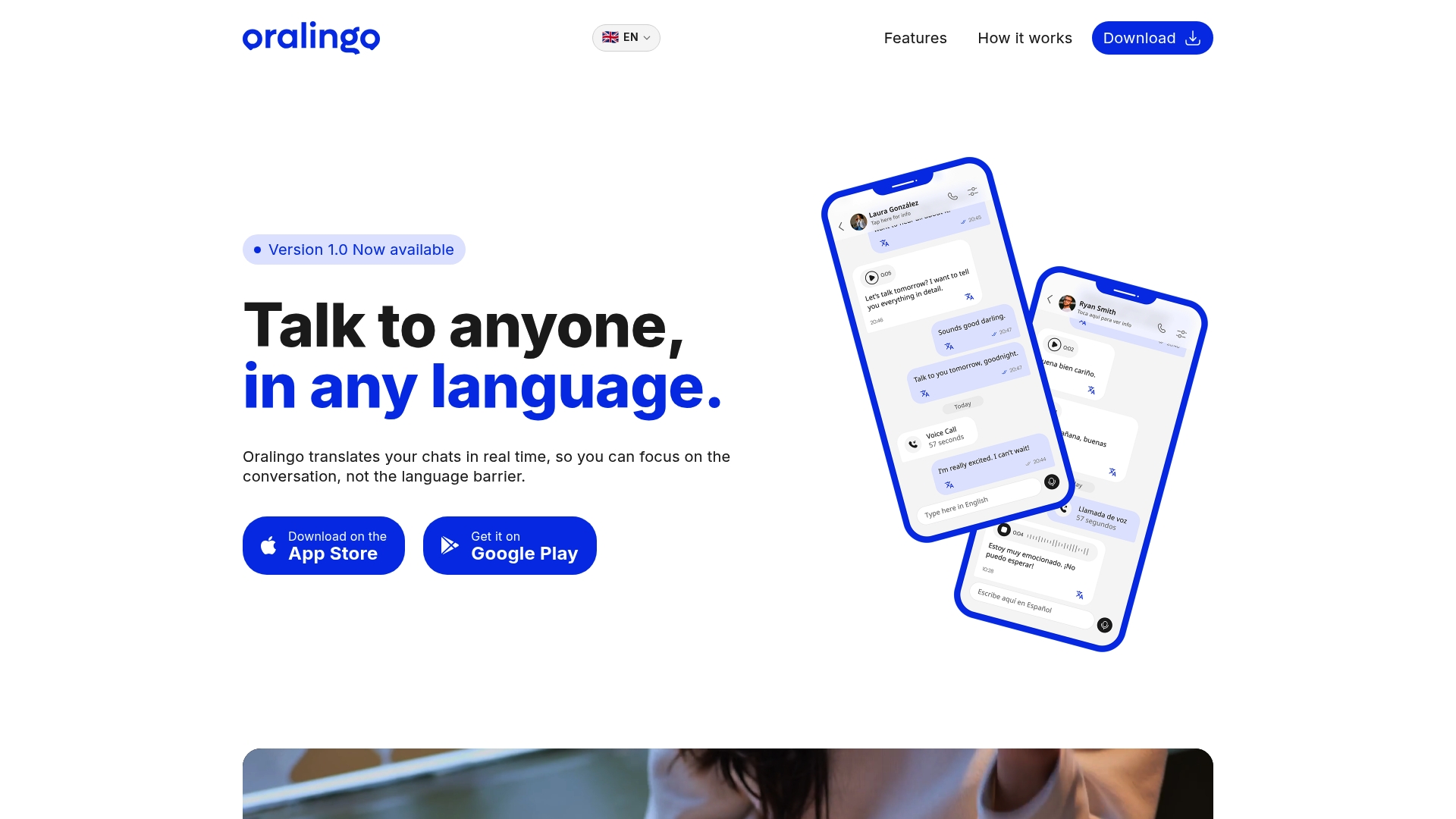
Every checklist item above, confirming preferred language, running a confirm-first loop, sending a translated recap, works directly inside the app. Chat translates before it's ever displayed, so the conversation reads naturally instead of like a translated document. Voice mode keeps a technical walkthrough or a feedback conversation feeling like two people talking, not two people waiting on software. End-to-end encryption keeps whatever gets discussed between the manager and the new hire, exactly where it belongs.
If your next onboarding call involves two people who don't share a first language, try Oralingo before that call and see how much faster alignment happens.
Frequently Asked Questions
Does AI translation replace the need for a human interpreter in onboarding? No. It handles day-to-day information sharing and alignment well, but disciplinary, legal, or contract conversations should still go through a qualified human interpreter.
How accurate is real-time AI voice translation during a live onboarding call? Accuracy stays high in quiet, clear-speech conditions but drops with background noise, strong accents, or heavy idiom use, which is why a confirm-first loop matters for anything critical.
What's the difference between pre-delivery translation and translating a transcript afterward? Pre-delivery translation happens inside the live conversation, so both people respond to each other in real time. A translated transcript arrives after the fact, once context has already faded.
Can AI translation be customized for company-specific jargon? Many tools let you add custom terms or phrases, which helps preserve industry-specific language and internal shorthand instead of translating it literally.
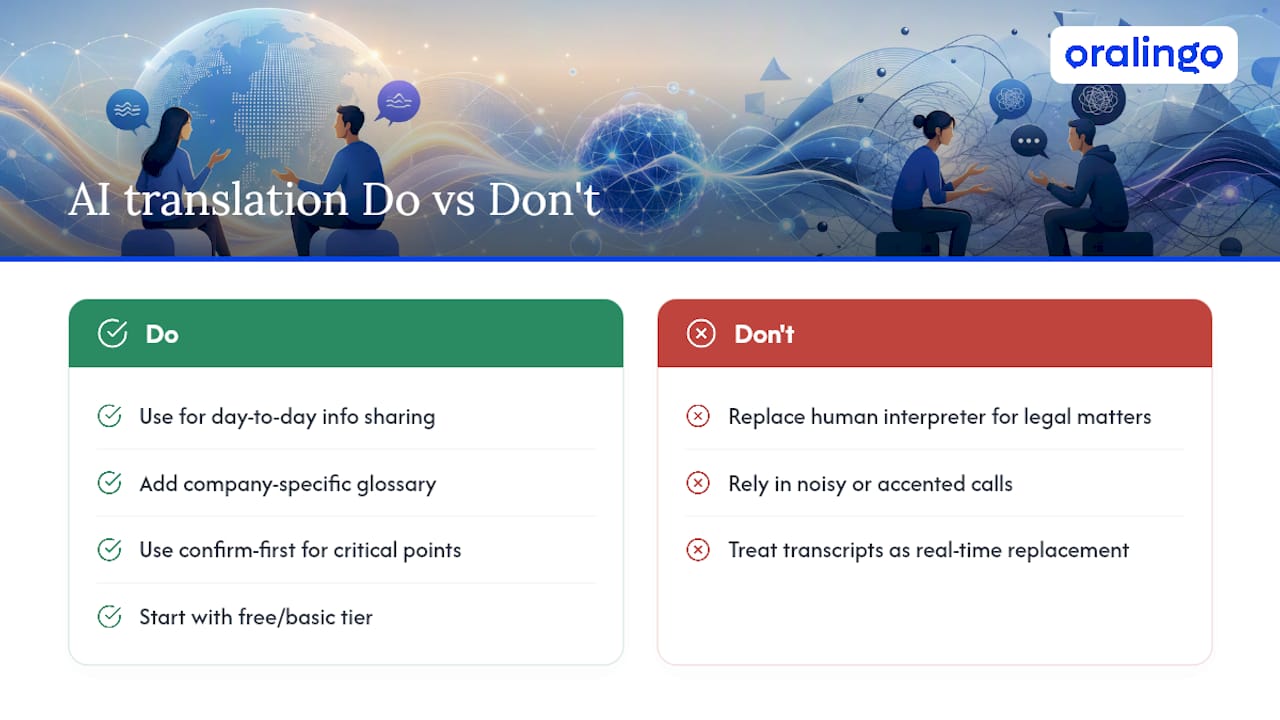
Is there a cost to using AI translation for onboarding? Most tools, including Oralingo, offer a free basic tier with paid subscription options for higher usage or premium features, which fits teams running frequent onboarding conversations across languages.
Sources
- Practices for effective onboarding in dynamic Global Virtual Teams — Organizational Dynamics (2026)
- AI live translation for HR onboarding: A step-by-step guide — The Human Capital Hub
- Remote Onboarding Across Cultures — ISPA