
You struggle without local fluency because three things happen at once: your brain gets anxious about mistakes, your social world quietly walls itself off in English, and the language you hear on the street is too fast and messy to actually learn from. Psychologist Stephen Krashen called the first mechanism the affective filter, and a 2026 study of 281 expatriates confirms the second: people with smaller local networks feel the language gap the hardest.
Here's what this article covers:
- The psychological toll: anxiety, identity loss, and mental fatigue
- The social trap: expat bubbles, workplace English, and gatekeeping
- The practical wall: noisy input, accents, and jargon
- A prioritized plan for making real progress, starting this week
Key Takeaways
Expats struggle without local fluency because anxiety blocks retrieval, expat bubbles remove the need to practice, and everyday speech is too fast and noisy to learn from passively.
| Point | Details |
|---|---|
| Anxiety blocks language use | The affective filter shuts down access to known vocabulary under social pressure, so low-stakes practice matters more than more study. |
| Immersion alone doesn't work | Acquisition needs comprehensible input plus real interaction, not just years of ambient exposure to the language. |
| Expat bubbles stall progress | English-speaking services, coworkers, and social circles quietly remove the daily pressure to build local skills. |
| High-stakes situations need humans | Healthcare, legal, and safety conversations deserve a certified interpreter, not a guess or a general app. |
| Oralingo eases daily friction | Real-time chat and voice translation helps with everyday tasks while you build fluency through study and practice. |
Table of Contents
- Why Expats Struggle Without Local Language Fluency: The Psychological Toll
- The Expat Bubble and Workplace English
- Why Living There Isn't Enough: The Immersion Myth
- A Realistic Plan for Actually Learning the Language
- What the Research Says About Language and Adjustment
- Language Barriers and Access to Healthcare and Public Services
- Language and Real Integration Into Local Life
- Beyond Words: Reading Non-Verbal Cues Abroad
- Everyday Friction: Shopping, Transit, and Emergencies
- Local Language, Legal Rights, and Personal Safety
- A Personal Note on Progress
- Use Oralingo to Ease Daily Friction While You Build Real Fluency
- Frequently Asked Questions
- Sources
Why Expats Struggle Without Local Language Fluency: The Psychological Toll
Your brain treats a foreign conversation like a small threat, and that changes how you learn. Krashen's affective filter describes exactly this: when anxiety spikes, your mind blocks access to language you've already studied, even words you know cold in a quiet room. You freeze at the counter, reach for English, and walk away feeling like you know less than you actually do.
That fear compounds fast. Miss a word in a fast exchange with a pharmacist or a landlord, and the instinct is to avoid the next similar situation rather than push through it. Avoidance feels like relief in the moment. It's actually the mechanism that keeps you stuck.
There's a second cost that's easy to miss: identity loss. You may run a team, crack jokes, or argue politics fluently in your first language, but abroad you sound like a beginner. That gap between who you are and how you come across chips away at self-esteem in ways people rarely name out loud. Research on expat adjustment documents this directly: qualitative studies link limited language skills to stress, loneliness, and reduced self-expression, not just inconvenience.
Then there's cognitive load, which nobody warns you about before you move. Your brain is already spending huge amounts of energy decoding a new grocery store layout, a new tax system, new social rules for eye contact and small talk. Adding vocabulary drills on top of that is like asking someone to study calculus while moving apartments. Something has to lose, and usually it's the language practice.
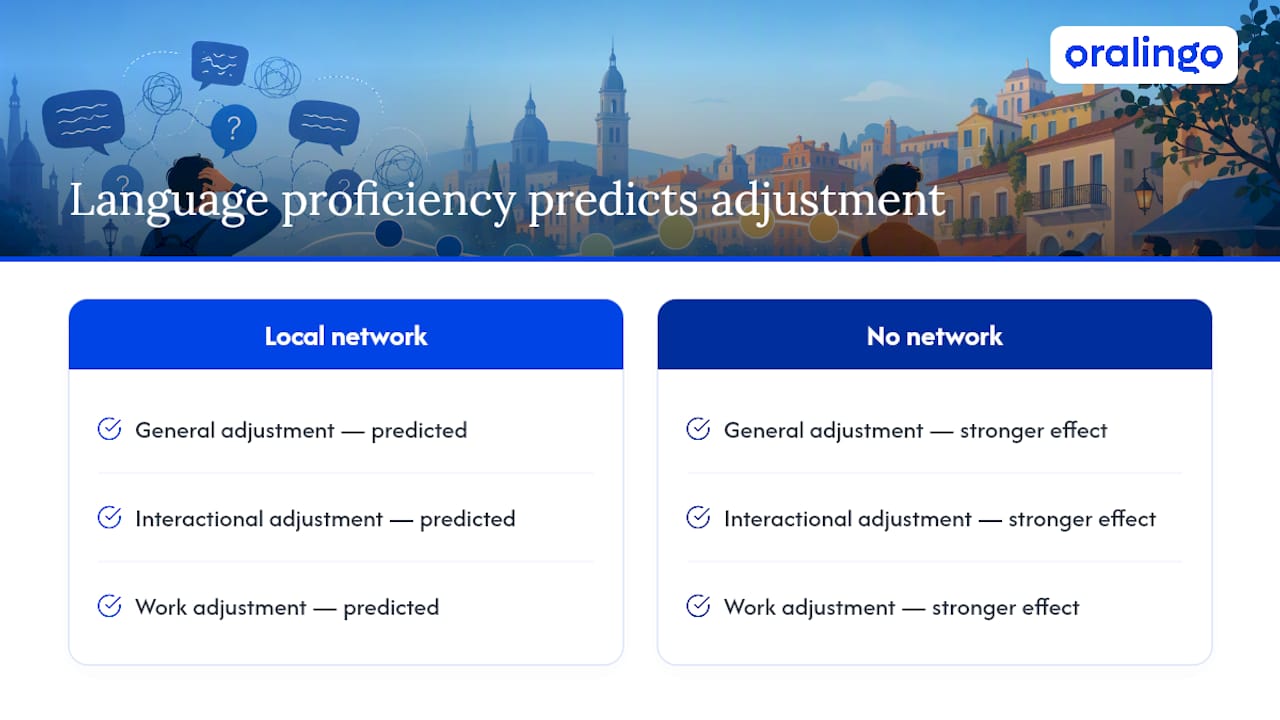
The 2026 study of 281 expatriates found host-country language proficiency predicts better general, interactional, and work adjustment, and the effect is strongest for expats with smaller local networks. Language isn't just a nice-to-have skill here. It's the mechanism that determines whether you build a support system or spend years on the outside of one.
Three signals you're hitting the affective filter, not a vocabulary gap:
- You know the word in your head but can't produce it under pressure
- You rehearse simple sentences internally before saying them out loud
- You default to English even when you clearly understand the question
Pro Tip: Practice out loud alone before you need the phrase in real life. Say your coffee order, your address, or your standard small talk answer to your bathroom mirror. Rehearsed phrases survive anxiety better than phrases you're composing live.
The Expat Bubble and Workplace English
Every expat destination has a shadow infrastructure: English-speaking real estate agents, international schools, expat Facebook groups, and restaurants that hand you an English menu before you ask. None of it is malicious. It's just friction removal, and friction removal is exactly what stalls language learning.
The pattern shows up in three predictable ways:
- Service defaults to a lingua franca. Banks, clinics, and government offices in expat-heavy areas often staff at least one English speaker, so you never have to struggle through the local process.
- Corporate policy locks in English. Multinational offices frequently mandate English as the working language, which removes daily pressure to build local vocabulary even after years on the ground.
- Bilingual gatekeepers filter your world. A local partner, translator colleague, or English-speaking friend becomes your default interpreter, and you stop building the skill because someone else always has it covered.
That third pattern carries a hidden cost. Research on expatriate assignments describes how gatekeepers filter and reframe information, which creates a mediated experience rather than direct relationships with local colleagues and neighbors.
Expatriates who rely on English or intermediaries risk exclusion from information flows and weaker trust with local staff. The absence of host-language skills doesn't just limit conversation. It can reshape how much local colleagues actually confide in you.
That dynamic is documented in research on expatriate host-country language learning and its effect on workplace relationships, and it explains why some expats hit a career ceiling that has nothing to do with performance.
Why Living There Isn't Enough: The Immersion Myth
"Just move there and you'll pick it up" is one of the most repeated pieces of advice expats hear, and it's largely wrong. Length of residence is a weak predictor of how well someone ultimately speaks a language, because exposure and learnable exposure are different things.
Linguists draw a sharp line between ambient noise and comprehensible input, often written as i+1: language just slightly above your current level, which you can parse with effort and context clues. Overheard chatter at a train station, fast-talking neighbors, or a dubbed movie playing in the background is mostly noise. Your brain can't extract structure from it, so it doesn't build anything. Research on immersion confirms exposure without negotiation of meaning is largely ineffective; acquisition depends on interaction where you and your conversation partner actively repair misunderstandings.
Three practical snags make this worse for adults:
- Accents and speech rate. Textbook Spanish and a rapid regional dialect are barely the same language to a learner's ear.
- Sector-specific jargon. Legal, medical, and technical vocabulary rarely shows up in general courses, so professionals often hit a plateau where survival language works fine but nothing deeper does.
- Time and cost. Structured lessons compete with work, kids, and jet lag, and many expats quietly stop investing once they can order food and take a taxi.
That plateau is well documented: many long-term expats reach a comfortable survival level and stop progressing because the incentive to keep struggling disappears once daily life feels manageable.
Realistic timelines help set expectations. Conversational comfort for a moderately similar language (Spanish for an English speaker, for instance) typically takes several hundred hours of combined study and practice, not weeks. For anything high-stakes, a lease negotiation, a medical diagnosis, a police interview, use a professional human interpreter rather than leaning on your half-formed vocabulary or a general translation tool. The margin for error is too costly.
A Realistic Plan for Actually Learning the Language
Progress comes from combining three things most expats do separately, when they do them at all: deliberate study, live interaction, and engineered comprehensible input. Skip any one leg and the other two wobble.
- Anchor 20 minutes a day to deliberate study. Use spaced repetition software for vocabulary and a grammar reference for structure. This is unglamorous, but it's the leg that pure immersion never replaces.
- Book one weekly conversation with a tutor or exchange partner. This is where negotiation of meaning happens, the back-and-forth repair work that drives acquisition faster than passive exposure. Language exchange meetups and structured study-group formats work well here, and pairing with peers going through the same study group communication across languages reduces the isolation of solo studying.
- Build survival scripts for recurring situations. Write and memorize a short script for ordering coffee, explaining a symptom, or asking for directions. Reuse the same café or pharmacy weekly so the vocabulary becomes familiar rather than random.
- Set a weekly conversation quota, not a vocabulary quota. Five short real conversations a week beats fifty flashcards with no one to use them on.
- Escape the bubble on purpose. Join a local sports club, volunteer group, or hobby class where English isn't the default. Genuine friendships without a shared language start with small, repeated low-stakes contact, not grand gestures.
- Track milestones, not vague fluency. Aim for A2 (basic daily tasks) within three to six months of consistent effort, and B1 (independent conversation on familiar topics) within a year. The Common European Framework of Reference for Languages gives concrete benchmarks for each level, which beats guessing at your own progress.
- Escalate to professional help when stakes rise. Legal contracts, medical procedures, and formal complaints deserve a certified interpreter, not a best guess.
Even a small, visible effort pays off early. Accounts from long-term expats consistently note that a few sincere phrases in the local language shift how locals treat you, well before real fluency arrives.
Pro Tip: Pick one recurring errand, the same bakery, the same bus driver, and use it as a weekly language lab. Familiar faces are more patient, and repetition in a low-stakes setting builds the confidence that generic classroom drills can't.

What the Research Says About Language and Adjustment
The clearest evidence on this topic comes from a 2026 study tracking 281 expatriates, which found host-country language proficiency predicts general, interactional, and work adjustment, largely because it opens up social support from locals. That effect is strongest for expats who arrive without a built-in local network, meaning the people who need language skills most are often the ones with the least existing support to fall back on.
The same body of research confirms immersion by itself is a weak lever. Structured study combined with real interaction consistently outperforms passive exposure, which is why translation apps work differently than language lessons: one builds skill over months, the other removes friction in the moment.
That's the honest use case for a tool like Oralingo. It translates conversations in real time, in text or hands-free voice, so a phone call with a landlord or a text with a new neighbor doesn't stall out. It's not a substitute for the deliberate study and live interaction that build actual proficiency, but it fills the gap while you're building it.
Language Barriers and Access to Healthcare and Public Services
A doctor's appointment is not the place to discover you don't know the local word for "dizzy" or "allergic." Public services, clinics, tax offices, immigration desks, run on precise, often bureaucratic vocabulary that general conversation classes rarely teach, and the consequences of a misunderstood form or symptom description are higher than a fumbled restaurant order.
Domain-specific miscommunication in healthcare and banking carries more risk than casual conversation, and general translation tools weren't built with that precision in mind for complex, technical exchanges. A mistranslated dosage, a missed allergy, or a misunderstood loan term isn't a minor slip. It's the kind of error that turns a five-minute appointment into a serious problem.
This is where the calculus should shift toward caution. For a pharmacy visit or a straightforward doctor's note, a translation app closes the gap fine. For a diagnosis, a surgical consent form, or a hearing at an immigration office, bring a certified interpreter or a bilingual advocate. Many public hospitals and legal aid offices offer interpretation services precisely because language errors in these settings carry real legal and medical weight, not just embarrassment.
The practical habit worth building early: learn the vocabulary for your own recurring health needs (chronic conditions, allergies, medications) before you need it in an emergency, and keep a written translated summary of your medical history on your phone. That single document has saved more confused emergency room visits than any app.
Language and Real Integration Into Local Life
Fluency doesn't just unlock conversation. It unlocks invitations. Locals tend to socialize in their own language by default, and expats who never cross that threshold often end up permanently adjacent to the culture rather than inside it, no matter how many years they've lived there.
This shows up in subtle ways. You get invited to the big holiday party but not the casual Tuesday dinner. You're included in group photos but not group decisions. None of this is exclusion on purpose. It's simply that deep social bonds form in the language people think and joke in, and switching to accommodate a non-fluent guest gets tiring fast, even for genuinely welcoming hosts.
The research on expat adjustment backs this up structurally, not just anecdotally: proficiency predicts stronger interactional and general adjustment, especially for people without an existing local network to lean on. Language is the on ramp to community, not a courtesy extended after you've already arrived socially.
Integration doesn't require perfect grammar. It requires enough functional language to sit through an unstructured conversation without needing it translated, to catch a joke a beat late instead of missing it entirely, to contribute an opinion rather than just nodding along. That threshold, often B1 level, is where locals start treating you as a participant instead of a guest.
Beyond Words: Reading Non-Verbal Cues Abroad
Language fluency covers vocabulary and grammar. It does not automatically cover the unspoken rules that carry as much meaning as the words themselves, and expats often misread these even after their spoken language improves.
Eye contact norms, personal space, gift-giving etiquette, and even the acceptable volume of a conversation vary widely by culture, and getting them wrong sends signals you didn't intend. A direct "no" that's polite in one culture can read as rude in another, where the expected response is a vague, deflecting "maybe" that a literal-minded expat completely misses.
Tone and context matter as much as vocabulary. The same phrase said with a smile, a raised eyebrow, or a flat tone can carry three different meanings, and machine translation, however accurate on the words, generally can't capture that nuance. This is where paying attention to how locals react, not just what they say, becomes its own kind of language learning. Watching for hesitation, laughter, or a subtle change in posture teaches you as much about a culture as a textbook chapter on formal grammar.
The practical takeaway: treat non-verbal fluency as a parallel track to spoken fluency, not an afterthought. Ask a trusted local friend to flag moments when your tone or body language didn't match your intention. That kind of direct feedback catches mistakes that no app or class ever will.
Everyday Friction: Shopping, Transit, and Emergencies
Small daily tasks reveal language gaps faster than any test. Reading a shampoo bottle at the pharmacy, understanding a bus route change announced over a crackling intercom, or asking a mechanic what's actually wrong with your car all demand vocabulary that general courses rarely prioritize.
Grocery shopping without fluency means guessing at labels, missing sales, and occasionally buying the wrong product entirely (dish soap instead of dish detergent, decongestant instead of allergy medicine). Public transportation adds a layer of urgency: missing a platform change announcement or misreading a ticket machine can mean a missed flight or a wrong-direction train with no easy way to ask for help.
Emergencies are where the stakes jump sharply. Calling for an ambulance, reporting a break in, or explaining a car accident to police all require precise, fast communication, exactly the situation where anxiety spikes and fluency drops. Knowing basic emergency vocabulary (your address, "I need help," "call an ambulance") before you need it is worth more than an hour of grammar drills. A travel language barrier guide covering these exact scenarios is worth reviewing before, not during, a crisis.
Translation apps genuinely shine here. Real-time voice translation during a taxi ride or a pharmacy visit closes the gap in the moment, even if it doesn't build the underlying skill.
Local Language, Legal Rights, and Personal Safety
Some conversations simply cannot afford a misunderstanding. Signing a lease, understanding a work contract, responding to a police officer, or navigating an immigration interview all carry legal weight, and a misread clause or misunderstood question can have consequences that outlast the conversation itself.
Legal and government documents use precise, often archaic phrasing that trips up even confident intermediate speakers. A lease clause about deposit conditions, a work contract's non-compete language, or a residency permit's renewal requirements deserve a professional translation or a bilingual lawyer's review, not a best guess based on cognates.
Personal safety follows the same logic. Knowing how to describe an emergency, state your address clearly, or understand a police officer's instructions isn't optional vocabulary. It's the language you hope you never need but must have ready. Many countries require at least functional local-language proficiency for residency renewal or naturalization specifically because officials recognize that legal and civic participation depends on it, not because of any wish to make immigration harder.
The rule of thumb: the higher the legal or physical stakes, the less room there is for improvisation. Learn your emergency phrases cold, and when a document or interaction has legal consequences, bring a qualified human, not a phone.
A Personal Note on Progress
Progress here is never linear. Combine weekly deliberate study with daily real-world practice, and let a translation app catch the gaps in between. Some weeks will feel like backsliding. That's normal, not failure.
Use Oralingo to Ease Daily Friction While You Build Real Fluency
Oralingo won't teach you grammar, and it won't replace the tutor sessions and survival scripts covered above. What it does is remove the daily friction that makes those early months abroad exhausting: a text to your landlord, a voice note to a new neighbor, a quick exchange with a delivery driver, all translated instantly, before the message even displays, so the conversation feels natural instead of stalled.
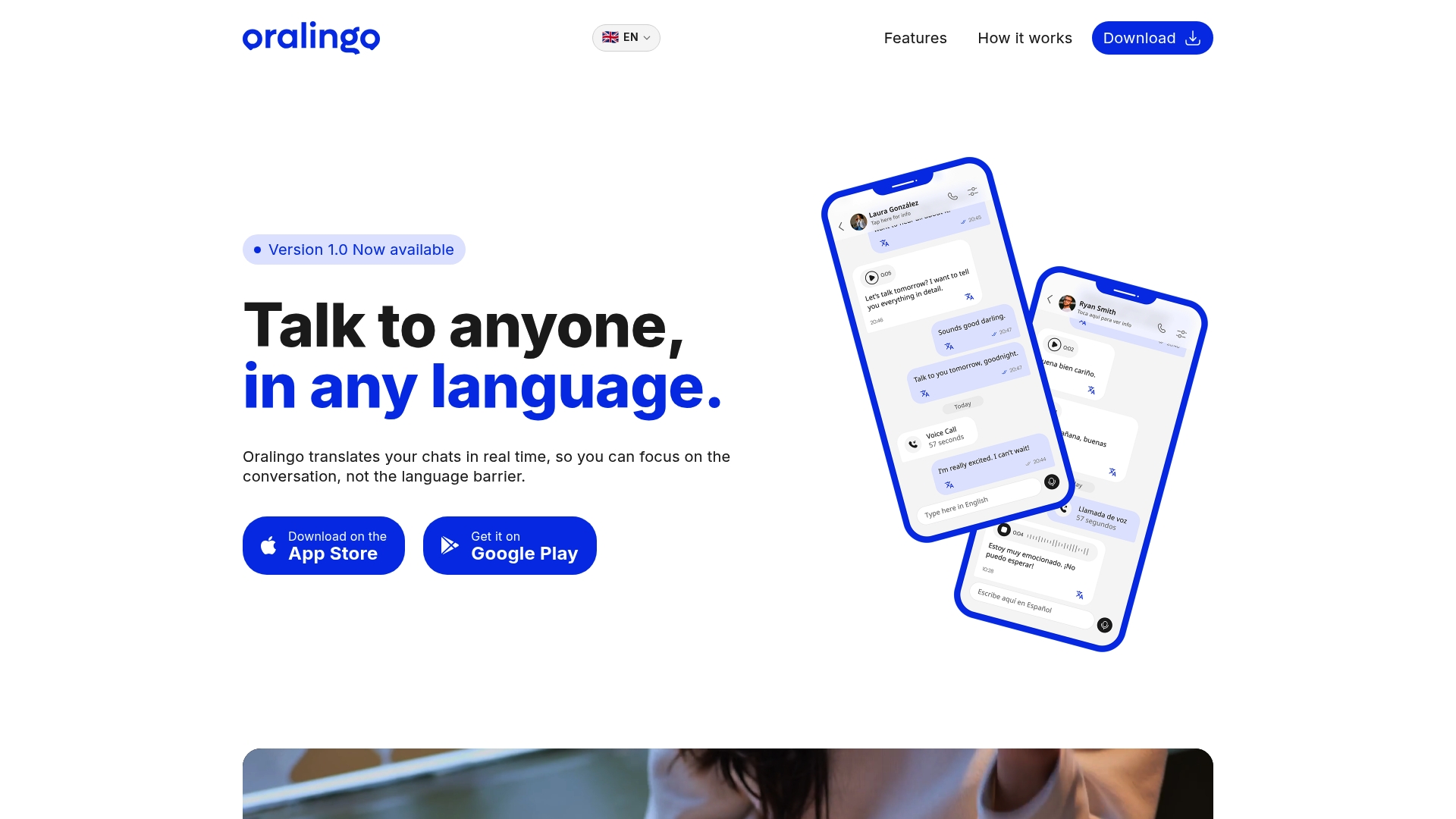
The hands-free voice mode matters more than it sounds. Speaking a language out loud, even through an app, builds a different kind of comfort than typing does, and it's useful for the exact moments when you're too rushed or nervous to type a translation request. Every conversation stays end-to-end encrypted, so the private details of your daily life abroad, medical questions, lease terms, family messages, stay private.
Use it the way this article recommends: as the safety net under your language learning, not the reason to stop learning. Lean on it for daily logistics while you invest your real study time in the deliberate practice and live conversation that actually build fluency. Start using Oralingo today to make those daily exchanges easier while you keep building the skill behind them.
Frequently Asked Questions
Why do so many expats never become fluent even after years abroad? Most hit a survival plateau: once ordering food, taking transit, and basic small talk feel manageable, the incentive to keep struggling through deliberate study disappears, even though real fluency requires pushing well past that comfort zone.
How long does it realistically take to feel comfortable speaking a new language abroad? Conversational comfort in a moderately similar language typically takes several hundred hours of combined study and interaction, often stretching across six months to a year of consistent weekly effort, not the few weeks casual immersion myths suggest.
Does living in an English-speaking expat community actually hurt language learning? Yes. Expat bubbles reduce the daily pressure to use the local language by defaulting to English-speaking services, coworkers, and social circles, which removes the repeated low-stakes practice that builds real fluency.
When should an expat use a professional interpreter instead of a translation app? Reserve professional interpreters for legal, medical, and safety-critical situations, lease signings, diagnoses, police interviews, where a misunderstood word carries real consequences; general translation tools work fine for daily errands and casual conversation.
Can a translation app like Oralingo actually help someone learn the local language? Oralingo reduces the daily stress of not understanding a message or conversation, which frees up mental energy for deliberate study, but it works best as a supplement to lessons and live practice, not a replacement for them.
Sources
- Language proficiency and expatriate adjustment (2026)
- The science of immersion: why living abroad isn't enough
- From dilemmatic struggle to legitimized indifference: expatriates' host country language learning and impact on expatriate–HCE relationship