Speed changes emotional conversations because it preserves timing, and timing is where feeling lives. A fast, well-managed translation keeps the rhythm of a conversation intact: the hesitation before bad news, the quick "I'm sorry" after an interruption, the pause that signals someone is still listening. But speed without control strips nuance. Research on translators under time pressure links working-memory overload to lower quality output, and emergency-response documentation from the CDC ties interpreter delays directly to worse outcomes in urgent calls. Tools like Oralingo were built around this exact tension.
Three emotional elements shift the most when speed changes:
- Prosody and tone — pitch, tempo, and emphasis often get flattened when a translator or app rushes.
- Turn-taking — natural back-and-forth breaks down when one side waits too long for a response.
- Repair opportunities — the small "wait, what I meant was..." moments that fix misunderstandings disappear when delay makes them feel awkward or late.
Key Takeaways
Translation speed shapes emotional outcomes because timing carries tone, turn-taking, and repair, the elements that make a message feel human rather than processed.
| Point | Details |
|---|---|
| Speed preserves timing | Fast translation keeps pauses, hesitation, and prosody intact, which carries much of a message's emotional weight. |
| Working memory limits accuracy | Time pressure raises translator anxiety and reduces quality, per peer-reviewed research on emotion regulation. |
| Match urgency to the moment | Prioritize speed for safety and triage; prioritize depth for therapy, legal statements, and complex negotiation. |
| Use turn-design techniques | Pre-briefing, shorter turns, and clear pause signals preserve tone without adding real delay. |
| Oralingo handles everyday speed | Its pre-delivery translation and voice mode keep casual and personal conversations flowing in real time, while high-stakes exchanges still call for a human interpreter. |
Table of Contents
- How timing, memory, and pauses actually carry emotion
- What does the research say about speed and emotional quality?
- Where does translation speed change real outcomes?
- When should speed beat accuracy, and when shouldn't it?
- What techniques keep emotion intact under time pressure?
- Do real-time apps replace human interpreters?
- What most guides get wrong about translation speed
- A faster way to keep tone intact in real conversations
- Frequently Asked Questions
- Sources
How timing, memory, and pauses actually carry emotion
A conversation is not just words. It's timing. A half-second pause before "I love you" means something different than the same words fired back instantly. Prosodic cues, pitch, tempo, stress, do the emotional heavy lifting that vocabulary alone can't carry. When translation lags, those cues are often the first casualty because someone has to compress the message to catch up.
That compression comes from working-memory load. A translator or interpreter holding a full sentence in mind while also converting it, checking grammar, and preserving tone hits a mental ceiling fast. Peer-reviewed research on translators' emotion regulation shows this pressure correlates with higher anxiety and lower quality output. Under stress, people simplify. Nuance gets cut first.
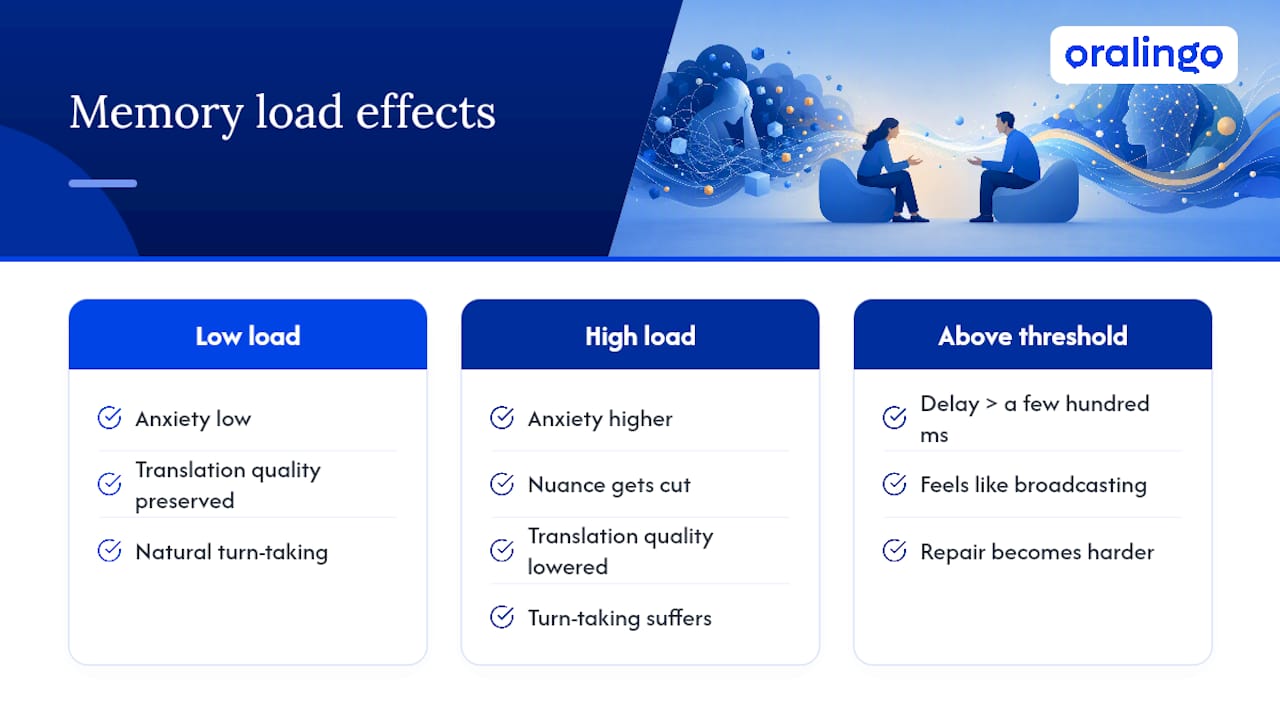
Turn-taking suffers next. Picture a simple sequence: speaker talks, lag happens, listener reacts to a delayed or flattened version of what was actually said. That gap is where misread tone creeps in. Repair, the natural correction that happens in live conversation, becomes harder because by the time the translation lands, the emotional moment has often passed.

Practitioner accounts describe a rough threshold for this: once delay stretches past a few hundred milliseconds, conversation starts feeling less like shared interaction and more like two people taking turns broadcasting at each other. A technical study on real-time speech-to-speech translation found that keeping latency low helps preserve perceived urgency and naturalness, though some textual accuracy gets traded away to hit that speed.
What does the research say about speed and emotional quality?
The clearest signal comes from two directions: translator psychology and emergency response data.
On the psychology side, studies on translators' emotional regulation show that time pressure raises anxiety and taxes working memory, which directly correlates with reduced speed and weaker output quality. This isn't just about people typing slower. It's about the brain having less capacity left over for tone, subtext, and cultural framing once it's fighting the clock.
On the outcomes side, CDC documentation on emergency communication links interpreter-connection delays to extended call durations in urgent medical and safety situations. A wait of even 90 seconds can change how a critical call unfolds.
The strongest takeaway across both bodies of evidence: speed and emotional fidelity aren't opposites, they're usually correlated, because rushed translators lose composure and delayed systems lose the moment entirely.
Separately, work on human interpreters preserving interactional meaning shows they flag ambiguity and enable repair in ways automated tools still struggle to match consistently.
Where does translation speed change real outcomes?
Some conversations tolerate a slow, careful translation. Others don't survive one. Here's where speed makes or breaks the exchange:
- Medical bad news. A doctor delivering a diagnosis needs the patient to hear tone alongside facts. A slow, choppy translation can make devastating news feel clinical or, worse, confusing about severity.
- 911 and emergency dispatch. A delay connecting an interpreter can stretch a call by minutes. Every second matters when a dispatcher needs an address or symptom description immediately.
- Live negotiation. Hesitation reads as weakness or dishonesty across cultures differently. Streaming translation that keeps pace with natural turn-taking preserves the feel of live dialogue far better than a stop-and-wait exchange, a dynamic covered in more depth in this guide to real-time multilingual negotiation.
- Therapy sessions. Emotional disclosure needs space, not speed. A rushed translation of trauma disclosure can flatten the moment a client needed to be heard slowly.
- HR disciplinary meetings. Precision protects everyone. A delayed or garbled translation of a warning can create legal ambiguity about what was actually communicated.
Faster translation generally preserves urgency and connection. Delay usually erases the small emotional signals, tone, hesitation, timing, that make a message land the way it was meant to.
When should speed beat accuracy, and when shouldn't it?
Not every conversation needs the same balance. A few working rules help:
- Prioritize speed when there's immediate safety risk: medical triage, emergency dispatch, active de-escalation.
- Prioritize depth when precision has legal or emotional weight: therapy, legal admissions, complex multi-party negotiations.
- Watch for red flags where delay is genuinely dangerous: escalating aggression, a patient in acute distress, someone about to make a legally binding statement.
- Use a hybrid stance for borderline cases. Start fast to establish the situation, then slow down and bring in more careful translation once the immediate risk passes. A support call might open with quick, rough translation to identify the problem, then shift to a more careful mode once both sides understand the stakes.
The goal isn't picking one mode forever. It's recognizing which mode the moment calls for and switching deliberately.
What techniques keep emotion intact under time pressure?
Skilled interpreters don't just talk faster. They manage the conversation differently:
- Pre-brief when possible. A short heads-up on topic, tone, and sensitivity lets an interpreter prepare phrasing before pressure hits.
- Design shorter turns. Ask speakers to pause every sentence or two rather than delivering a two-minute monologue that has to be compressed later.
- Use controlled summarization. When full accuracy isn't possible in real time, summarize faithfully rather than guessing at details.
- Signal clearly. A simple raised hand or phrase like "one moment for translation" prevents the listener from misreading silence as evasion.
- Separate drafting from revision. Expert translators mentally draft first, then refine, rather than trying to perfect every phrase on the first pass, a pattern documented in studies of translators' metacognitive control.
Pro Tip: Mirror the speaker's pace for the first few words of your translation, even if you have to speed up afterward. Matching initial tempo signals emotional continuity before the listener even processes the content.
Do real-time apps replace human interpreters?
Real-time tools are strong where speed and availability matter most: instant response, no scheduling, no cost barrier for casual use. Their limits show up around sarcasm, extreme emotion, and prosody, the layers that carry meaning beyond literal words. Reporting on AI translation fluency confirms that even fluent systems still miss non-verbal and interactional cues.
Human interpreters remain essential where repair, cultural mediation, and controlled register matter, therapy, legal proceedings, high-stakes negotiation. Experimental research into emotion-aware translation is promising but still research-stage for high-stakes use.
A practical rule: let fast tools carry routine, low-risk conversation. Bring in a human the moment stakes, ambiguity, or emotional weight rise.
Oralingo fits the first category well: real-time, pre-delivery translation designed to keep tone intact for everyday emotional exchanges, family check-ins, travel, cross-language relationships. For legal or clinical conversations, escalate to a qualified human interpreter.
What most guides get wrong about translation speed
Most advice treats speed and emotional accuracy as a trade-off you accept or reject. In practice, they're intertwined: a translator fighting the clock produces worse emotional output than one working at a sustainable pace, and a system that's too slow erases the moment before any accuracy matters. The real skill is recognizing which failure mode threatens a given conversation and adjusting speed deliberately rather than defaulting to either extreme. Training for speed and training for emotional sensitivity shouldn't be separate disciplines. They're the same skill viewed from different angles.
A faster way to keep tone intact in real conversations
Oralingo translates messages before they're displayed, so the pause that usually breaks a conversation's rhythm mostly disappears. That matters most in exactly the situations this article covers: a quick check-in with family abroad, a sensitive text exchange with a partner who speaks a different language, a business chat where hesitation could be misread. The hands-free voice mode extends that same speed to spoken conversation, so you're not stuck typing while someone waits for a reply.
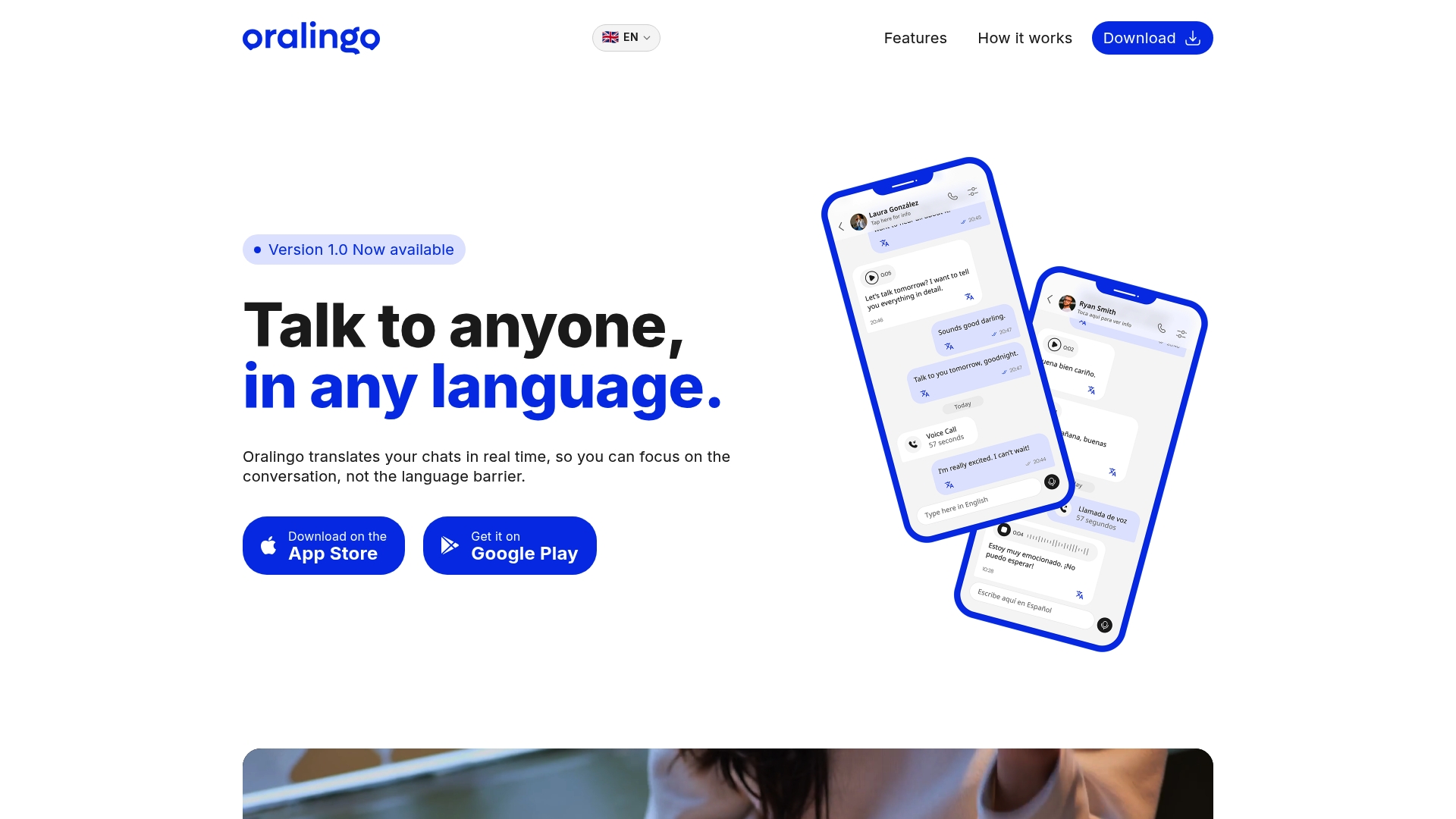
Oralingo supports over 100 languages with a 99% accuracy rate and end-to-end encryption, built for the everyday emotional conversations where timing carries as much meaning as the words themselves. For legal, medical, or high-stakes negotiations, bring in a qualified human interpreter instead. For everything else, from long-distance relationships to cross-border business chats, try Oralingo and see how it handles your next conversation.
Frequently Asked Questions
Does faster translation always mean better emotional communication? No. Speed helps preserve timing and tone, but rushed translation without technique can strip nuance and increase errors, especially under high working-memory load.
What's the safest latency for emotionally sensitive conversations? Research on real-time speech translation suggests average latency under three seconds helps preserve naturalness and urgency, though some accuracy trade-off remains at that speed.
When should a human interpreter replace a translation app? Bring in a human interpreter for therapy, legal proceedings, medical diagnoses, and any exchange where ambiguity, repair, or cultural nuance carries real consequences.
Can apps like Oralingo handle emotional conversations well? Yes, for everyday emotional exchanges, family, relationships, casual business chat, Oralingo's pre-delivery translation and voice mode preserve tone and timing effectively. For high-stakes situations, pair it with human oversight.
Sources
- Exploring the role of translators' emotion regulation and critical ...
- Real-time speech-to-speech translation with urgency preservation in time-sensitive scenarios
- Breaking barriers with an emotion translator - CREATE at UW