
The fastest path to cross-cultural trust combines seven prioritized steps: check your assumptions, set shared expectations early, demonstrate consistent competence, invest in relationship rituals, use plain and clear language, listen and verify understanding, and repair breaches quickly. Do those seven things, and you will see trust grow across almost any cultural gap.
Here is your quick-start checklist:
- Check your bias first. Name one assumption you hold about the other person's culture before your first conversation.
- Set expectations out loud. Agree on how you will communicate, how often, and what "on time" means to each of you.
- Show up reliably. Do what you say, when you say it, every single time in the early weeks.
- Schedule relationship time. Block time for non-task conversation, shared meals, or cultural events.
- Use plain language. Cut jargon, slow down, and confirm understanding after key points.
- Listen to understand, not to respond. Pause, summarize what you heard, and ask one open question.
- Repair fast. When a misunderstanding happens, address it within 24 hours.
You will know trust is growing when the other person starts sharing context you did not ask for, initiates contact outside of scheduled check-ins, or volunteers a personal detail. Those small signals matter.
Key Takeaways
Cross-cultural trust builds fastest when you combine consistent, reliable behavior with genuine relationship investment, and repair misunderstandings quickly before they compound.
| Point | Details |
|---|---|
| Start with self-awareness | Name one cultural assumption before every first conversation to stay genuinely curious. |
| Match trust type to culture | Task-based cultures respond to competence signals; relationship-based cultures need personal warmth first. |
| Use plain language and verify | Simplify, then use teach-back or paraphrase to confirm the other person heard what you meant. |
| Repair breaches within 24 hours | Pause, validate, explain intent, propose a remedy, and confirm acceptance before moving on. |
| Oralingo reduces language friction | Real-time, tone-preserving translation across 100+ languages keeps conversations clear and trust intact. |
Table of Contents
- How to build trust in cross-cultural relationships, step by step
- Communication techniques that actually build trust
- Why cognitive trust and affective trust require different tactics
- How to handle misunderstandings and restore trust after a breach
- Conversation starters that surface expectations without causing offense
- What most people get wrong about cross-cultural trust
- Real-time translation that keeps your conversations on track
- Sources
How to build trust in cross-cultural relationships, step by step
A clear timeline removes the guesswork. Here is a practical playbook from day one through the first three months, grounded in what research from Harvard Business Review confirms: partners who trust each other spend less time protecting themselves and reach better outcomes together.
1. Day 1: Check your assumptions and set your intention. Before you say a word, write down one assumption you hold about the other person's culture. Then set a simple intention: "I will stay curious and ask before I conclude." This single habit, supported by Peace Corps cultural training materials, is the most underrated first step in any intercultural relationship.
2. Week 1: Learn one local norm and show up in their context. The Community Tool Box at the University of Kansas recommends learning local customs and attending cultural events as early trust signals. You do not need to become an expert. Showing up at a cultural event, trying a local greeting, or asking one genuine question about a tradition signals respect before competence is even on the table.
3. Week 1: Agree on communication norms. In your first real conversation, surface the basics:
- "How do you prefer to get updates, by message or by call?"
- "What does a missed deadline mean to you? I want to make sure we're aligned."
- "Is it okay to ask questions when I'm unsure, or do you prefer I figure it out first?"
These prompts prevent the silent misunderstandings that erode trust before it has a chance to form. For more on setting these norms with a team, see how to set communication norms for multilingual teams.
4. Month 1: Deliver on small promises consistently. Cognitive trust, the kind built on competence and reliability, forms fastest through small, repeated wins. Send the file when you said you would. Follow up after every meeting. Confirm what was agreed in writing. These micro-behaviors compound quickly.
5. Month 1: Add one relationship ritual. Shared meals, a standing coffee chat, or a brief "how are things going personally?" at the start of a call all build affective trust. Relationship-based cultures, including many in Latin America, the Middle East, and sub-Saharan Africa, often require this warmth before cognitive trust can even register.

6. Months 1–3: Adjust your pacing. Thunderbird School of Global Management notes that effective cross-cultural leaders assume positive intent, seek contextual background, and adjust pacing. Some cultures expect personal disclosures within weeks; others treat that as intrusive until months of shared experience have passed. Watch for cues: if the other person keeps conversations strictly professional, match that pace and let them lead the shift.
7. Months 1–3: Build a shared "third culture." Rather than expecting the other person to adapt entirely to your norms, negotiate a hybrid set of rituals and expectations that belong to both of you. Decide together how you will handle disagreements, how you will celebrate milestones, and what your shared shorthand will be. This prevents the resentment that builds when one person feels they are always the one adapting.
Pro Tip: If you are unsure whether to prioritize competence signals or relationship gestures in the first month, ask directly: "Is there anything about how we work together that would make things easier for you?" The answer tells you exactly which kind of trust to build first.
Communication techniques that actually build trust
Words are only part of the picture. How you listen, how you phrase things, and even where you stand all send trust signals that cut across language.
Plain-language habits that prevent misunderstandings
Simplifying your language is not the same as talking down to someone. It means removing idioms, acronyms, and compound sentences that create unnecessary cognitive load. Aperian's research on cross-cultural work relationships identifies plain language, active listening, and individual follow-up as the three most practical techniques for closing cross-cultural gaps.
After a key point, use the teach-back method: "Can you tell me back what you heard, just so I know I explained it clearly?" This shifts the burden of clarity onto you, not them, which is exactly where it belongs.
Active listening behaviors that signal respect
- Pause before responding. A two-second pause after someone finishes speaking signals you processed what they said, not just waited for your turn.
- Summarize out loud. "So what I'm hearing is X. Is that right?" This one habit prevents more misunderstandings than any other single technique.
- Ask open context questions. "Can you help me understand the background on that?" invites explanation without implying the other person was unclear.
- Avoid finishing sentences. In many cultures, completing someone else's thought is rude, not helpful.
Nonverbal cues to watch and adapt
Nonverbal communication varies widely. Eye contact that reads as confident in the United States can feel aggressive in parts of East Asia. Physical proximity that feels warm in Brazil may feel intrusive in Germany. Formal titles that seem stiff to an American colleague may be a basic sign of respect to a Japanese counterpart.
Dos:
- Mirror the other person's level of formality in the first meeting.
- Use open body posture: uncrossed arms, slight forward lean.
- Nod to signal you are following, not necessarily agreeing.
Don'ts:
- Do not assume silence means agreement. In many cultures, silence signals discomfort or disagreement.
- Do not use humor until you know the other person well. Sarcasm and irony rarely translate.
- Do not rush to fill pauses. Comfortable silence is a trust signal in many cultures.
For a deeper look at what gets in the way, see cross-cultural communication barriers explained.
Why cognitive trust and affective trust require different tactics
Not all trust is the same. INSEAD Knowledge identifies two primary foundations: cognitive trust, built on competence and reliability, and affective trust, built on emotional closeness and genuine care. Cultures vary significantly in which they prioritize first.
Task-based cultures, commonly including the United States, Germany, Australia, and the United Kingdom, tend to extend cognitive trust relatively quickly based on credentials, track record, and consistent delivery. Relationship-based cultures, including China, Brazil, Saudi Arabia, and Nigeria, typically require affective trust before cognitive trust even becomes relevant. In those contexts, a flawless project delivery from a stranger carries less weight than a shared meal with a trusted contact.
What this means for you: if you are working with a partner from a relationship-based culture and you lead with a polished presentation, you may be solving the wrong problem. They are not yet asking "Can you do the job?" They are asking "Do I know you well enough to find out?"
Pro Tip: In the first meeting with a new cross-cultural contact, spend the first five minutes on genuine personal exchange before any agenda item. Ask about their week, their city, or a recent local event. That five minutes builds more affective trust than an hour of professional credentials.
| What to do | Cognitive trust (task-based cultures) | Affective trust (relationship-based cultures) |
|---|---|---|
| First meeting | Share credentials, past results, clear process | Personal exchange, shared meal, show genuine interest |
| Building momentum | Deliver on small promises consistently | Invest in regular non-task contact |
| Signaling respect | Punctuality, written follow-ups, clear scope | Remember personal details, acknowledge family or life events |
| What to expect | Trust granted after demonstrated competence | Trust granted after sustained personal investment |
How to handle misunderstandings and restore trust after a breach
Misunderstandings are not failures. They are turning points/01%3A_The_Study_and_Practice_of_Intercultural_Communication/1.06%3A_Relationships_and_Cultural_Identity) — specific moments where your response either advances or undermines the relationship. Handle them well and trust often comes out stronger.
The repair protocol
- Pause. Do not respond in the heat of the moment. Give yourself and the other person time to process.
- Validate. Acknowledge the other person's experience before explaining yours. "I can see why that landed the way it did."
- Explain intent without excusing impact. "My intention was X, but I understand it came across as Y, and that matters."
- Propose a remedy. Offer something concrete: a follow-up call, a written clarification, a changed behavior going forward.
- Confirm acceptance. Ask directly: "Does that feel like a fair way to move forward?" Do not assume a polite nod means the issue is resolved.
Apology scripts adapted to cultural context
Some cultures expect a direct, explicit apology: "I was wrong, and I apologize." Others find that framing uncomfortable and respond better to relationship-restoring gestures, like a shared meal, a thoughtful gift, or simply investing extra time in the relationship after the breach.
- Direct apology (common in the U.S., Germany, Australia): "I want to be direct: I got that wrong, and I'm sorry. Here's what I'll do differently."
- Relationship-restoring approach (common in many East Asian, Middle Eastern, and Latin American contexts): Skip the explicit apology and instead invest visibly in the relationship. Suggest a call, send a thoughtful follow-up, or acknowledge the other person's perspective in a group setting.
When to involve a mediator
Bring in a mediator when the same misunderstanding has surfaced more than twice, when one party has gone silent, or when the breach involves a public loss of face. A trusted third party who understands both cultures can reframe the situation without either side losing ground.
After any repair, follow up within a week. A short message that says "I've been thinking about our conversation and I want to make sure we're good" does more to prevent lingering resentment than any formal resolution.
Conversation starters that surface expectations without causing offense
The right question at the right moment prevents weeks of silent misalignment. These prompts are designed to open honest conversations without putting anyone on the spot.
Professional context prompts
- "How do people on your team usually handle it when a deadline shifts? I want to make sure I flag things the right way."
- "When you're deciding something, do you prefer to talk it through first or get a proposal in writing?"
- "What does a good working relationship look like to you? I'd love to know what matters most."
- "Is there anything about how I communicate that would make things easier for you?"
Personal context prompts
- "I'd love to understand more about how things work in your family. Are there any traditions or expectations I should know about?"
- "What's the best way to bring up something that's bothering me, from your perspective?"
- "Are there topics that are better to avoid, at least at first?"
Dos and don'ts for sensitive questions
Do:
- Frame questions as curiosity, not evaluation. "I'm still learning" signals openness.
- Ask about preferences, not rules. "What works for you?" is less threatening than "What does your culture say about X?"
- Give the other person an easy out. "You don't have to answer this if it's too personal" lowers the stakes.
Don't:
- Ask multiple sensitive questions in one conversation. One at a time builds trust; a list feels like an interrogation.
- Treat the answer as a fixed cultural rule. One person's preference is not their entire culture's position.
- Use "you people" or any phrasing that groups the other person with a stereotype.
Building a shared "we" perspective, where you explicitly negotiate rituals and milestones together, is one of the most effective strategies for reducing relationship distress in intercultural partnerships, according to research on intercultural relationship strategies.
What most people get wrong about cross-cultural trust
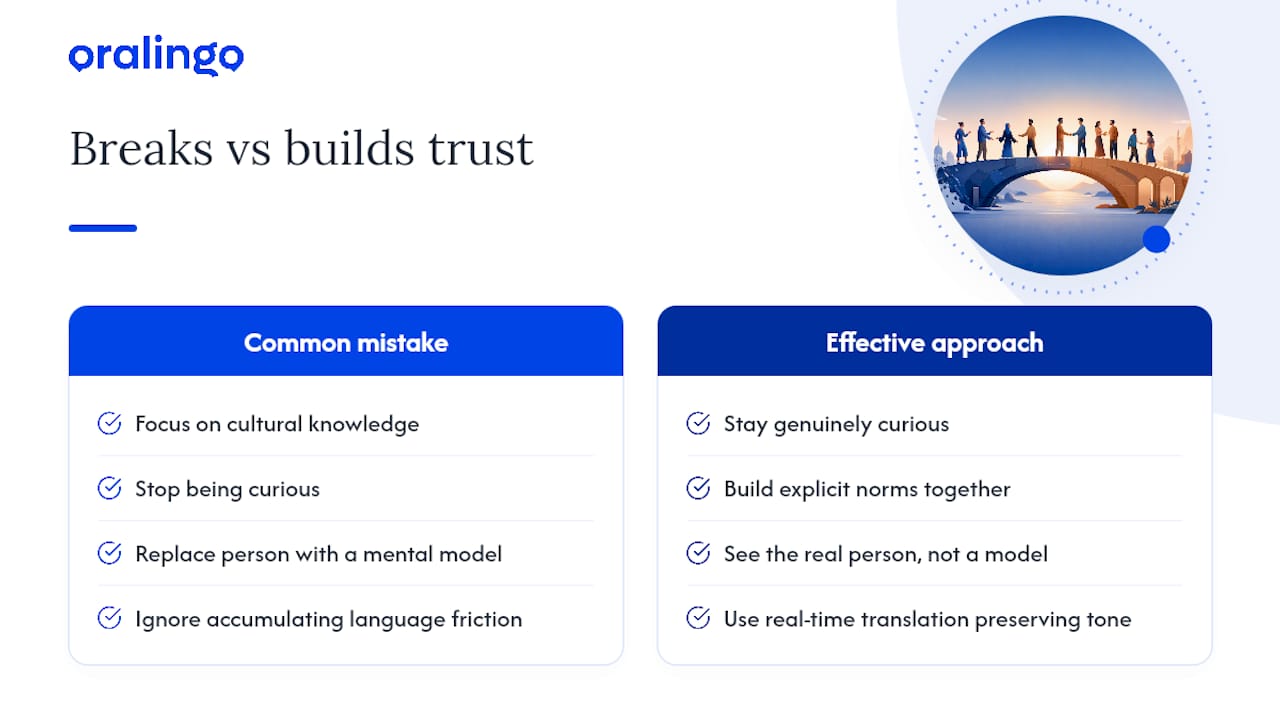
Most professionals focus on cultural knowledge: read a country guide, learn a few customs, avoid the obvious faux pas. That is useful, but it misses the deeper mechanism.
Cross-cultural trust does not fail because people lack information. It fails because they stop being curious. The moment you think you understand someone's culture well enough to stop asking questions, you have replaced a real person with a mental model. That model will eventually be wrong, and the other person will feel it.
The most durable cross-cultural relationships are not the ones where both parties became experts in each other's cultures. They are the ones where both parties stayed genuinely curious and built explicit norms together, a process that Social Sci LibreTexts research on intercultural relationships suggests can make intercultural relationships more resilient than homogeneous ones, precisely because the active navigation of difference builds communication skills that most people never develop.
One thing I see consistently is this: language friction is the silent trust killer that nobody names. A small mistranslation, a tone that reads as cold in text, a word that carries a different weight in another language — these micro-misunderstandings accumulate. Each one is minor. Together, they create a persistent sense that something is off, and neither person can quite say why. Removing that friction, with real-time translation that preserves tone and context, is not a luxury for cross-cultural relationships. It is maintenance.
Pro Tip: When you notice a recurring tension but cannot identify the cause, try switching the communication channel. A misunderstanding that started in text often resolves in a voice call, because tone and warmth come through in ways that written words cannot carry.
Real-time translation that keeps your conversations on track
Language friction is one of the most common reasons cross-cultural trust stalls, even when both parties are genuinely trying. Oralingo removes that friction directly. The app translates messages before they are displayed, so the conversation flows naturally without either person pausing to decode meaning. Its hands-free voice mode lets you talk instead of type, which is especially useful during the relationship-building rituals that affective trust depends on.
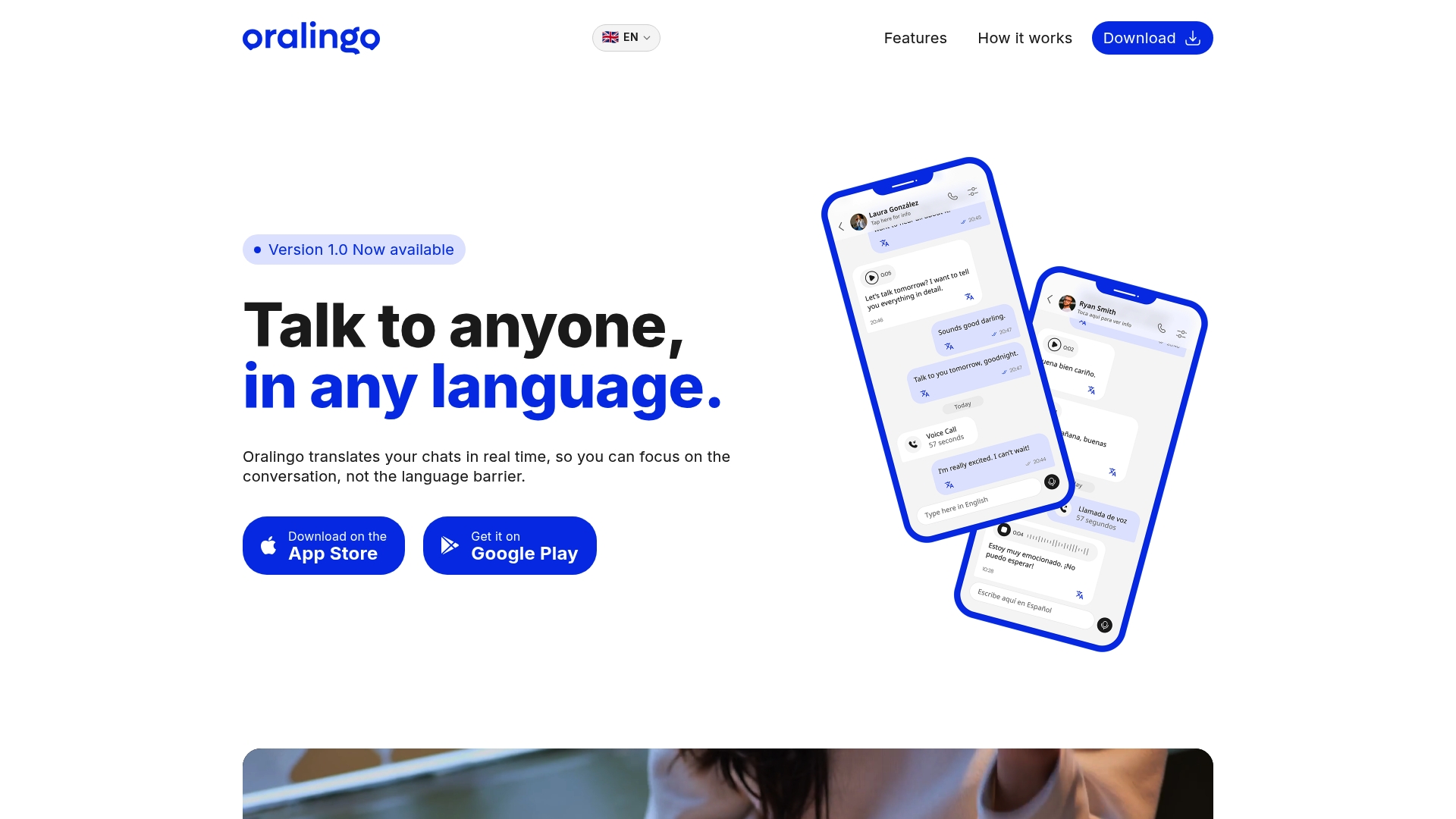
Tone and context preservation matter here. A message that sounds warm in one language can read as cold or abrupt once translated by a basic tool. Oralingo keeps the intent intact across more than 100 languages, so your words land the way you meant them. Every conversation is end-to-end encrypted, which means your personal and professional exchanges stay private. Download Oralingo and focus on the relationship, not the language gap.
Sources
The following sources informed this guide and are worth consulting for deeper reading.
- Building Trust Across Cultures | INSEAD Knowledge
- Research: How to Build Trust with Business Partners from Other Cultures | Harvard Business Review
- Building trust, loyalty and productivity across cultures | Thunderbird School of Global Management
- Building relationships with people from different cultures | Community Tool Box (KU)
Additional practical references: