
Tone-aware translation preserves register, relationship, emotional temperature, and cultural resonance across a whole message, not just word-for-word meaning. You need it anywhere a mistranslated tone costs something real: customer support chat, marketing copy, UX strings, or voice conversations where warmth or formality shifts the outcome. Legal and technical text still calls for literal precision, but nearly everything else benefits from combining document-level AI with a human brief and a review pass.
TL;DR:
- Providing detailed, project-specific tone briefs and style rules significantly reduces register mismatches and cultural insensitivity in translation.
- Document-level context, glossaries, and cultural references improve accuracy and emotional nuance, especially in live chat or voice conversations.
- Human reviewers remain essential for culturally sensitive content and translating non-text cues, which AI alone cannot reliably handle.
- Automatic metrics like BLEU are insufficient for tone assessment; manual QA and A/B testing better ensure message consistency and emotional accuracy.
- Prioritizing clear tone guidance over chasing minor AI model improvements leads to more consistent, authentic translations in fast-paced communication.
Table of Contents
- Tone-Aware Translation vs. Sentence-Level Machine Translation
- Why Getting Tone Wrong Costs More Than You Think
- How Tone-Aware Systems and Human Teams Work Together
- Building a Tone-Aware Translation Workflow
- How to Evaluate Whether Tone Actually Survived Translation
- Where Tone-Aware Translation Still Falls Short
- How Oralingo Handles Tone in Real-Time Chat and Voice
- What the Research Actually Tells You to Prioritize
- Talk Naturally Across Languages With Oralingo
- Sources
Tone-Aware Translation vs. Sentence-Level Machine Translation
Sentence-level machine translation looks at one sentence, guesses its best equivalent, and moves on. It has no memory of what came before or after, so it can flip formality mid-conversation or miss that a "you" in French needs to stay formal because the speaker is addressing a client, not a friend. Tone-aware translation works differently: it reads a message, a thread, or a whole document as one unit and carries decisions about register and relationship across every line.
That difference matters most in three areas. Register means whether the language stays formal or casual throughout an exchange. Relationship means the translation reflects how close or distant the speakers are, something languages like Japanese, German, and Spanish encode directly into pronoun choice and verb conjugation. Cultural resonance means idioms, humor, and emotional cues land the way they were intended instead of translating literally into nonsense or offense.
Tone-aware translation also differs from transcreation, a related but distinct discipline. Transcreation rebuilds a message almost from scratch to hit the same emotional effect in a new market, often used for slogans and ad campaigns. Tone-aware translation stays closer to the source text but makes sure its emotional and social signals survive the trip.
A five-part context framework, developed by translation researchers, gives a useful checklist for what "context" actually means in practice:
- Co-text: the surrounding sentences and paragraphs within the same document.
- Rel-text: related documents, such as a previous email in the same thread or a style guide.
- Chron-text: the timeline or sequence of events the message refers to.
- Bi-text: parallel content in another language, like an existing translated version.
- Non-text: real-world knowledge, audience intent, and cultural background not written anywhere.
This five-aspect framework gives translators and project managers a shared vocabulary for requesting exactly the inputs a translation needs, instead of vaguely asking for "more context."
Why Getting Tone Wrong Costs More Than You Think
Tone isn't decoration on top of meaning. It carries a large share of the actual message, and losing it changes how a reader feels about the sender.

Translation quality depends greatly on context beyond individual sentences. One survey of neural machine translation found that over a significant share of tested sentences needed more context than the sentence itself to translate or evaluate correctly, and some sentences required more than two preceding sentences. That's not a rounding error. It means a huge share of everyday communication is genuinely ambiguous without document-level awareness.
Register mismatches happen when a translation lands too formal or too casual for the relationship it's serving. A support agent who sounds robotic in one language and overly familiar in another creates inconsistent brand experience even when the underlying facts are identical. Providing linguistic, cultural, and situational context up front is one of the most effective ways to reduce these errors before they reach a reader.
The practical risks stack up fast:
- Customers feel talked down to, or feel the brand is being falsely familiar.
- Marketing copy falls flat or, worse, causes unintended offense in a specific market.
- Conversion rates drop when messaging feels foreign instead of native.
- Brand voice fragments across languages, undermining trust in every market at once.
How Tone-Aware Systems and Human Teams Work Together
Tone-aware translation runs on two layers working in tandem: the technical layer that gives models enough surrounding information, and the human layer that catches what no model can infer on its own.
- Document-level context. Modern neural machine translation and large language models can process a full document, or at least several surrounding sentences, instead of isolating each one. This intersentential context is what lets a system keep pronoun formality consistent or recognize that a name mentioned three sentences earlier is the subject of the current one.
- Style rules and persistent brand-voice profiles. A one-off prompt asking for "casual tone" fades the moment the conversation moves on. A persistent style rule, built once and reused across every project, enforces the same formality and vocabulary choices automatically. Digital voice profiles that live outside any single prompt tend to hold up far better at scale than repeated manual instructions.
- Retrieval and cultural-knowledge lookups. Idioms and local metaphors rarely translate word for word. Systems that can pull in a glossary entry or a cultural reference at the moment of translation catch these cases instead of rendering them literally, which is usually where machine translation embarrasses itself the most.
- Human roles that close the gap. Translators, cultural reviewers, and post-editors still matter because non-text context, things like audience intent or unwritten cultural assumptions, often can't be captured in any dataset. Developer documentation on API context parameters is explicit that context inputs improve ambiguous cases but don't replace style rules or glossaries built for the specific brand or project.
Pro Tip: Don't ask a model to "sound friendly" in a prompt and call it done. Write the tone requirement into a reusable style rule or glossary entry instead, so it survives across every future translation request without anyone having to remember to repeat it.
Cultural collaboration deserves its own mention here. Working with reviewers who understand the target culture, not just the target language, is what separates a translation that reads naturally from one that technically parses but feels foreign.

Building a Tone-Aware Translation Workflow
Most tone failures aren't model failures. They're brief failures, someone never told the system or the translator what tone the message needed in the first place.
- Write a one-line tone brief for every project. Specify the audience, the scenario, the relationship level between speakers, the emotional temperature (urgent, warm, neutral, celebratory), and any adaptations that are explicitly forbidden, like changing a legal disclaimer's wording.
- Build formality rules into your glossary, not just your prompts. Glossaries and style guides should encode clause-level rules ("always use formal address in customer emails," "never translate this product name") so the rule persists regardless of who runs the project next.
- Choose tools that support document-level or context-parameter inputs. Favor document endpoints over single-string translation calls when your platform supports them, and use style rules rather than ad-hoc prompts once you're translating at any real volume. This combination is what developer guidance consistently recommends for controlling tone without re-explaining it every time.
- Watch your translation memory for size versus relevance. A bloated TM full of unrelated past projects can pull in the wrong register for a new context. Curate it the way you'd curate a style guide.
For chat and voice UI strings specifically, keep these constraints in mind:
- Preserve message timing in dubbing or live voice so tone doesn't get lost in a delayed or clipped delivery.
- Keep character counts in mind for UI strings, since a tone-perfect translation that overflows a button is still a failure.
- Test voice output for warmth and pacing, not just word accuracy, since spoken tone reads differently than written tone.
How to Evaluate Whether Tone Actually Survived Translation
Standard automatic metrics weren't built for this job. BLEU and similar sentence-level scores are largely blind to tone, coherence, and pronoun consistency, the exact phenomena document-level translation is supposed to fix. A targeted test suite approach that checks pronoun and gender handling, anaphora resolution, register shifts, and idiom treatment gives a far more honest picture of quality than a single aggregate score.
Build your QA checklist around what a score can't catch:
- Does the register stay consistent from the first line to the last?
- Would a native speaker read this as coming from a real person in this relationship, or as obviously translated?
- Do idioms and cultural references land as intended, or read as literal nonsense?
- Does the emotional temperature match the brief (urgent, celebratory, neutral, apologetic)?
- Did pronoun formality stay consistent across the whole thread, not just within one sentence?
Beyond manual QA, run structured comparisons. A/B testing tone variants against conversion rate, customer satisfaction scores, or reply rate turns tone from a subjective argument into a measurable business decision. If a warmer register lifts response rates in one market and a more formal one wins in another, that's data worth encoding straight into your style guide.
Where Tone-Aware Translation Still Falls Short
No system, however context-aware, should make unilateral calls on culturally sensitive material. The ethical boundary is straightforward: adapt tone freely where the stakes are low, and escalate to a human reviewer the moment a message touches identity, religion, politics, or anything where a wrong guess could cause real harm.
Bias shows up in specific, predictable ways. Gender-neutral source language can get force-fit into a gendered target language based on stereotype rather than fact, and a speaker's identity markers can get flattened or mistranslated if the brief doesn't address them explicitly. The fix isn't a better model. It's an explicit brief instruction plus a human reviewer checking the output.
Bring in cultural or subject-matter experts whenever content touches culturally loaded references like idioms, proverbs, or region-specific humor, since cultural competence measurably reduces the risk of unintended offense. And when the content is a private conversation rather than marketing copy, consent and data handling deserve the same scrutiny as the translation itself.
How Oralingo Handles Tone in Real-Time Chat and Voice
You don't get a second pass to fix tone in a live conversation. Oralingo translates messages before they're displayed, so the tone and context of a chat carry through in real time instead of arriving as a stiff, literal afterthought. Hands-free voice mode extends that same tone-preserving approach to spoken conversation.
- Support for over 100 languages with a 99% accuracy rate
- End-to-end encryption on every conversation
- Formatting and speaker intent preserved across chat and voice
Try a quick test: send the same message in a formal and a casual register and see how the translation adapts. Learn more at Oralingo.
What the Research Actually Tells You to Prioritize
The conventional advice in this field is "use a better AI model," and that's incomplete. The research points somewhere more useful: the biggest tone failures happen because nobody wrote down what tone was supposed to be in the first place, not because the underlying model was weak. A five-aspect context brief costs a few minutes to fill out and prevents most of the register mismatches teams spend hours fixing in post-editing.
What's overrated is chasing marginal accuracy gains from a newer model while skipping the brief entirely. What's underrated is the boring stuff: a persistent glossary entry, a one-line tone spec, a test suite that checks pronoun consistency instead of trusting a BLEU score. Teams that treat tone as a specifiable artifact, something you write down once and reuse, consistently outperform teams that re-explain it in a fresh prompt every single time.
If you take one thing from this, prioritize the brief before the tool. Even the most context-aware system still needs to be told what "formal," "warm," or "urgent" means for this specific audience and relationship. Get that right, and the rest of the workflow, human or automated, has something solid to work from.
— Poul
Talk Naturally Across Languages With Oralingo
Most translation tools force a tradeoff: fast but flat, or accurate but slow enough to kill a live conversation. Oralingo skips that tradeoff by translating messages before they ever appear on screen, so the tone, warmth, or urgency you typed shows up on the other end instead of getting flattened into generic phrasing.
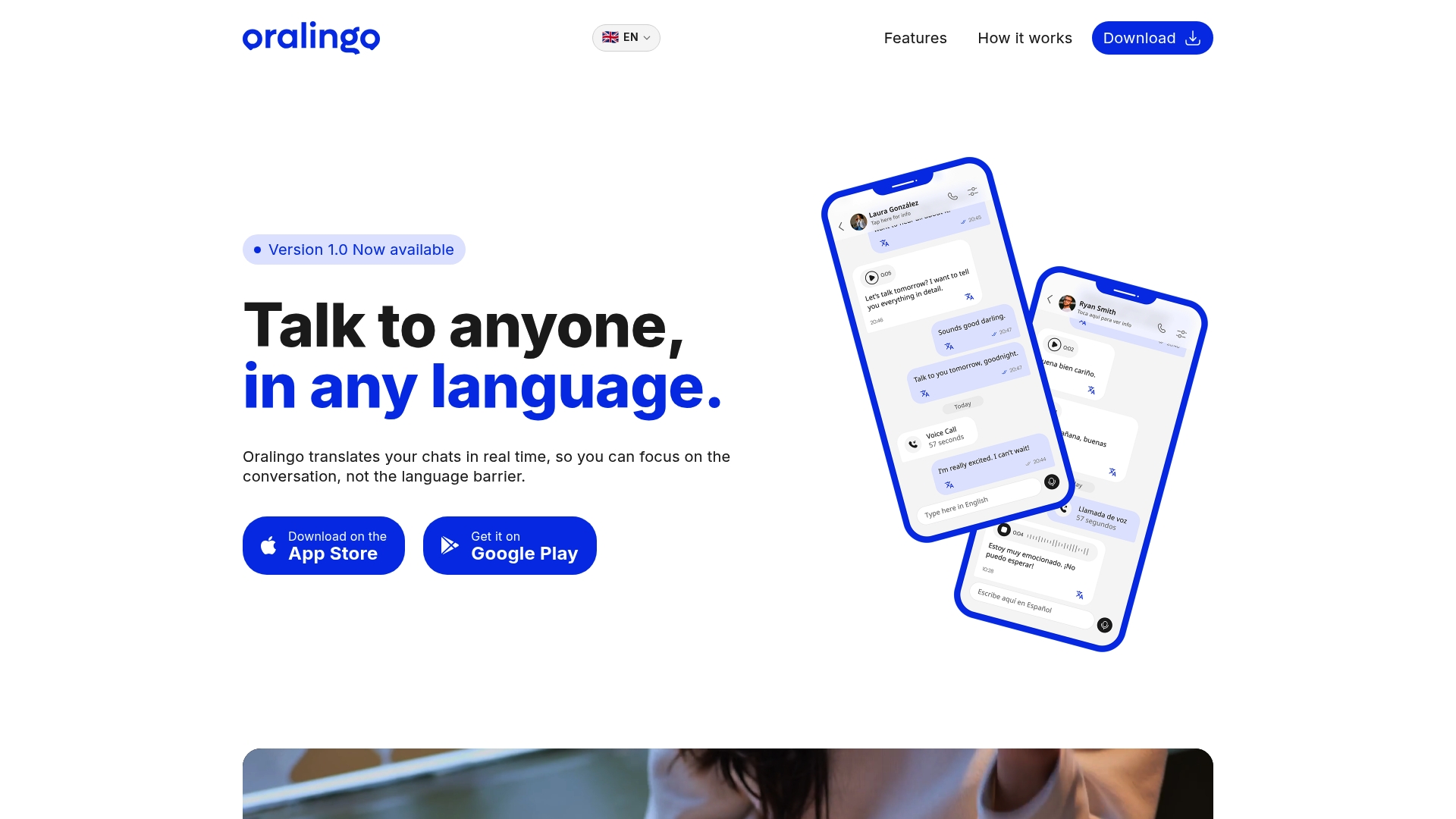
That matters most in the exact situations this article covers: a business call where formality has to stay consistent, a family chat where warmth needs to survive the language switch, or a live voice conversation where there's no time for a second draft. With support for over 100 languages, a 99% accuracy rate, and end-to-end encryption on every message, Oralingo is built for real conversations, not just document translation. Download the app and send your first cross-language message at Oralingo to see how it handles your own tone.
Sources
- Survey of context in neural machine translation and its evaluation
- Context in translation: Definition, access and teamwork
- How to use context parameter — DeepL docs
- Understanding the importance of contextual translation