
Yes, emoji meaning survives translation, but only when you combine context-aware habits with a translation tool built to preserve them. Skip a step and the 😊 you sent as warm reassurance can land as sarcasm or confusion. Three moves fix most of it: default to fewer emoji in formal chats, add a short interpretation note when an emoji is ambiguous, and use a translator like Oralingo that carries tone and context metadata alongside the words. A comparative study of Eastern and Western emoji use backs the first move; the rest is workflow.
TL;DR:
- Using fewer emoji in formal communication minimizes misunderstandings caused by cultural differences and platform-specific rendering.
- Adding a short interpretation note when an emoji’s meaning is ambiguous helps clarify intent in cross-cultural or brief messages.
- Translating sentiment rather than just words, and offering mode options like Preserve, Interpret, or Minimal, enhances tone accuracy across languages.
- Viewing the original emoji from the sender’s device helps identify rendering differences that might alter perceived intent.
- Tailoring emoji use and translation practices to relationship type, such as sparing in business chats or preserving in romantic exchanges, reduces miscommunication risks.
Table of Contents
- Why Emoji Meaning Changes Across Languages and Platforms
- How Do You Preserve Emoji Meaning When Translating Chat?
- How Oralingo Keeps Emoji Meaning Intact in Real Time
- Getting Emoji Right in Business, Family, and Romantic Chats
- Why Emoji-Aware Translation Deserves More Attention
- Try Emoji-Preserving Translation Settings With Oralingo
- Sources
Why Emoji Meaning Changes Across Languages and Platforms
Emoji look universal. They aren't. The same 🙏 that reads as "please" in one culture reads as "thank you" or "praying" in another, and that split isn't random.
Culture shapes how people use emoji in the first place. Research comparing Eastern and Western usage found that collectivist cultures lean on emoji for politeness and face-saving, softening requests or cushioning bad news. Individualist cultures tend to use the same symbols for self-expression, broadcasting mood rather than managing the relationship. Translate the words correctly and you can still miss the social function the emoji was doing.
Then there's rendering. Apple, Google, and Samsung each draw their own version of "face with tears of joy" or "slightly smiling face," and the differences aren't cosmetic. A grin on one platform can look like a smirk on another, changing how the receiver reads intent before they've processed a single word of the message.
Short messages make everything worse. When text is brief or sarcastic, it stops doing its job of narrowing down what the emoji means. Research on emoji ambiguity found that accompanying text often fails to disambiguate emoji in exactly these cases. And language itself matters at the symbol level: a cross-lingual study presented at EMNLP found that whether an emoji is used literally or figuratively shifts by language, meaning the "same" emoji doesn't map onto the same intent across a translation.
Put together, four forces are working against you:
- Cultural norms decide whether an emoji signals politeness or personal feeling.
- Platform rendering changes the facial expression the receiver actually sees.
- Short or sarcastic text removes the context clues that would normally clarify intent.
- Emoji polysemy means one symbol can carry different figurative meanings depending on the language.
None of this is a reason to strip emoji out of every chat. It's a reason to treat emoji translation as its own skill, not a side effect of translating words.
How Do You Preserve Emoji Meaning When Translating Chat?
You don't need a linguistics degree to get this right. You need six habits, applied in order, whether you're texting a colleague in Tokyo or your in-laws in Lisbon.
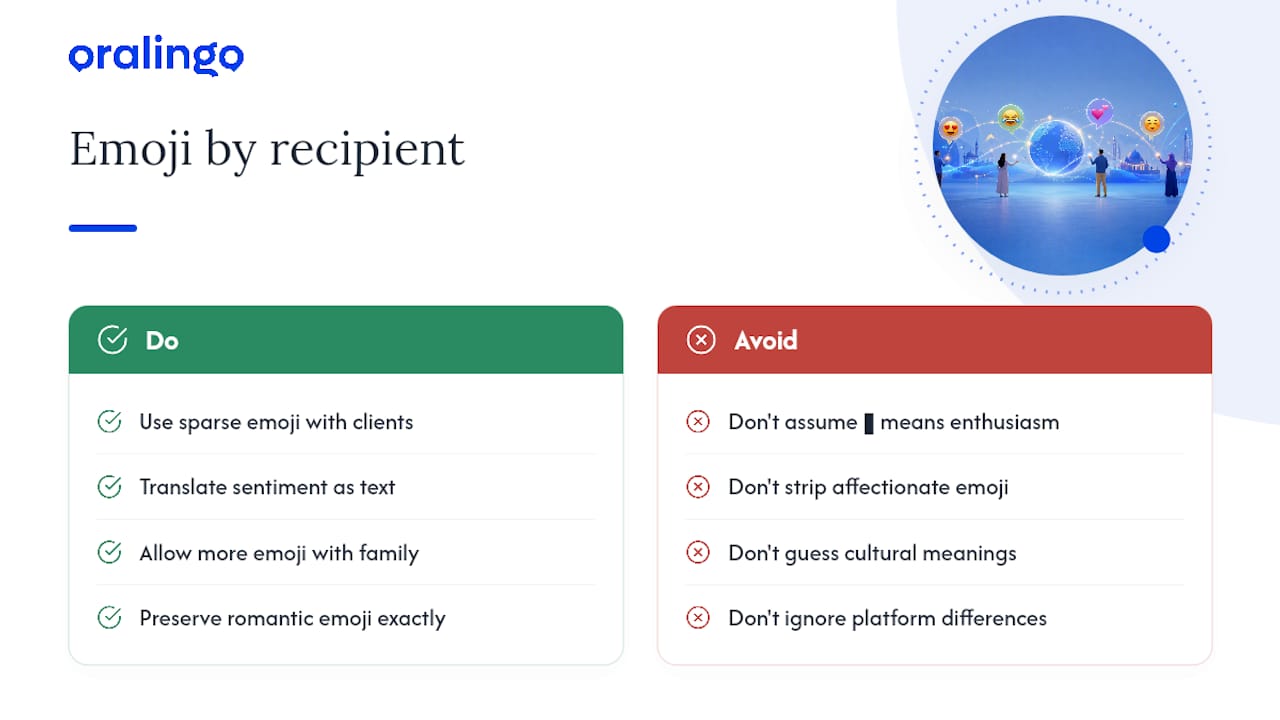
- Default to emoji-sparse in formal or business channels. When you're not sure how a symbol will land, don't send it. Fewer emoji means fewer chances for a cultural mismatch to derail a work conversation.
- Translate sentiment, not just words, when an emoji is ambiguous. Instead of swapping in a different emoji that "feels equivalent," translate the message and add a short note on intended tone, such as "(warm, not sarcastic)."
- Give yourself three modes to choose from: Preserve, Interpret, or Minimal. Preserve keeps the original emoji as sent. Interpret adds a plain-language sentiment note. Minimal strips emoji from formal exchanges automatically.
- See the sender's original emoji, not just your platform's version. A thumbnail or hover preview showing how the emoji rendered on the sender's device flags the cases where Apple and Android disagree on what a face is doing.
- Treat ultra-short messages as a yellow flag. A single emoji with no text is the highest-risk message type. Pause before assuming intent and confirm when it matters.
- Keep your data footprint small. Store sentiment metadata only long enough to render the message, and keep the underlying conversation end-to-end encrypted the whole time.
Pro Tip: If you're building or evaluating a chat translation product, don't overthink the metadata. A confidence score, the sender's platform, and one detected sentiment label are enough to power a clarification prompt, and keeping that payload small protects both speed and privacy.
These rules work whether you're applying them manually mid-conversation or expecting a translation app to apply them for you. The gap between "good advice" and "actually followed" is almost always a product gap, which is the next problem worth solving.
How Oralingo Keeps Emoji Meaning Intact in Real Time
Most translation apps convert your words and leave emoji to chance. Oralingo treats emoji as part of the message worth translating on purpose, not an afterthought that survives the trip by luck.
Here's how the features map to the rules above. Oralingo translates messages before they're displayed, which is exactly where sentiment metadata needs to attach, before the receiver ever sees the text. Support for over 100 languages means the tone-preservation logic has to work across scripts and cultural norms, not just inside one language pair. The pre-delivery translation approach also means the interpretation note, when one is needed, arrives with the message instead of as a separate correction.
A quick example: a sender types "on it 🫡" in a business thread. Translated literally, the salute emoji can read as mockery in some cultures and as respectful acknowledgment in others. Oralingo's context handling renders it as "Got it, working on it now (respectful acknowledgment)" for a receiver whose language and setting suggest they'd otherwise misread the tone.
Context matters enough that a single default won't serve every relationship. That's why per-context presets make sense as toggles rather than one-size-fits-all settings:
- Business: minimal emoji, sentiment translated in plain language, no substitutions.
- Family: more tolerance for emoji, interpret mode available for older relatives less familiar with newer symbols.
- Romantic: preserve original emoji by default, with a light confirmation prompt only when intensity is ambiguous.
For product teams and IT admins evaluating a tool like this, the checklist is short: does it keep a metadata schema light enough to stay fast, does the UI show original rendering when it matters, does a clarification prompt exist for ultra-brief messages, and is the whole exchange still end-to-end encrypted? Worth noting: 22% of consumers say they've muted a brand over emoji that felt inauthentic or "cringey", which is exactly the failure mode a conservative business default prevents.
Getting Emoji Right in Business, Family, and Romantic Chats
The right emoji behavior isn't one rule. It changes depending on who's on the other end of the thread, and treating a client message like a text to your sister is where most of the awkward moments start.
In business chats, keep emoji sparse and translate sentiment plainly instead of guessing at an equivalent symbol. If a client sends a single 👍 after a price quote, don't assume enthusiasm. In some regions, a thumbs-up is neutral or even mildly rude. Translate the acknowledgment as text and ask for confirmation if the deal hinges on it.
Family group chats can carry more emoji without much risk, since the relationship already carries shared context. Interpret mode helps most here, particularly for older relatives who may not recognize newer emoji or platform-specific redesigns. A guide to translating family group chats covers how to handle mixed-language threads where three generations are texting at once.
Romantic and long-distance relationships benefit from preserving affectionate emoji exactly as sent, since stripping them out flattens the warmth that's often the whole point of the message. Add a confirmation prompt only when an emoji is unusually intense or could be read multiple ways. Resources built specifically for couples using translation tools and general guidance on thoughtful digital communication both point to the same idea: the goal isn't fewer emoji, it's fewer misreads.
Ask for clarification when a message is a single emoji with no text, when the symbol is a culturally loaded gesture like a thumbs-up or OK sign, or when you know the sender's platform renders faces differently than yours.
Why Emoji-Aware Translation Deserves More Attention
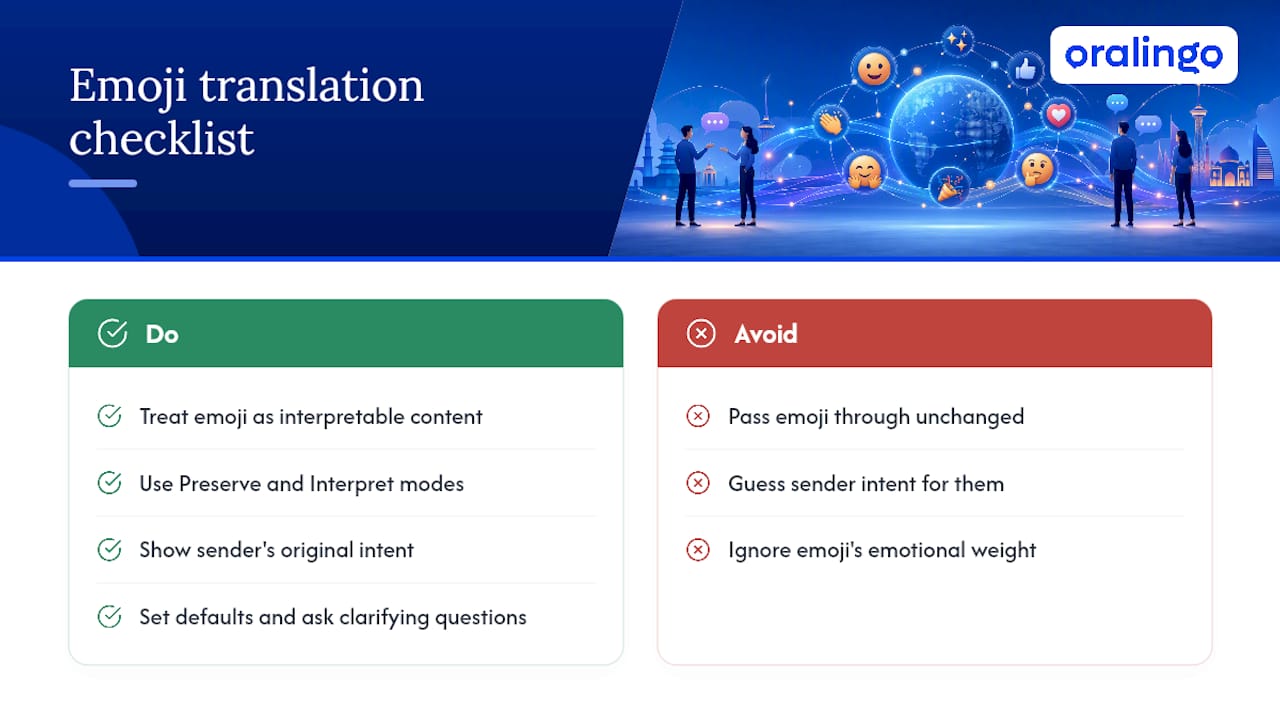
Most translation tools still treat emoji as decoration, something to pass through untouched rather than something to interpret. That's backwards. An emoji often carries more emotional weight than the sentence around it, and letting it through unexamined is how warm messages turn cold and jokes turn into offense.
The fix isn't complicated. It's a handful of defaults, a clarification habit, and a product willing to show you the sender's original intent instead of guessing on your behalf. If you manage a team or a family chat spanning languages, try switching between Preserve and Interpret modes for a week and see which messages actually needed the extra context.
— Poul
Try Emoji-Preserving Translation Settings With Oralingo
Oralingo was built around the idea that translation shouldn't strip the feeling out of a message. Messages translate before they're displayed, so tone and emoji intent travel with the words instead of arriving as an afterthought.
If you've been guessing at what a colleague's 🙏 or a partner's 😅 actually meant, start by testing the interpret mode on your next ambiguous message. Set a context preset for business, family, or romantic chats so the defaults match the relationship, not just the language pair. Hands-free voice mode is there too, for when typing isn't practical and tone matters even more. Head to Oralingo to try it on your own conversations.
Sources
- Lost in Translation: How Emojis Confuse Workers and Customers
- The Etymological Roots of Emoji Miscommunication: A Comparative Study of Eastern and Western Emoji Usage
- Understanding emoji ambiguity in context: the role of text in emoji-related miscommunication