
A cross-language long-distance relationship is a romantic partnership where two people are separated by geography, speak different native languages, and often navigate different cultural communication styles and time zones at the same time. More commonly called a cross-cultural LDR, it layers the usual long-distance relationship challenges of missed proximity onto the added complexity of meaning that can shift in translation. The good news: research shows that LDRs can produce greater intentionality and intimacy than geographically close relationships, but they do carry unique pressures that need active management from the start.
Three things you can do in the next 48 hours to reduce friction right now:
- Set a predictable check-in window. Agree on one daily or every-other-day time that works for both time zones, even if it is just a five-minute voice note exchange.
- Agree on language rules for urgent messages. Decide together whether urgent messages go in your native language, your partner's language, or a shared third language, and whether you will use a translation tool for those.
- Pick your translation approach. Decide now whether you will use a real-time translation app, a mix of both languages, or a hybrid approach. Consistency beats improvisation every time.
Table of Contents
- What is a cross-language long-distance relationship, really?
- How do you send first messages when you don't share a native language?
- How can you make video calls feel intimate despite the language gap?
- How do you keep the relationship alive and build a shared identity?
- How do you learn each other's language without it becoming a source of resentment?
- What are the most common communication friction points, and how do you fix them?
- How do you handle time zones, visit planning, and the cost of distance?
- Which tools actually help with cross-language communication?
- How does real-time translation reduce friction in a cross-language LDR?
- Key Takeaways
- The part most guides skip: patience is a skill, not a personality trait
- Oralingo keeps the conversation moving, privately
- Useful sources and further reading
What is a cross-language long-distance relationship, really?
The phrase describes a specific kind of partnership that most relationship advice does not fully address. Standard LDR guidance assumes you share a language. Standard cross-cultural relationship tips often assume you live in the same city. You are dealing with both at once, and that combination creates friction points that neither category covers on its own.
The core challenge is layered. Geographic distance removes the body-language cues that help you decode tone. Different native languages mean that even a well-translated message can carry the wrong emotional register. Cultural communication styles, which vary significantly between high-context cultures (where meaning is implied) and low-context cultures (where meaning is stated directly), add a third layer of potential misreading. Time zones compress the windows where you can actually talk.
What makes this manageable is that all three layers respond to the same basic strategy: intentional structure. Couples who build predictable routines, agree on communication rules, and create a shared "third culture" of their own tend to report higher satisfaction than those who try to wing it. Consistency, not intensity, is what keeps the relationship stable day to day.
How do you send first messages when you don't share a native language?
The safest first message is short, curious, and explicit about your language situation. You do not need to apologize for the barrier. You just need to name it and invite collaboration.
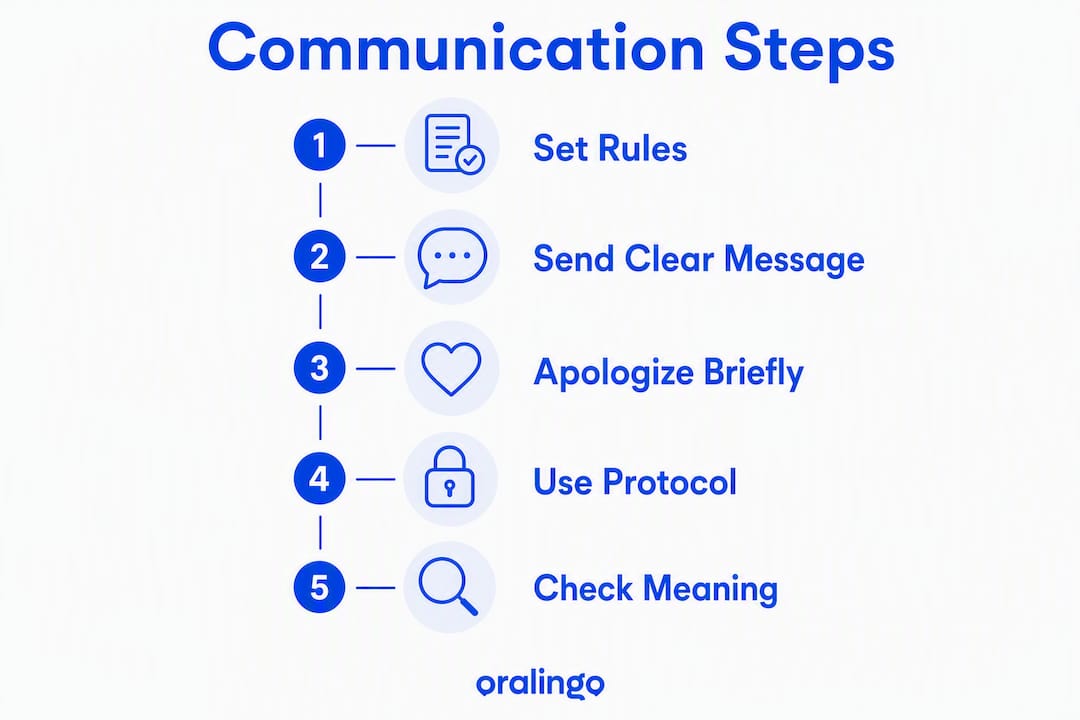
A message that works: "Hi, I'm [name]. My English is much stronger than my [partner's language], so I'll sometimes use a translation app to make sure I'm saying what I mean. I'd love to know how you prefer to communicate." That single message does three things: it names the asymmetry honestly, it signals that you are putting in effort, and it asks a question that gives your partner agency.
Naming a communication protocol early matters more than most couples realize. Decide together how to mark urgent messages (a specific emoji, a subject line, a flag word), when to pause a conversation and pick it up later rather than push through a misunderstanding, and whether you will use translation tools openly or only as a private backup. These are not bureaucratic rules. They are the scaffolding that lets you relax into the conversation instead of constantly second-guessing tone.
On translation errors: apologize once, briefly, and move on. "I think my translation made that sound harsher than I meant it, sorry" is enough. You do not need to over-explain. What you should not apologize for is using a translation tool at all. Using one is a sign of care, not laziness.
Pro Tip: When a message lands wrong, try the phrase "I think something got lost in translation, can I try again?" It signals good faith without assigning blame and gives both of you a reset.
How can you make video calls feel intimate despite the language gap?
The biggest mistake couples make with video calls is treating them as high-stakes performances. A call where both people are anxious about being understood is exhausting. A call with a loose structure and a shared activity is actually fun.
A simple call structure that works:
- Opening ritual (2–3 min). Start with something small and predictable: show each other one thing near you, share one word in the other person's language, or just say hello in both languages. Ritual reduces anxiety.
- Shared activity (10–15 min). Watch a short clip together, cook the same simple recipe on camera, or take a photo tour of your space. Activities reduce the pressure to perform conversation.
- Check-in (15–20 min). Talk about your week, your feelings, what is on your mind. This is the emotional core of the call.
- Language micro-practice (5–10 min). Teach each other one phrase, one word, or one cultural reference. Keep it light.
- Close with a ritual. A specific goodbye phrase in both languages, a countdown, or a shared song. Endings matter as much as openings.
For the technical setup, run through this before every call:
- Use headphones to reduce echo and improve audio clarity.
- Position your camera at eye level so the conversation feels face-to-face, not top-down.
- Turn on live captions if your platform supports them (Google Meet and Zoom both offer this).
- Confirm recording consent before you hit record. Always.
- Test your connection speed. A lagging call breaks emotional rhythm faster than a language gap does.
Shared activities are particularly useful because they give you something to react to together, which generates natural, low-pressure conversation. Watching a three-minute comedy clip and laughing at the same moment does more for intimacy than 20 minutes of structured talking.
Pro Tip: Schedule calls for when you are both rested. A call at the end of an exhausting day, when your language processing is slower and your patience is lower, will feel harder than it needs to. Protect your best hours for each other.
How do you keep the relationship alive and build a shared identity?
Small, repeated rituals are what hold a cross-language LDR together between visits. Not grand gestures. Not marathon calls. Rituals.
A morning voice note in your partner's language, even if it is just one sentence, does something a long call cannot: it says "you were my first thought today" in a way that lands before either of you has had to navigate a single misunderstanding. A weekly "language swap" date, where you spend 20 minutes speaking only in each other's native language, builds both skill and affection. A shared photo album where you caption pictures in both languages creates a running record of your relationship that belongs to both of you.

The concept behind all of this is what researchers and couples therapists call a third culture: a shared space of rituals, language, and rules that neither partner brought from their home culture. It is not a compromise. It is something new that belongs to the relationship itself.
When tone or intent gets unclear, use a meta-communication script rather than pushing through. Try: "I want to make sure I understood you correctly. I heard [X]. Is that what you meant?" Then pause. Let your partner respond before you react. This three-step pattern (state what you heard, check, pause) prevents the quiet corrosion that builds when small misunderstandings go unaddressed.
Therapists who work with cross-cultural couples consistently recommend regulating your nervous system before any heavy conversation. If you feel defensive or anxious, take five slow breaths before you type or speak. Regulate first, negotiate second.
Pro Tip: Before a hard conversation, text your partner: "I want to talk about something that matters to me. Can we find a good time?" That one message reduces the chance of catching them off-guard and sets the tone for a collaborative conversation rather than a confrontation.
How do you learn each other's language without it becoming a source of resentment?
Micro-practice beats heavy study for relationship benefits. You do not need fluency. You need enough shared language to feel close, and that requires consistency over intensity.
A realistic weekly plan:
- Daily (5–10 min): Learn one new word or phrase in your partner's language. Send it in a message. Ask them to send one back.
- Three times a week: Use a language app like Duolingo or Babbel for a short lesson in your partner's language. Keep it under 15 minutes.
- Once a week: Do a "language swap" activity together: caption a shared photo in both languages, annotate a playlist with translations, or play a word-association game over text.
- Once a month: Watch a film in your partner's language with subtitles in your own. Talk about one scene afterward.
Language games that build affection rather than pressure:
- Caption contests: Share a funny photo and each write a caption in the other's language. Wrong grammar is part of the fun.
- Playlist annotations: Share a song you love and write a short note explaining what the lyrics mean to you. Your partner does the same.
- Labeled photo albums: Add captions to a shared album in both languages. Over time, it becomes a bilingual record of your relationship.
A few things to avoid: do not correct your partner's grammar during an emotional conversation. Do not insist on fluency before you feel close. Do not make language learning feel like homework. The goal is connection, not a language exam.
What are the most common communication friction points, and how do you fix them?
The top three friction points in cross-language relationships are tone in text, misread indirect bids, and culturally shaped emotion expression. The single best short-term fix for all three is meta-communication: talking about how you communicate, not just what you are communicating.
Cultural communication styles split broadly into high-context and low-context. In high-context cultures (common in East Asia, the Middle East, and Latin America), meaning is often implied through context, tone, and relationship history. In low-context cultures (common in the US, Germany, and Scandinavia), meaning is expected to be stated directly. The same phrase, "that's fine," can mean genuine agreement in one context and suppressed frustration in another.
A practical Cultural Fluency exercise: spend 10 minutes each writing down three things your partner does that you find confusing or hard to read. Then swap lists and, for each item, try to explain what that behavior means in your own cultural context. This exercise often produces the single most clarifying conversation a cross-language couple can have.
For repair conversations, use this script: "I felt [emotion] when [specific thing happened]. I'm not sure if I read it correctly. Can you help me understand what you meant?" This framing avoids accusation, names your experience, and invites explanation rather than defense.
Text carries a tone gap that most people underestimate. Senders consistently overestimate how well their tone travels in writing. Practical rules that help: use explicit markers for sarcasm (a specific emoji or the word "joking"), agree on shorthand for emotional intensity ("I need to talk" vs. "I want to share something"), and set an escalation plan for when a text exchange starts to feel heated (move to voice, not more text).
Pro Tip: If a conversation starts to spiral over text, send this: "I think we need to hear each other's voices. Can we call?" Voice carries tone that text cannot, and it resets the emotional temperature fast.
How do you handle time zones, visit planning, and the cost of distance?
Visits carry disproportionate emotional weight. Clinicians note that couples often arrive at a visit with months of compressed expectations, which sets up a near-impossible standard for a few days together. Planning for ordinary moments, not just highlights, is what makes visits feel real rather than performative.
Time-zone planning basics:
- Find your overlap window and protect it. Even 30 minutes of shared waking time is enough for a daily check-in.
- Rotate who takes the inconvenient call time. If one partner always calls at midnight, resentment builds quietly.
- Use a shared calendar (Google Calendar works well) to mark your overlap windows and schedule calls in advance.
- Build a 15-minute buffer before and after calls. Rushing into a call from a meeting, or rushing off to one, kills the emotional tone.
Visit checklist:
| Phase | What to plan |
|---|---|
| Pre-visit | Set one or two low-key goals (a neighborhood walk, a home-cooked meal, a local errand together) |
| During visit | Mix ordinary moments with one or two meaningful activities; avoid over-scheduling |
| Departure | Plan a specific goodbye ritual and a "first contact" message for after you part |
| Post-visit | Schedule a call soon; expect a short emotional dip and plan low-demand activities |
Visit costs vary widely depending on distance, but budgeting transparently as a couple reduces the financial stress that can quietly undermine the relationship. Agree on a rough visit frequency (every 3 months, every 6 months) and a shared savings target. A shared end-date for the long-distance phase, even a provisional one, reduces the psychological weight of open-ended separation significantly.
Which tools actually help with cross-language communication?
Tech reduces friction. It does not replace cultural fluency. Choose tools based on what you actually need: real-time meaning, language learning, or an archival record of your conversations.
| Tool category | Best for | Privacy flag |
|---|---|---|
| Real-time translation apps | Keeping conversational flow during calls and chats | Check for end-to-end encryption; not all apps offer it |
| Live captioning tools | Video calls where audio clarity is low | Captions may be stored by the platform; check settings |
| Voice-record + translate | Reviewing what was said after a call | Always get explicit consent before recording |
| Language learning apps | Building vocabulary between conversations | Generally low privacy risk; data is non-sensitive |
Selection checklist before you commit to a tool:
- Does it support both of your languages?
- What is the latency? A two-second delay breaks conversational rhythm.
- Does it preserve tone and context, or does it produce flat, literal translations?
- Is the conversation data encrypted? Who can access it?
- What does it cost at the usage level you need?
Privacy checklist for couples:
- Agree before you start recording any call or saving any transcript.
- Decide together what stays private (personal venting, family details) and what can be shared or reviewed.
- Use apps with end-to-end encryption for sensitive conversations. This is not paranoia; it is basic digital hygiene.
For a deeper look at how translation apps work in real conversations, including the trade-offs between speed, accuracy, and tone preservation, it is worth understanding the mechanics before you pick a tool.
Pro Tip: Build a habit of quick post-translation checks. After an auto-translated message, add: "Is that what you meant?" It takes five seconds and catches the misreadings that would otherwise sit quietly and compound.
How does real-time translation reduce friction in a cross-language LDR?
The core benefit of real-time translation is that it preserves conversational flow. When you have to stop, copy a message, open a separate app, translate it, and return to the conversation, you lose the thread. More than that, you lose the feeling of being in a real conversation. That interruption creates what some counselors describe as a low-level anxiety response: the sense that you are always slightly behind, always slightly unsure of what just happened.
Real-time translation tools address this by translating before the message is displayed, so the conversation reads naturally in both languages without either partner having to break their attention.
A practical workflow that works well: use auto-translation for the main flow of a conversation, then pause for a quick manual check-in when tone feels ambiguous. Something like: "That came through as [X] on my end. Is that the feeling you meant?" This two-step approach keeps the conversation moving while catching the contextual gaps that auto-translation misses.
The privacy dimension matters here too. Conversations between partners often cover sensitive ground: family dynamics, health, finances, fears. Understanding how real-time chat translation works technically, including what data is stored and how it is protected, is part of choosing a tool you can actually trust with intimate conversations. End-to-end encryption is not optional for this use case.
Counseling literature on cross-cultural couples consistently points to "proof of work" as a trust signal: visible, effortful actions that show you are entering your partner's world, not just waiting for them to enter yours. Learning key phrases, celebrating their holidays, and using a translation tool consistently are all forms of proof of work. They reduce the sense that one partner is carrying all the cultural labor.
Pro Tip: Use your translation app's voice mode for short audio messages when typing feels too slow or too flat. Hearing your partner's voice, even through a translation layer, carries emotional information that text cannot.
Key Takeaways
A cross-language LDR succeeds when you replace improvisation with intentional structure: clear communication rules, shared rituals, and tools that reduce friction without replacing genuine connection.
| Point | Details |
|---|---|
| Set communication rules first | Agree on language use, urgent message protocols, and translation tools within the first week. |
| Build rituals, not just calls | Daily micro-interactions (voice notes, shared photos, one-word exchanges) build more resilience than infrequent long calls. |
| Use meta-communication for repair | When tone is unclear, pause and ask: "Is that what you meant?" before reacting. |
| Plan visits for ordinary moments | Pre-visit goals, a post-visit buffer, and a shared end-date for the distance phase reduce emotional pressure significantly. |
| Oralingo for real-time flow | Oralingo's pre-delivery translation, hands-free voice mode, and end-to-end encryption reduce friction during calls and chats without breaking conversational rhythm. |
The part most guides skip: patience is a skill, not a personality trait
Most advice on cross-language relationships treats patience as something you either have or you don't. That framing is not useful. Patience in this context is a practiced response to a specific trigger: the moment when you feel misunderstood and your nervous system reads it as a threat.
What actually works is building a small, repeatable habit for that moment. Before you respond to a message that landed wrong, take three slow breaths. Not because it is a nice idea, but because it gives your prefrontal cortex time to catch up with your amygdala. You will write a different message after those three breaths. Every time.
The couples who thrive in cross-language LDRs are not the ones with the most patience. They are the ones who have built the most structure. They have communication rules, shared rituals, and a clear picture of where the relationship is going. Cultural difference, in that context, stops being a problem to solve and starts being one of the most interesting things about the relationship. Your partner's way of expressing care, resolving conflict, or marking a celebration is not wrong. It is just different from yours, and learning to read it is one of the more genuinely rewarding things you can do in a relationship.
One concrete practice: at the end of each week, send your partner one thing you noticed about their culture or communication style that you found interesting or beautiful. Not a critique. Not a question. Just a genuine observation. Over time, this builds a shared archive of curiosity that makes the cultural gap feel like an asset.
Oralingo keeps the conversation moving, privately
Long-distance couples who speak different languages spend a lot of mental energy on the mechanics of communication. Oralingo removes that friction. It translates messages in real time, before they appear on screen, so your conversation reads naturally in both languages without either of you having to stop and switch apps.
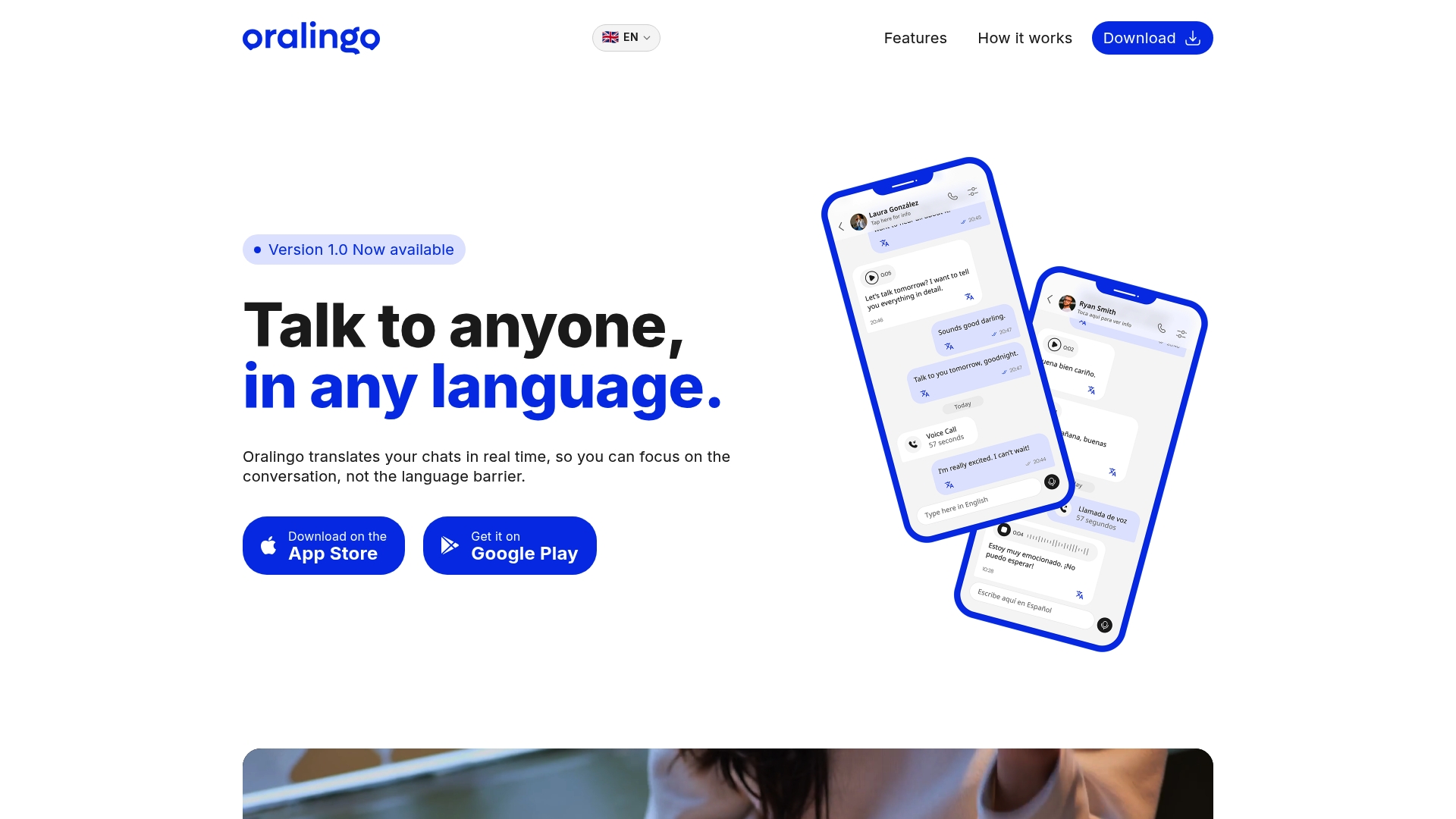
Three ways it fits directly into a cross-language LDR: it keeps text chats flowing during the day without translation interruptions; its hands-free voice mode lets you send and receive spoken messages without typing; and its end-to-end encryption means your most personal conversations stay between the two of you. For couples building a translation toolkit for romantic partners, Oralingo's support for 100+ languages and pre-delivery translation make it a practical daily tool, not just an occasional backup.
Recording and transcript features are available, but always use them with your partner's explicit consent. Privacy in a relationship starts with that conversation.
Try the free tier at oralingo.app and see how much easier the conversation gets when the language barrier is not the first thing you have to manage.
Useful sources and further reading
The sources below back the claims in this article and offer deeper reading on specific topics.
- Long-Distance Relationships: Psychological Challenges and What Helps — Simply Psychology: Research-backed overview of LDR mental health, visit weight, tone gaps in text, and what predicts relationship satisfaction over distance.
- Mixed-Culture Relationships: A Practical Guide for Couples — The Couple Summit: Practical framework for building a third culture, managing cultural decisions, and creating shared rituals.
- How Real-Time Translation Supports Romantic Communication — Oralingo Blog: Practical workflows for couples using real-time translation, including post-translation check habits and tone preservation.
- How Translation Apps Work in Real Conversations — Oralingo Blog: Technical explainer on latency, accuracy, and the trade-offs between speed and contextual fidelity in auto-translation.
- Multilingual Relationship Communication Checklist: 7 Steps — Oralingo Blog: A compact seven-step action plan for couples who want a structured communication framework they can implement immediately.
- 10 Ways Messaging Apps Help Relationships Thrive — Pingher: Industry research on how messaging frequency and app features support relationship health and daily connection.